
Black-crowned Night-Heron Identification Guide
A stocky, short-necked heron with a black cap and back, pale grey wings, and glowing red eyes, most active at dusk and dawn.
Read the full Black-crowned Night-Heron encyclopedia entry →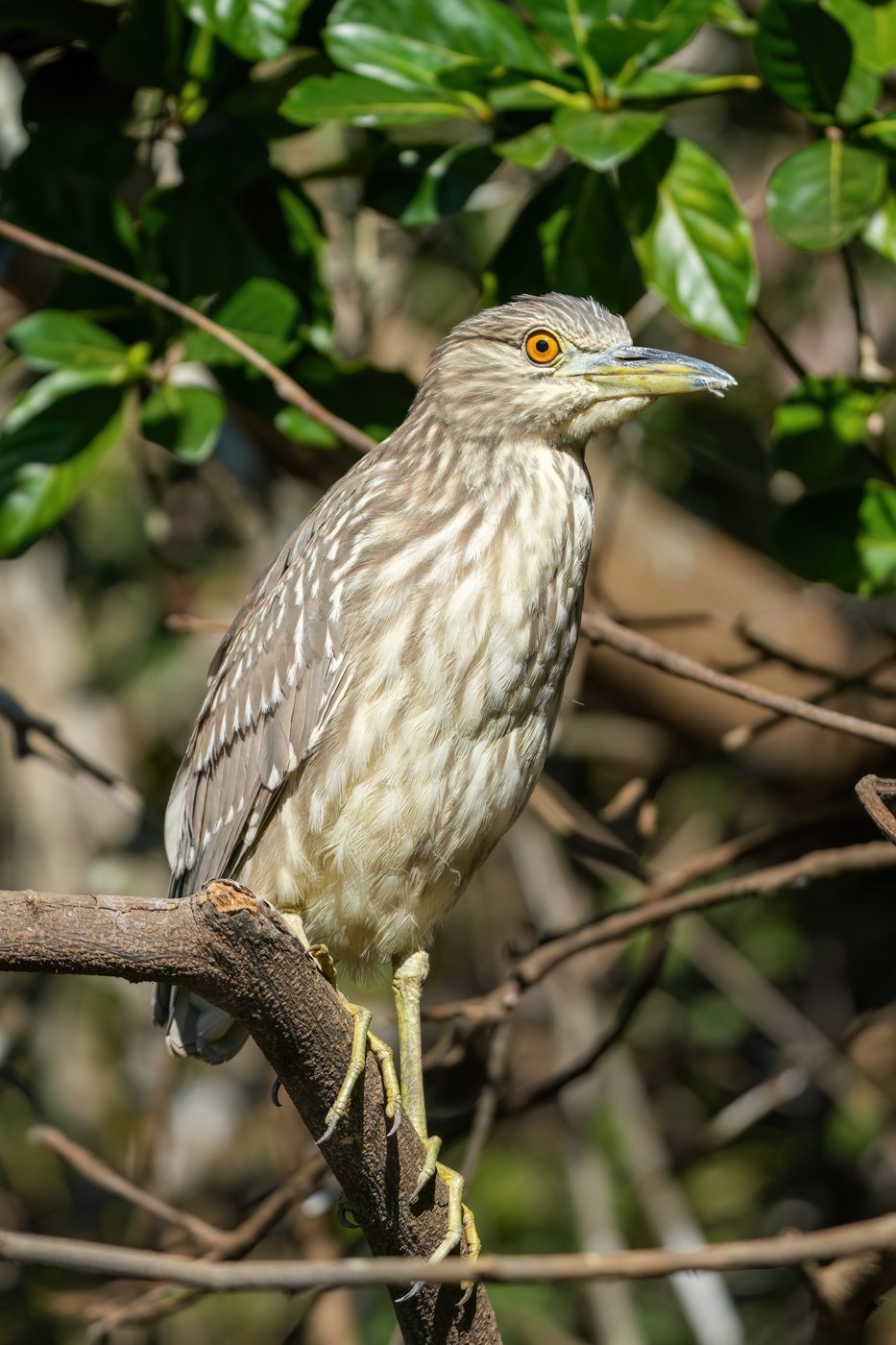
Key Field Marks
- Compact, hunched-looking heron with a thick neck that is often drawn in, giving it a squat silhouette compared to other herons.
- Adults show a glossy black crown and back contrasting with pale grey wings and whitish underparts.
- Eyes are bright red; bill is thick, straight, and black; legs are short and yellowish (turning pink/red in breeding adults).
- Breeding adults grow two to three long, thin white plumes trailing from the back of the head.
- Juveniles are brown, heavily streaked and spotted with buff/white on the wings — quite different from the sharp adult pattern.
Separating It From Similar Species
- Yellow-crowned Night-Heron has a grey body overall, a bold black-and-white face pattern, and notably longer yellow legs that extend well past the tail in flight; Black-crowned Night-Heron's legs barely project past the tail.
- Juvenile Black-crowned can be mistaken for American Bittern, but the bittern has a longer, more pointed bill, lacks the heron's stocky hunched posture, and shows different flight action (bitterns fly with slower wingbeats and a more stretched neck when flushed).
- Adult Yellow-crowned Night-Heron juveniles are very similar to young Black-crowned but have finer, more uniform spotting and a stouter bill; range and habitat overlap require close study of bill and leg proportions.
Where and When to See It
- One of the most widespread herons in the world, found on every continent except Antarctica and Australia.
- Inhabits marshes, swamps, mangroves, pond edges, and riverbanks; often roosts communally by day in dense trees near water.
- In temperate regions, northern populations migrate south for winter; in milder climates the species is a year-round resident.
- Most active at dusk, night, and dawn, though it can be seen loafing at day roosts.
Voice and Behavior
- Best known for its harsh, barking flight call, a loud "quok" or "wok," often the first clue to its presence as it flies overhead at twilight.
- Feeds by standing motionless or slowly stalking at the water's edge, striking suddenly at fish, frogs, and invertebrates.
- Nests colonially, sometimes alongside egrets and other herons, in trees or shrubs over or near water.
Frequently asked questions
What does a Black-crowned Night-Heron's call sound like?
A short, harsh, barking "quok" or "wok," usually given in flight, especially around dusk and after dark.
How can I tell a juvenile Black-crowned Night-Heron from an American Bittern?
The night-heron juvenile has a shorter, stockier build and thicker bill, while the bittern is slimmer with a longer, dagger-like bill and different flight posture.
Why is this heron hard to see during the day?
It is primarily crepuscular and nocturnal, spending daylight hours roosting quietly in dense trees near water rather than actively foraging.
How do you distinguish adult Black-crowned from Yellow-crowned Night-Heron?
Black-crowned has pale grey wings against a black cap and back with a plain face, while Yellow-crowned has a uniformly grey body, a bold black-and-white striped face, and much longer legs.