
Black Crowned-Crane Identification Guide
A striking West African crane known for its spray of stiff golden crown feathers, black body, and bare pink-and-white cheek patches.
Read the full Black Crowned-Crane encyclopedia entry →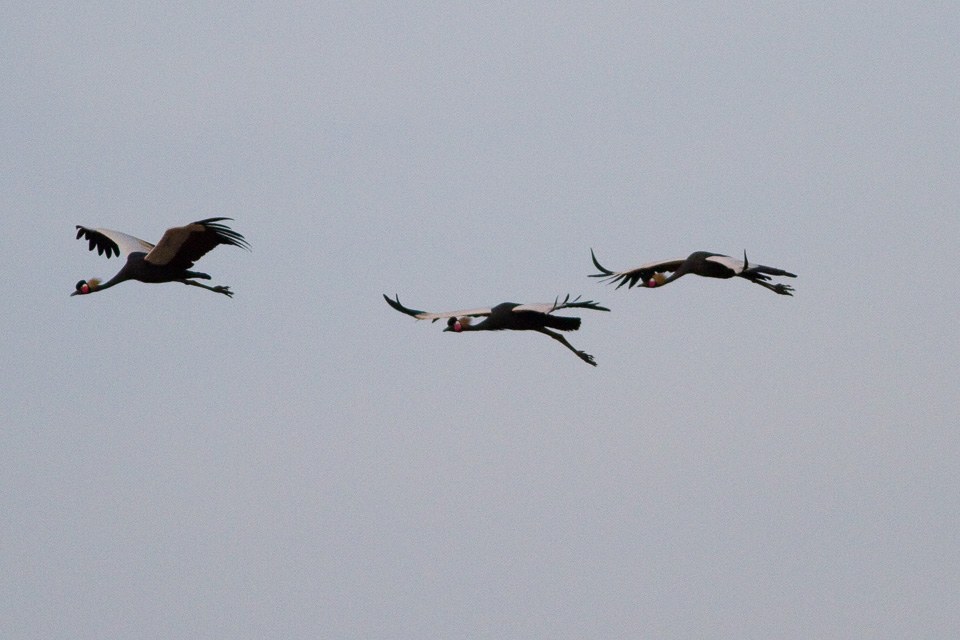
Key Field Marks
- Medium-large crane, roughly 1 m tall, with a slender neck and long legs typical of cranes.
- Body plumage is mostly slate-black, contrasting with pale grey wing coverts visible in flight.
- Crown is topped with a dense tuft of stiff, bristly golden-yellow feathers radiating outward like a halo — the field mark that gives the species its name.
- Bare facial skin forms a white cheek patch, with a small red spot above and a red-and-white inflatable throat wattle below the bill.
- Bill is short, stout, and grey; legs are black.
- Sexes look alike, though males average slightly larger.
Separating It From Similar Species
- Grey Crowned-Crane (the other crowned-crane species) has pale grey body plumage rather than black, and a proportionally larger white cheek patch — the two species' ranges barely overlap, with Black Crowned-Crane confined to the Sahel and West/Central Africa.
- No other African crane shares the golden bristle crown; Wattled Crane and Blue Crane lack the crown tuft entirely and have very different plumage tones.
- In flight, both crowned-cranes show a mix of white, buff, and black in the wings, but Black Crowned-Crane's body appears noticeably darker overall.
Where and When to See It
- Resident across the Sahel belt of West and Central Africa, from Senegal and Gambia east to Chad and South Sudan.
- Favors seasonal wetlands, floodplains, marshes, and wet grasslands, often near rice paddies or lightly grazed pasture; also roosts communally in trees, unlike most other crane species.
- Largely sedentary but makes local movements tracking rainfall and flooding, gathering in larger flocks outside the breeding season.
Voice and Behavior
- Calls include a resonant, far-carrying trumpeting or honking, produced with the aid of an elongated windpipe, often given in duet by paired birds.
- Displays include bowing, leaping, and wing-flapping dances similar to other cranes, performed both in courtship and general social interaction.
- Feeds by walking through shallow wetlands and grassland, taking seeds, insects, and small vertebrates.
Frequently asked questions
What is the easiest way to identify a Black Crowned-Crane?
Look for the combination of black body plumage, a spiky golden crown of bristle feathers, and a bare white cheek patch with a red throat wattle — no other African bird shares this combination.
How do you tell Black Crowned-Crane from Grey Crowned-Crane?
Body color is the quickest cue: Black Crowned-Crane has dark slate-black plumage while Grey Crowned-Crane is pale grey. Their ranges also barely overlap.
Where is the best place to see a Black Crowned-Crane?
Sahel wetlands and floodplains in West and Central Africa, such as those in Senegal, Nigeria, and Chad, are the most reliable areas, especially during and just after the rainy season.
Do Black Crowned-Cranes migrate?
They are largely non-migratory but do make local, rainfall-driven movements between wetlands within their Sahel range.