
Black-collared Barbet Identification Guide
A chunky African barbet with a bright red face and throat bordered by a broad black collar, best known for the loud, bubbling duet calls paired birds give together.
Read the full Black-collared Barbet encyclopedia entry →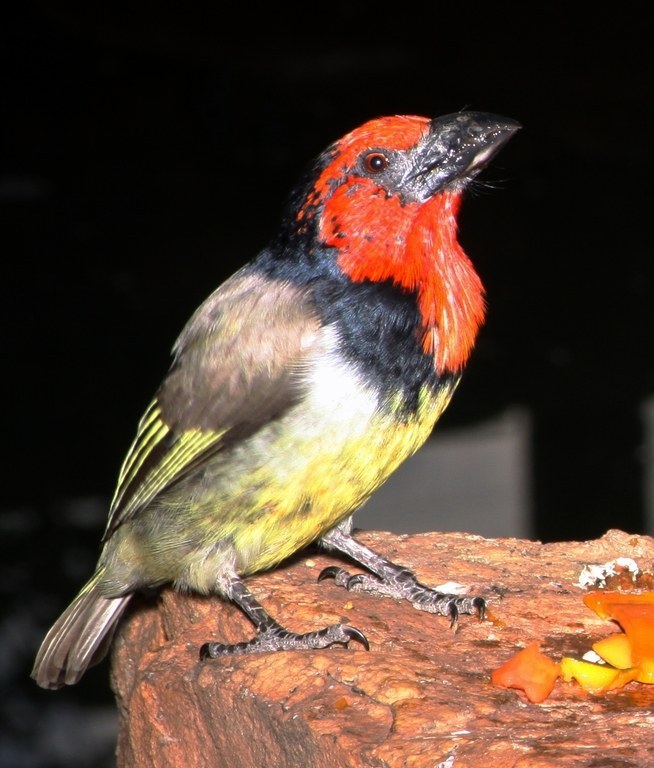
Key Field Marks
- Chunky, large-headed barbet, about 8 inches (20 cm) long, with a stout, pale, slightly hooked bill.
- Bright red face and throat, bordered by a broad black collar that wraps around the back and sides of the neck.
- Black crown; olive-yellow upperparts; pale, whitish-yellow underparts, often with a light yellow wash.
- Some individuals (especially in parts of the range) show more extensive yellow on the face, mixed with or replacing red — a normal variation rather than a different species.
Similar Species
- Within its range, the combination of a red face, black collar, and stout pale bill is fairly distinctive among barbets.
- Other regional barbets typically lack the sharply defined black collar or show different head patterns and are usually separable by range and overall color pattern.
Habitat & Behavior
- Found in woodland, savanna, riverine forest edges, and well-wooded gardens and parks.
- Excavates nest holes in dead or rotting wood, often reusing sites across seasons.
- Feeds on fruit as well as insects, and is often detected before it is seen thanks to its loud calling.
- Typically encountered in pairs, which perform coordinated duet calls.
Range & Season
- Resident across southern and eastern Africa, from South Africa north through Zimbabwe, Mozambique, and East Africa into Kenya and Tanzania.
- Non-migratory, present year-round throughout its range.
Voice
- Highly vocal; paired birds perform a loud, bubbling, rhythmic duet, often rendered as "too-puddly, too-puddly" or a popping, gurgling chorus, with each bird contributing alternating notes so quickly it can sound like a single bird.
Frequently asked questions
What is the most distinctive feature of Black-collared Barbet?
Its bright red face and throat bordered by a broad black collar around the neck, combined with a stout pale bill.
Why is it often heard before it's seen?
Paired birds perform loud, bubbling duet calls that carry a long distance through woodland and savanna habitat.
Does every individual show a fully red face?
No, some individuals show more yellow mixed into the face pattern, which is normal variation rather than a separate form.
Where in Africa is this species found?
It is resident across southern and eastern Africa, from South Africa north through parts of East Africa including Kenya and Tanzania.