
Black-chinned Hummingbird Identification Guide
A widespread western hummingbird whose male shows a black throat with a thin iridescent purple band at the base, and whose habit of pumping its tail while hovering aids identification.
Read the full Black-chinned Hummingbird encyclopedia entry →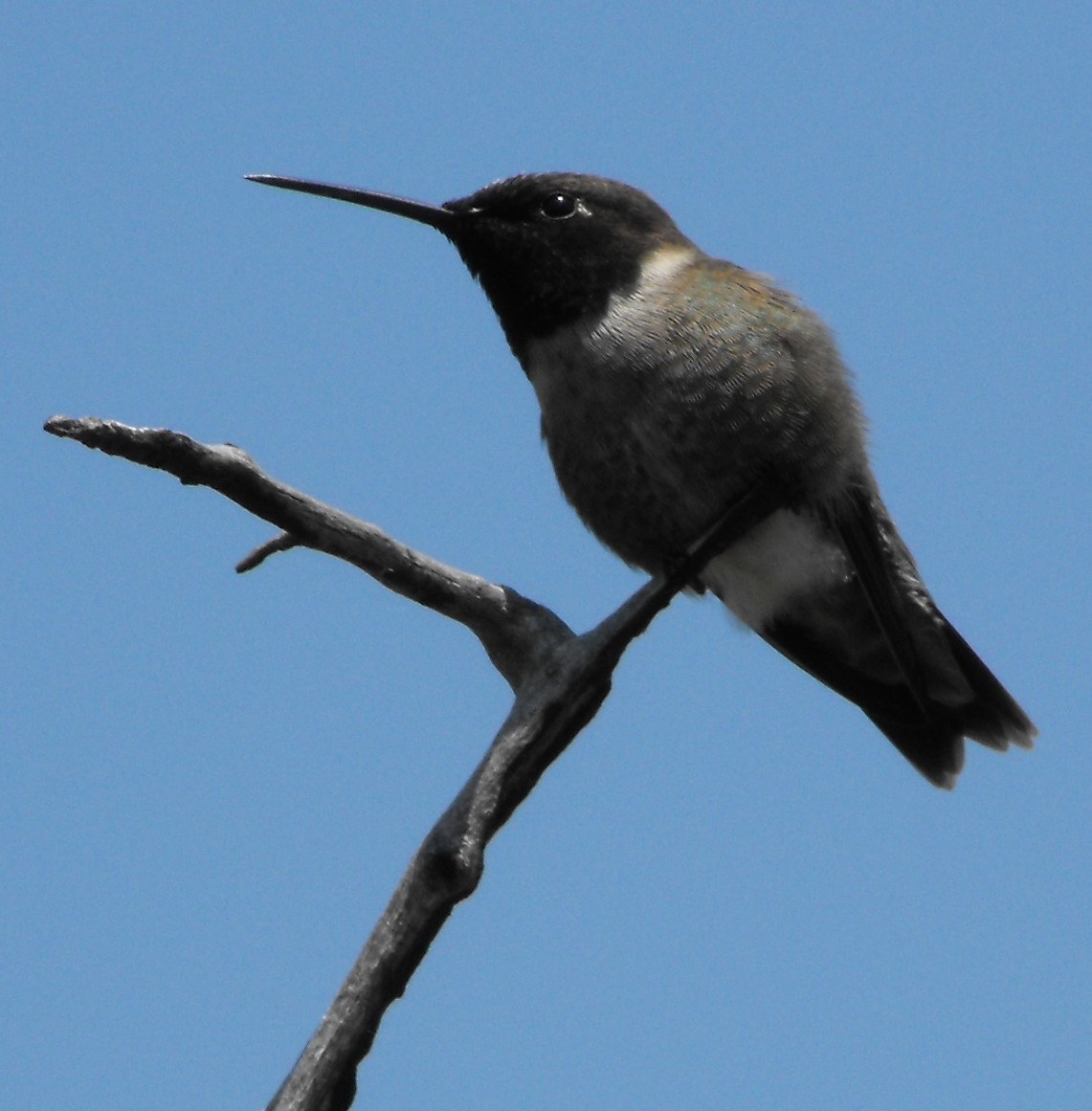
Key Field Marks
- Small hummingbird with a medium-length, slightly drooped bill.
- Adult male: throat (gorget) appears solid black in most light, but shows a narrow band of iridescent violet-purple at the bottom edge when lit at the right angle; a white collar sets off the gorget from the metallic green back.
- Adult female: whitish throat, sometimes faintly streaked or dotted, metallic green back, and pale grayish-white underparts — very similar to other female Archilochus and Selasphorus hummingbirds and often not safely distinguishable in the field.
- A useful behavioral clue: this species regularly pumps its tail up and down while hovering, more so than many other hummingbirds.
- Tail is notably forked in males.
Similar Species
- Ruby-throated Hummingbird: male has a red (not purple) gorget; ranges are mostly separate (Ruby-throated in the east, Black-chinned in the west), with limited overlap in the central Great Plains and Texas.
- Anna's Hummingbird: male has an extensive rose-pink to magenta crown and throat (not just a black throat with a thin purple band) and a chunkier build.
- Costa's Hummingbird: male has a violet crown and throat with elongated gorget feathers extending to the sides like a mustache.
Habitat & Behavior
- Highly adaptable, found in desert washes, riparian woodland, canyons, oak and pinyon-juniper woodland, chaparral, and suburban gardens with flowering plants and feeders.
- Occurs across a wide elevational range, from low desert to mountain foothills.
- Feeds on nectar and small insects, and readily visits hummingbird feeders.
Range & Season
- Breeds across much of the western United States, from the Pacific states east through the Great Basin and Rockies, and south through much of Texas.
- Winters mainly in Mexico, with small numbers regularly wintering along the U.S. Gulf Coast.
- A common summer visitor across its western breeding range, typically present from spring through early fall.
Voice
- Relatively quiet; gives soft chip and tick notes.
- Males produce a soft, dry, buzzy trilling sound with their wings/tail during display dives, rather than a loud song.
Frequently asked questions
How can I identify a female or immature Black-chinned Hummingbird?
Females are difficult to distinguish from other female hummingbirds by plumage alone; the habit of pumping the tail while hovering is a helpful, though not foolproof, behavioral clue.
What color is the male's throat?
It looks solid black in most lighting, but shows a thin band of iridescent violet-purple at the base of the throat when the light catches it at the right angle.
How do I separate Black-chinned from Ruby-throated Hummingbird?
Male gorget color differs (purple-black versus red), and the two species' breeding ranges are mostly separate, with Black-chinned in the west and Ruby-throated in the east, overlapping only in a narrow zone in the central Great Plains and Texas.
What habitats does Black-chinned Hummingbird use?
It is a habitat generalist across the West, found in desert washes, riparian corridors, canyons, oak woodland, and suburban gardens with feeders.