
Black-capped Vireo Identification Guide
A small, secretive vireo of dense oak scrub, identified by the male's glossy black cap, bold white spectacles, and red eye, and known for its jumbled, hurried song.
Read the full Black-capped Vireo encyclopedia entry →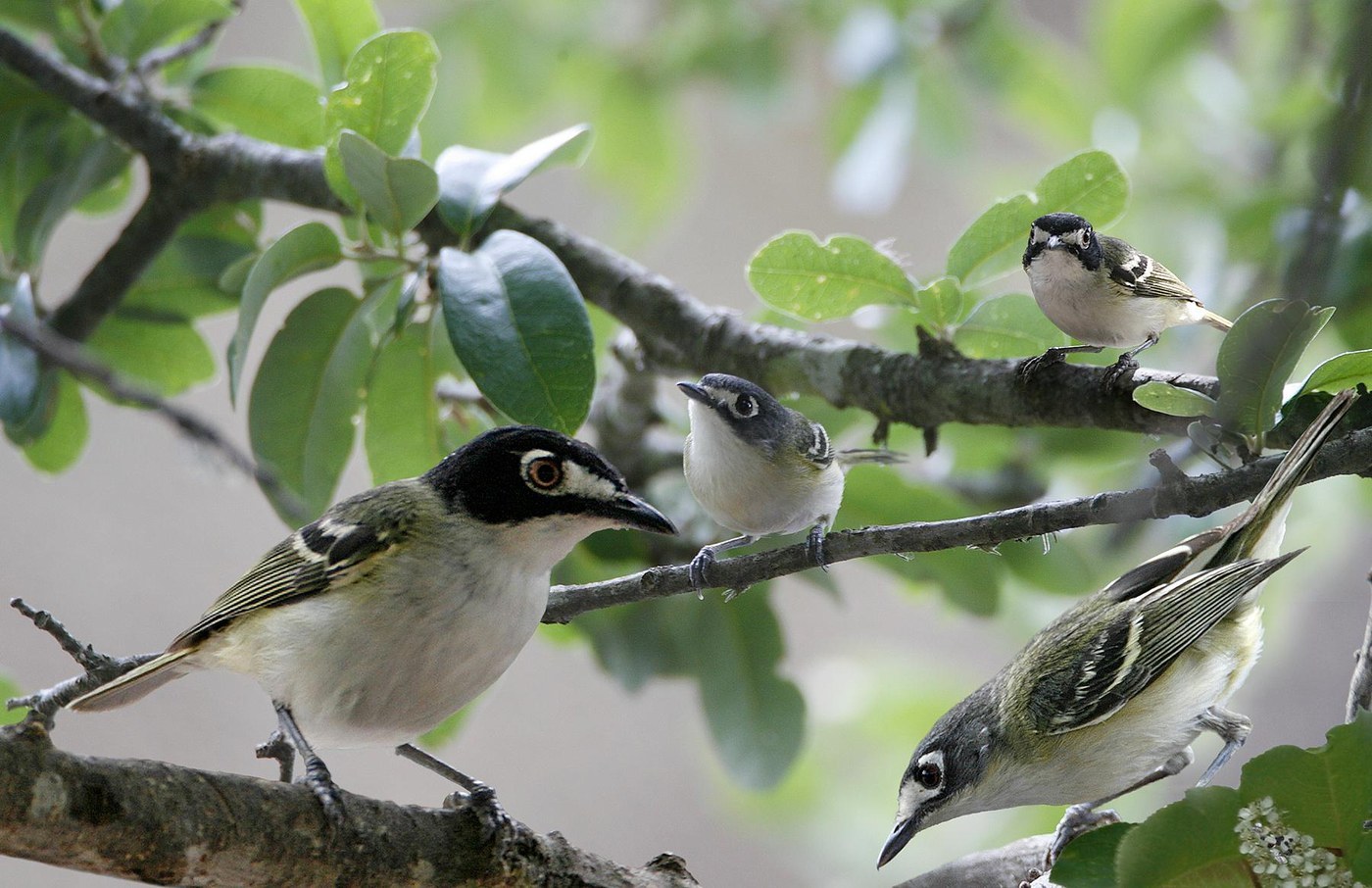
Key Field Marks
- Small vireo, about 4.5 inches long, with a relatively large head and short tail for the genus.
- Adult male: glossy black cap contrasting sharply with bold white "spectacles" (a broken white eye-ring connected to the lores) surrounding a red eye.
- Olive-green back, white underparts washed with pale yellow along the sides and flanks, and two white wing bars.
- Adult female: similar pattern but with a slate-gray (not black) cap and generally duller overall coloration.
Similar Species
- No other vireo shows this combination of a dark cap and bold white spectacles around a red eye.
- White-eyed Vireo has yellow (not white) spectacles, a whitish eye, and lacks a contrasting dark cap.
Habitat & Behavior
- Requires a very specific early-successional habitat: shrubby oak scrub with dense, low woody cover interspersed with open ground, typically maintained by periodic fire, grazing, or other disturbance.
- Stays low and skulks within dense shrub cover, making it more often heard than seen.
- Historically listed as endangered due to habitat loss and brood parasitism by Brown-headed Cowbirds; conservation and habitat management have helped some populations recover.
Range & Season
- Breeds primarily in the Texas Hill Country and adjacent parts of Oklahoma, with additional breeding range in northern Mexico.
- Winters along the Pacific slope of Mexico.
- A summer breeding visitor to its U.S. range, generally present from March/April through August.
Voice
- Song is a hurried, scratchy, and erratic jumble of husky notes and phrases, often described as "chip-a-per-weep-chip" — more disorganized and variable than the smoother, more measured songs of most other vireos.
- Persistent singer, often delivering song from within dense cover.
Frequently asked questions
What is the key field mark for male Black-capped Vireo?
A glossy black cap paired with bold white spectacles around a red eye is diagnostic among North American vireos.
How does the female differ from the male?
Females have a slate-gray cap rather than black, and are somewhat duller overall, though they show the same white spectacles and red eye pattern.
What habitat should I search for this species?
Dense, low shrubby oak scrub with a mix of open ground, typically maintained by fire or grazing disturbance — mature closed-canopy woodland is unsuitable.
Where and when can Black-capped Vireo be found in the U.S.?
Primarily in the Texas Hill Country and adjacent Oklahoma during the breeding season, roughly March/April through August; it winters in Mexico.