
Black-capped Chickadee Identification Guide
A familiar, acrobatic small songbird with a black cap and bib and white cheeks, known for its namesake 'chick-a-dee-dee' call and clear whistled 'fee-bee' song.
Read the full Black-capped Chickadee encyclopedia entry →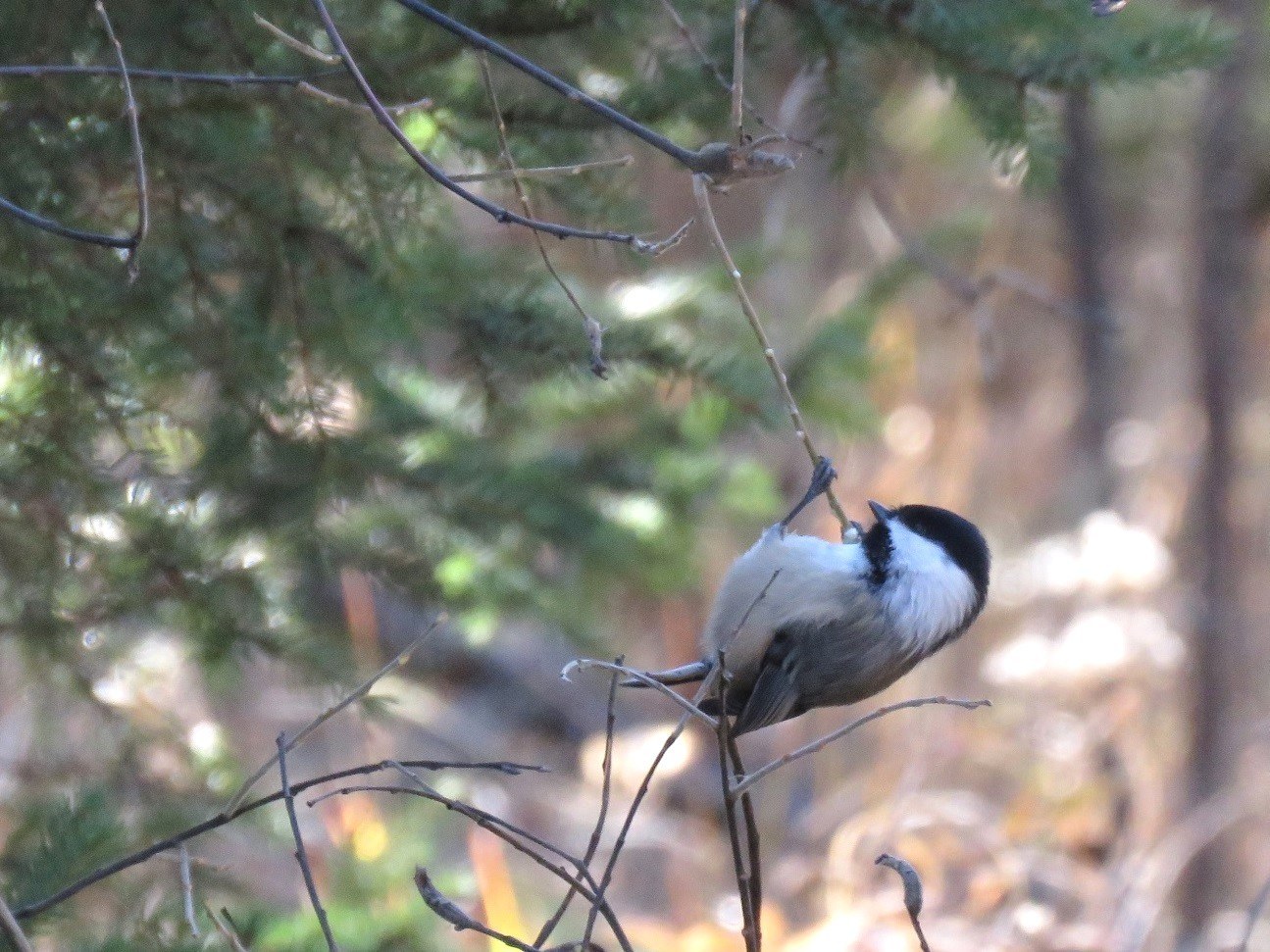
Key Field Marks
- Tiny, round-bodied songbird about 5.25 inches long with a big head and short neck.
- Black cap extending down over the crown and nape, black bib on the throat, and clean white cheeks in between.
- Gray back, wings, and tail, with pale edging on the wing feathers (greater coverts and secondaries) forming a subtly pale panel on the folded wing.
- Underparts buffy-white, washed with light rufous-buff along the flanks.
Similar Species
- Carolina Chickadee: nearly identical but slightly smaller, with a cleaner white cheek, less obvious pale wing edging, and a different, faster song; the two species meet and hybridize in a narrow contact zone through the mid-Atlantic and lower Midwest, where identification can be very difficult.
- Mountain Chickadee: shows a bold white eyebrow stripe above the eye, lacking in Black-capped Chickadee.
- Boreal Chickadee: has a brown (not black) cap and brownish flanks.
Habitat & Behavior
- Found in deciduous and mixed forests, forest edges, willow and alder thickets, parks, and suburban yards with trees, readily visiting feeders.
- Highly acrobatic, often hanging upside down on branches and feeders while foraging.
- Caches food items for later retrieval and joins mixed-species foraging flocks in winter, often with nuthatches, kinglets, and woodpeckers.
Range & Season
- Widespread year-round resident across most of Canada and the northern half to central belt of the United States.
- Largely non-migratory, though some populations show irregular winter irruptions southward in years of poor food supply.
Voice
- The namesake call, "chick-a-dee-dee-dee," varies in the number of "dee" notes and is used for alarm and flock communication.
- Song is a clear, whistled two-note "fee-bee" (sometimes rendered "hey, sweetie"), with the first note higher than the second.
Frequently asked questions
How do I tell Black-capped from Carolina Chickadee?
They are very similar, but Black-capped is slightly larger with more obvious white wing edging and a slower, two-note 'fee-bee' song, while Carolina Chickadee has a faster four-note song; where their ranges overlap, hybrids can be impossible to identify with certainty.
Why does the number of 'dee' notes in the call vary?
Chickadees add more 'dee' notes to signal a higher level of threat or alarm, such as when a predator is nearby.
Is Black-capped Chickadee migratory?
It is mostly a year-round resident, though some populations move irregularly and irruptively southward in winters with scarce food.
What habitat is best for finding Black-capped Chickadees?
Deciduous and mixed woodlands, forest edges, and wooded suburban yards, especially areas with bird feeders in winter.