
Black-browed Albatross Identification Guide
A medium-sized Southern Ocean albatross with a dark eyebrow smudge, orange-yellow bill, and broadly black-bordered underwings, rare but regular as a vagrant to the Northern Hemisphere.
Read the full Black-browed Albatross encyclopedia entry →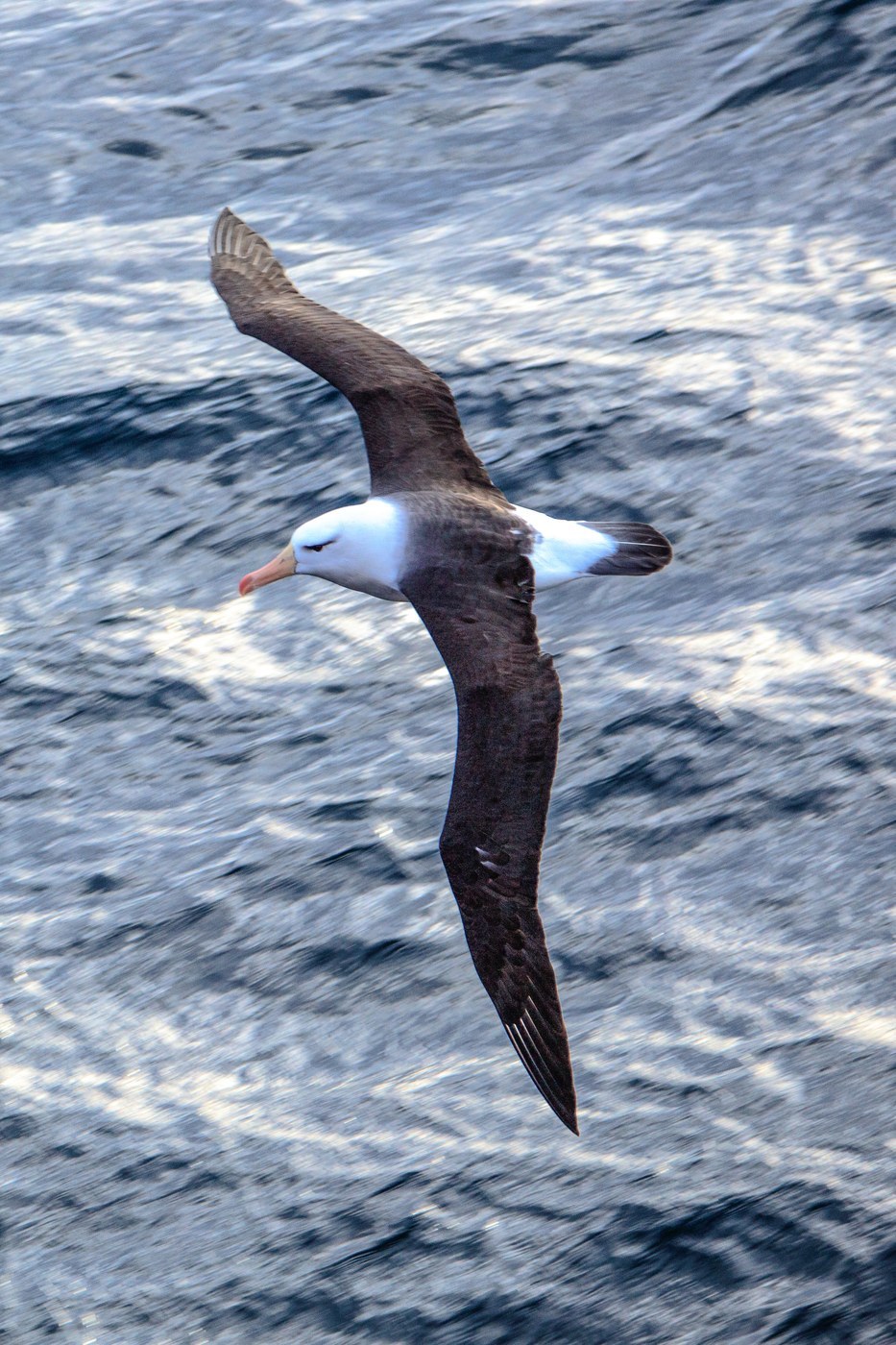
Key Field Marks
- A medium-sized albatross (small among the "great" seabirds but large by any other measure), with a wingspan of roughly 7–8 feet.
- White head and body with a distinctive dark smudge through and behind the eye — the "black brow" that gives the species its name.
- Bill is orange-yellow with a darker, often reddish-orange tip.
- Upperwings solid blackish-brown; underwings white with a broad, irregular black border, notably wider along the leading edge than the trailing edge.
- Juveniles differ from adults: they show a dusky gray collar/hood, a dark (not orange) bill, and much more extensive dark margins on the underwing, taking several years to attain full adult plumage.
Similar Species
- Other Thalassarche albatrosses such as Grey-headed Albatross (gray head and neck, dark bill with yellow ridges) and Yellow-nosed Albatross (all-white head, thin dark bill with yellow culmen) differ in head and bill pattern.
- Laysan Albatross, a North Pacific species, also has a dark smudge around the eye but differs in bill color and structure and does not naturally overlap in range.
Habitat & Behavior
- Entirely pelagic outside the breeding season, ranging over open ocean and rarely coming within sight of land except at breeding colonies.
- Glides low over waves on stiff, bowed wings using dynamic soaring, and readily follows fishing vessels for offal and bait.
Range & Season
- Breeds colonially on subantarctic islands of the Southern Ocean, including the Falkland Islands, South Georgia, and other sites around South America, Australia, and New Zealand.
- Disperses widely across southern oceans outside the breeding season; a rare but increasingly recorded vagrant to the North Atlantic and, less often, the North Pacific, usually associating with gannet or gull colonies far from its normal range.
Voice
- Largely silent at sea; at breeding colonies gives braying, grunting, and bill-clattering calls during courtship and territorial displays.
Frequently asked questions
What is the best field mark for Black-browed Albatross?
The dark smudge through the eye ('black brow') combined with an orange-yellow bill and broadly black-bordered white underwings.
How can I tell an adult from a juvenile Black-browed Albatross?
Juveniles have a dusky collar, a dark bill instead of orange-yellow, and much wider dark margins on the underwing; full adult plumage takes several years to develop.
Where would someone in North America realistically see this species?
It is a rare vagrant, occasionally found far offshore or, unusually, summering among gannet colonies in the North Atlantic (such as off eastern Canada), well outside its normal Southern Ocean range.
Where does Black-browed Albatross breed?
On subantarctic islands of the Southern Ocean, including the Falkland Islands and South Georgia, among other sites.