
Black-bellied Plover Identification Guide
The largest and chunkiest of the Arctic-breeding plovers, identified year-round by its black underwing 'wingpits' in flight and, in summer, a bold black face and belly.
Read the full Black-bellied Plover encyclopedia entry →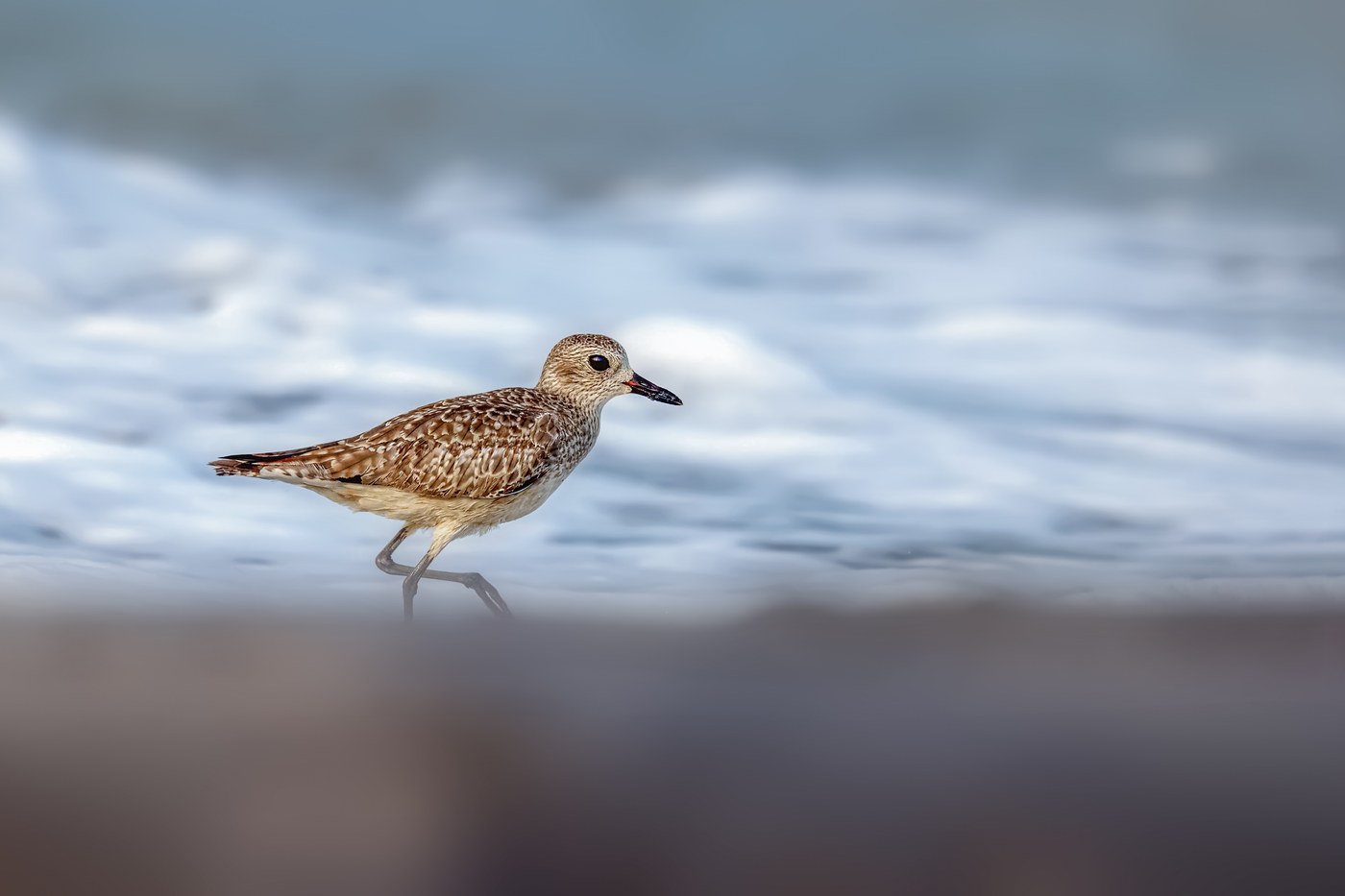
Key Field Marks
- Largest plover regularly seen on North American shorelines, about 11.5 inches long, with a bulky body, large rounded head, and short, stout black bill.
- Breeding plumage: black face, throat, breast, and belly bordered by a broad white band across the crown, neck, and flanks; upperparts spangled black-and-white.
- Nonbreeding/winter plumage: plain gray-brown above, whitish below with fine gray streaking on the breast, and a grayish cap — much less patterned than breeding birds.
- In flight at any season, shows a white rump, a white wing stripe, and, most diagnostically, black axillaries ("wingpits") visible from below.
Separating It From Golden-Plovers
- American Golden-Plover and Pacific Golden-Plover are smaller and slimmer with longer wings that project noticeably past the tail at rest.
- Golden-plovers show pale gray or buffy (not black) underwing linings/axillaries and lack the white wing stripe shown by Black-bellied Plover in flight.
- Breeding golden-plovers have golden-spangled (not black-and-white) upperparts and no white flank band.
Habitat & Behavior
- Favors coastal mudflats, sandy beaches, and tidal flats during migration and winter; less common on inland mudflats and flooded fields than golden-plovers.
- Forages with a characteristic run-stop-peck feeding style, standing upright between bursts of movement.
- Often the wariest shorebird on a flat, giving alarm calls that flush mixed shorebird flocks.
Range & Season
- Breeds on high Arctic tundra across northern Canada, Alaska, and Eurasia.
- Winters along coastlines nearly worldwide, including both U.S. coasts, the Gulf Coast, and south to South America.
- Common migrant along coasts in spring and fall; some non-breeding birds oversummer on wintering grounds.
Voice
- A mournful, far-carrying, slurred three-note whistle, often rendered "pee-oo-ee" or "tlee-oo-ee," with the middle note lower.
Frequently asked questions
What is the fastest way to tell Black-bellied Plover from a golden-plover in flight?
Check the underwing: Black-bellied Plover shows black axillaries (wingpits) and a white wing stripe, while both golden-plover species have pale underwings and no wing stripe.
Does Black-bellied Plover look the same year-round?
No. Breeding birds are boldly black-faced and black-bellied, while winter birds are plain gray-brown above and whitish below, much less strikingly patterned.
Where does Black-bellied Plover nest?
It breeds on open Arctic tundra in northern Canada, Alaska, and Eurasia, then migrates to coastlines worldwide for the winter.
What habitat should I search to find one?
Coastal mudflats, sandy beaches, and tidal flats are the most reliable spots, especially at low tide when birds are actively foraging.