
Black-backed Woodpecker Identification Guide
A stocky, solid-black-backed woodpecker of burned and beetle-killed conifer forests, best told from the similar American Three-toed Woodpecker by its unbarred black back.
Read the full Black-backed Woodpecker encyclopedia entry →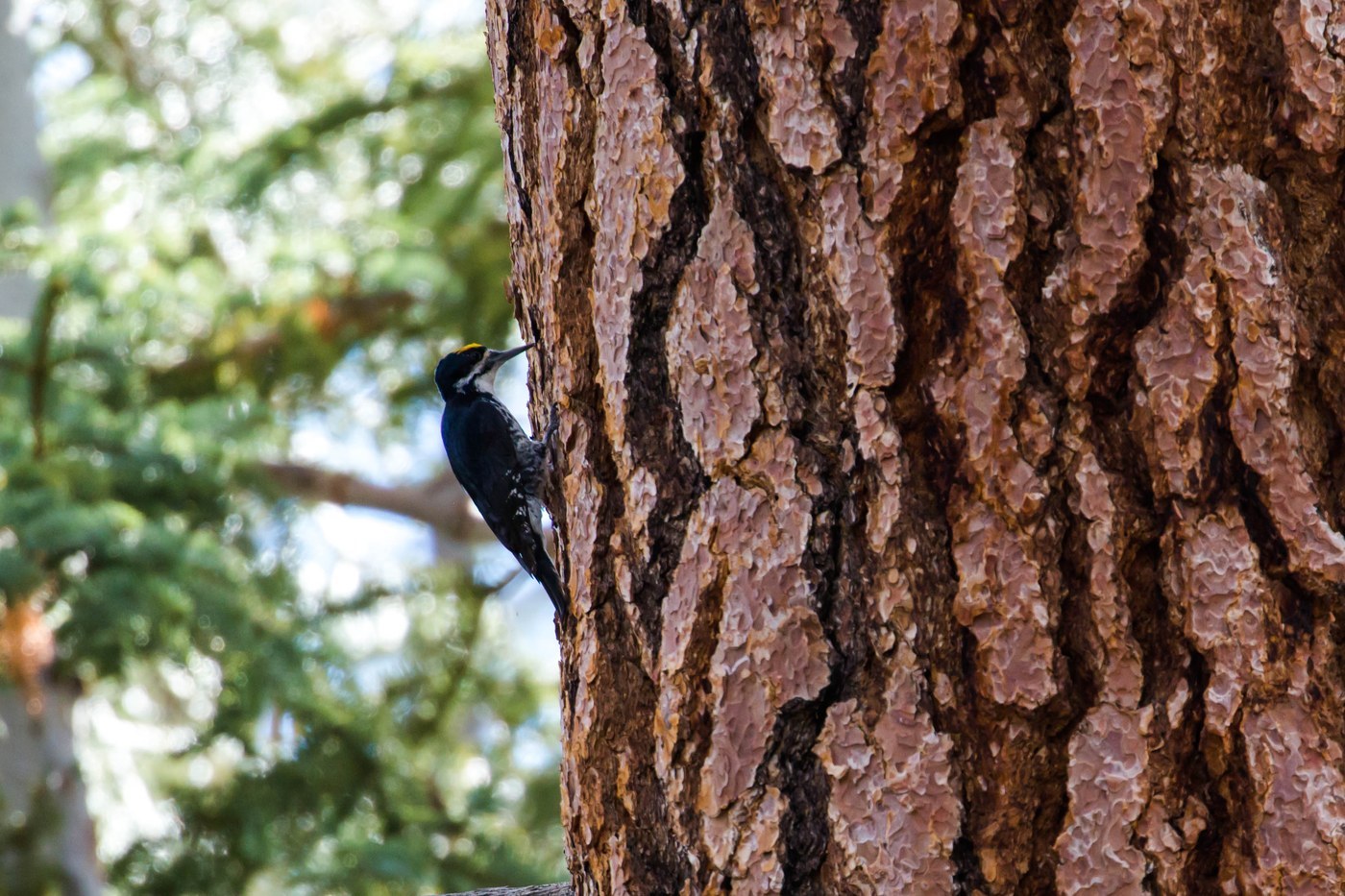
Key Field Marks
- Medium-sized, stocky woodpecker, about 9–9.75 inches long, with a large head and long, pale, chisel-like bill.
- Solid, glossy black back with no white barring — this is the single best mark separating it from all other North American woodpeckers.
- White underparts with bold black barring along the flanks.
- Black wings show white spotting/barring only on the flight feathers, not the back.
- Adult male has a small yellow crown patch; females lack yellow and show a plain black crown.
- Three toes on each foot (missing the hind toe), shared only with American Three-toed Woodpecker.
- Face is plain black-and-white with a narrow white mustache stripe and white line below the eye.
Similar Species
- American Three-toed Woodpecker: back is barred or ladder-patterned with white, not solid black; ranges broadly overlap in boreal and montane forest.
- Hairy Woodpecker: has a solid white back stripe, and the male shows a red nape patch rather than a yellow crown.
- Downy Woodpecker: much smaller, also white-backed, with a short bill.
Habitat & Behavior
- A fire and disturbance specialist — most reliably found in recently burned coniferous forest (1–8 years post-fire) and areas with bark-beetle outbreaks.
- Also uses mature spruce, fir, and pine forest with standing dead and dying trees.
- Forages by flaking off large slabs of loose bark from dead trees to expose wood-boring beetle larvae, leaving distinctive patches of bare, pale wood on trunks.
- Generally unafraid of humans and easiest to find by searching recent burns.
Range & Season
- Resident year-round across the boreal forest of Canada and Alaska, and in mountain conifer forests of the western U.S. (Sierra Nevada, Cascades, Rockies).
- A small, disjunct population also occurs in spruce-fir forest and bogs of the northeastern U.S. (northern New England, Adirondacks).
- Largely non-migratory but can wander irregularly, especially into newly burned areas far from typical range.
Voice
- A sharp, single-note "pik" call, lower and flatter than the calls of Hairy or Three-toed Woodpeckers.
- Drums in a rapid, even roll used for communication and territory defense.
Frequently asked questions
How do I tell a Black-backed Woodpecker from an American Three-toed Woodpecker?
Look at the back: Black-backed has a solid, unbroken black back, while Three-toed shows white barring or a ladder pattern down the back.
Do both sexes have a yellow crown patch?
No. Only adult males show the yellow crown patch; females have an all-black crown.
Where is the best place to look for this species?
Recently burned coniferous forest, typically one to eight years after a fire, is the most reliable habitat, along with areas experiencing bark-beetle outbreaks.
Is the Black-backed Woodpecker migratory?
No, it is essentially non-migratory, though individuals may wander to newly burned or beetle-killed forest patches outside their usual range.