
Bicknell's Thrush Identification Guide
A rare, high-elevation breeding thrush of the northeastern mountains, extremely similar to Gray-cheeked Thrush and best confirmed by voice, subtle plumage tones, and montane spruce-fir habitat.
Read the full Bicknell's Thrush encyclopedia entry →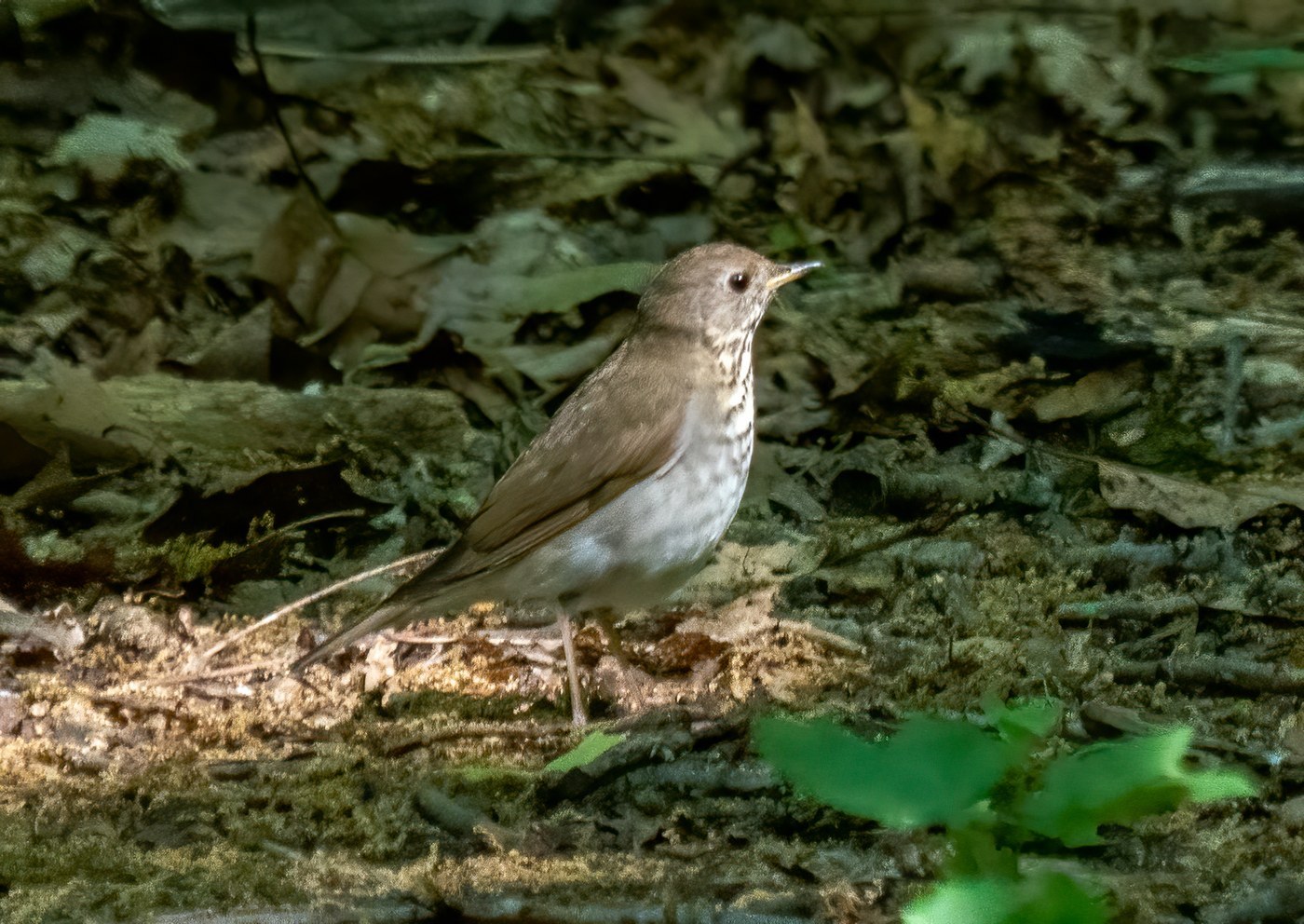
Key Field Marks
- Size & shape: A small brown-backed thrush (about 17 cm), slightly smaller and shorter-winged than most other Catharus thrushes, with a fairly upright, compact posture typical of the genus.
- Plumage: Warm olive-brown to slightly rufous-tinged upperparts (especially on the tail, which can show a subtle reddish-brown cast compared to the rest of the back), pale grayish-white underparts with dusky spotting on the breast.
- Face & bill: Faint, indistinct grayish eye-ring; the lower mandible often shows a notable yellowish-pink base, more extensive than in the very similar Gray-cheeked Thrush, though this mark requires a close, good view.
- Legs: Pinkish legs, similar to other Catharus thrushes.
- Behavior: Shy and elusive, tends to stay low in dense understory and forages on or near the ground; most often detected by voice rather than by sight, especially on its remote breeding grounds.
Similar Species
- Gray-cheeked Thrush: Extremely similar and formerly considered the same species; Gray-cheeked is very slightly larger, has slightly grayer (less rufous-tinged) tail and upperparts, and breeds in more northerly boreal/subarctic habitats rather than the high-elevation spruce-fir forest used by Bicknell's. Voice is the most reliable distinguishing feature between the two.
- Swainson's Thrush: Has a buffy, more prominent eye-ring and buffy wash across the face and breast, quite different from the plainer face of Bicknell's/Gray-cheeked.
- Hermit Thrush: Shows a clearly contrasting reddish-brown tail against a browner back (a more obvious contrast than the subtle tail tone of Bicknell's) and habitually raises and slowly lowers its tail while perched, a good behavioral clue.
Where & When to See
- Habitat: Breeds in dense, stunted high-elevation spruce-fir (krummholz) forest on mountaintops, typically above about 900 meters elevation in the northeastern United States and adjacent Canada.
- Range: Breeds locally in the mountains of the northeastern US (e.g., New York's Catskills and Adirondacks, New England) and southeastern Canada (Quebec, Maritime provinces); winters in the Caribbean, primarily on Hispaniola.
- Season: Present on breeding grounds from late spring through summer (roughly May to August); a long-distance migrant that spends winter in the Caribbean.
- Best viewing tips: Visit known high-elevation spruce-fir breeding sites at dawn or dusk during the breeding season and listen carefully for the distinctive nasal song; because the species is a conservation concern, observers should stay on trails and avoid disturbing breeding territories.
Voice
- Song is a flute-like series of phrases ending with a distinctive nasal, slightly descending or 'buzzy' quality, subtly different in tone and cadence from the very similar song of Gray-cheeked Thrush - considered the most reliable way to separate the two species in the field.
- Call note is a thin, descending 'veer' or nasal 'queeah,' again very close to but often distinguishable with practice from Gray-cheeked Thrush's call.
- Because visual differences are so subtle, many confirmed identifications, especially away from known breeding habitat, rely primarily on hearing the song or call clearly.
Frequently asked questions
How can I be sure I'm seeing a Bicknell's Thrush and not a Gray-cheeked Thrush?
The two are extremely similar visually, so the most reliable confirmation is voice - Bicknell's song has a distinctive nasal quality - combined with high-elevation spruce-fir breeding habitat in the northeastern mountains, which Gray-cheeked Thrush does not use.
Where does Bicknell's Thrush breed?
It breeds in dense, stunted spruce-fir forest on mountaintops above roughly 900 meters in the northeastern United States (such as the Catskills, Adirondacks, and New England) and adjacent southeastern Canada.
Where does Bicknell's Thrush spend the winter?
It winters primarily in the Caribbean, with the largest numbers on the island of Hispaniola.
Is Bicknell's Thrush a species of conservation concern?
Yes, its small, fragmented high-elevation breeding range and threatened wintering habitat in the Caribbean make it a species of conservation concern, and observers are encouraged to minimize disturbance at breeding sites.
What is a subtle plumage clue that can help separate Bicknell's from Gray-cheeked Thrush?
Bicknell's Thrush often shows a warmer, slightly rufous-tinged tail contrasting subtly with the rest of its upperparts, along with a more extensively yellowish-pink base to the lower bill, though these differences are subtle and best used alongside voice and habitat.