
Bewick's Swan Identification Guide
The smallest and shortest-necked swan of the Eurasian tundra, best told from Whooper Swan by its more rounded yellow-and-black bill pattern and stockier proportions.
Read the full Bewick's Swan encyclopedia entry →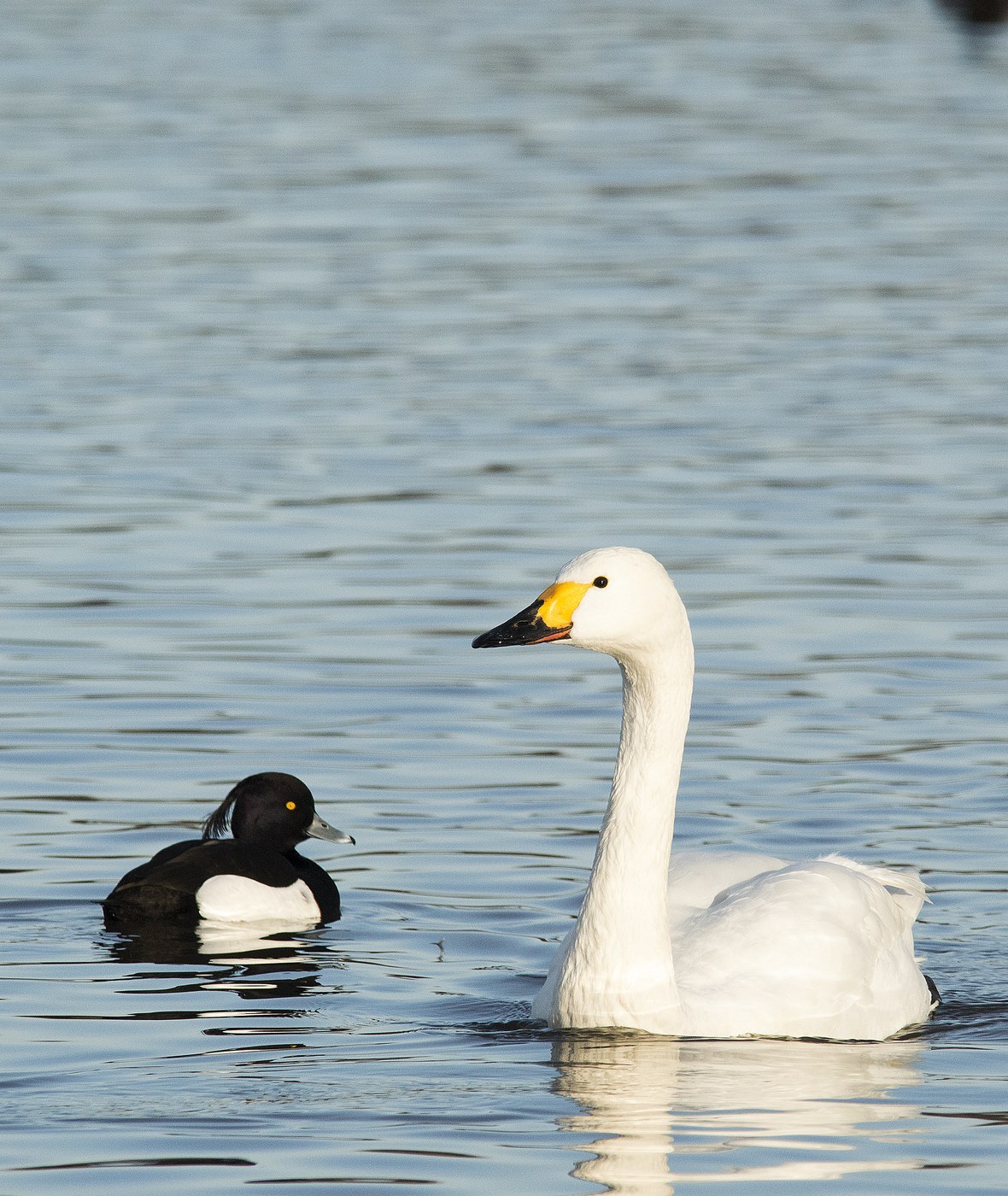
Key Field Marks
- Size & shape: The smallest swan in the Eurasian 'whistling swan' group, noticeably shorter-necked, more compact, and rounder-headed than Whooper Swan, with proportions closer to a large goose than to Mute Swan.
- Plumage: Entirely white in adults; juveniles are pale grayish-brown, gradually whitening over their first year.
- Bill pattern: Black bill with yellow at the base; critically, the yellow patch is more rounded and does NOT extend forward to a sharp point beyond the nostril, unlike the more extensive, wedge-shaped yellow of Whooper Swan. Each individual's bill pattern is unique and can be used to identify specific birds, much like a fingerprint.
- Neck & posture: Holds its shorter neck less erect than Mute Swan, often in a more level or slightly curved posture, without the Mute Swan's habitual neck-curve and downward-pointed bill.
- Behavior: Highly social outside the breeding season, forming large flocks on wintering grounds; family groups (parents with cygnets) often stay together through the winter and can be picked out within larger flocks.
Similar Species
- Whooper Swan: Larger, longer-necked, with a more angular head shape and a bill showing a larger, more pointed wedge of yellow extending further forward along the sides of the bill toward the tip.
- Mute Swan: Has an orange bill with a black basal knob (much more prominent in males) rather than the black-and-yellow pattern of Bewick's Swan, and typically holds its neck in a graceful S-curve with the bill often angled downward.
- Tundra Swan (North American counterpart, sometimes considered the same species complex): Very similar overall but occurs in North America rather than Eurasia; some individuals show a small yellow spot near the eye region on an otherwise mostly black bill, differing in extent from Bewick's yellow bill base.
Where & When to See
- Habitat: Breeds on Arctic tundra pools, wetlands, and river deltas; winters on lowland lakes, flooded farmland, reservoirs, and estuaries, often grazing on grass and waste crops in fields near open water.
- Range: Breeds across the Russian Arctic tundra; winters mainly in northwestern Europe (including Britain, the Netherlands, and Germany) and parts of eastern Asia.
- Season: Present on wintering grounds from autumn through early spring (roughly October to March), departing for Arctic breeding grounds in spring.
- Best viewing tips: Visit known wintering wetland reserves in late autumn and winter, where flocks often gather predictably at the same traditional sites; compare bill patterns carefully with any accompanying Whooper Swans for practice separating the two species.
Voice
- Highly vocal, giving loud, honking, goose-like calls, generally higher-pitched and less trumpeting than the deeper bugling calls of Whooper Swan.
- Flocks are noisy in flight and while feeding, with frequent contact calls maintaining group cohesion.
- Calls can help separate distant flying swans from geese, though close attention to bill pattern remains the most reliable way to distinguish Bewick's from Whooper Swan.
Frequently asked questions
How do I tell Bewick's Swan from Whooper Swan?
Bewick's Swan is smaller and shorter-necked with a more rounded yellow bill patch that does not reach a point near the bill tip, while Whooper Swan is larger with a more extensive, wedge-shaped yellow area extending further forward.
How is Bewick's Swan different from Mute Swan?
Bewick's Swan has a black-and-yellow bill and typically holds its neck less curved, whereas Mute Swan has an orange bill with a black basal knob and usually holds its neck in a graceful S-shape.
Can individual Bewick's Swans be identified from their bills?
Yes, the black-and-yellow bill pattern is unique to each individual, and researchers use it much like a fingerprint to track specific birds across years.
Where does Bewick's Swan spend the winter?
It winters mainly on lowland wetlands, lakes, and farmland in northwestern Europe and parts of eastern Asia, after breeding on Russian Arctic tundra.
What do juvenile Bewick's Swans look like?
Juveniles are pale grayish-brown rather than white, gradually acquiring full white adult plumage over their first year, along with a duller, pinkish-based bill that darkens with age.