
Belted Kingfisher Identification Guide
A stocky, big-headed waterside bird with a shaggy crest and dagger bill, easily identified by its blue-gray plumage, breast band, and loud rattling call as it patrols rivers, lakes, and coasts.
Read the full Belted Kingfisher encyclopedia entry →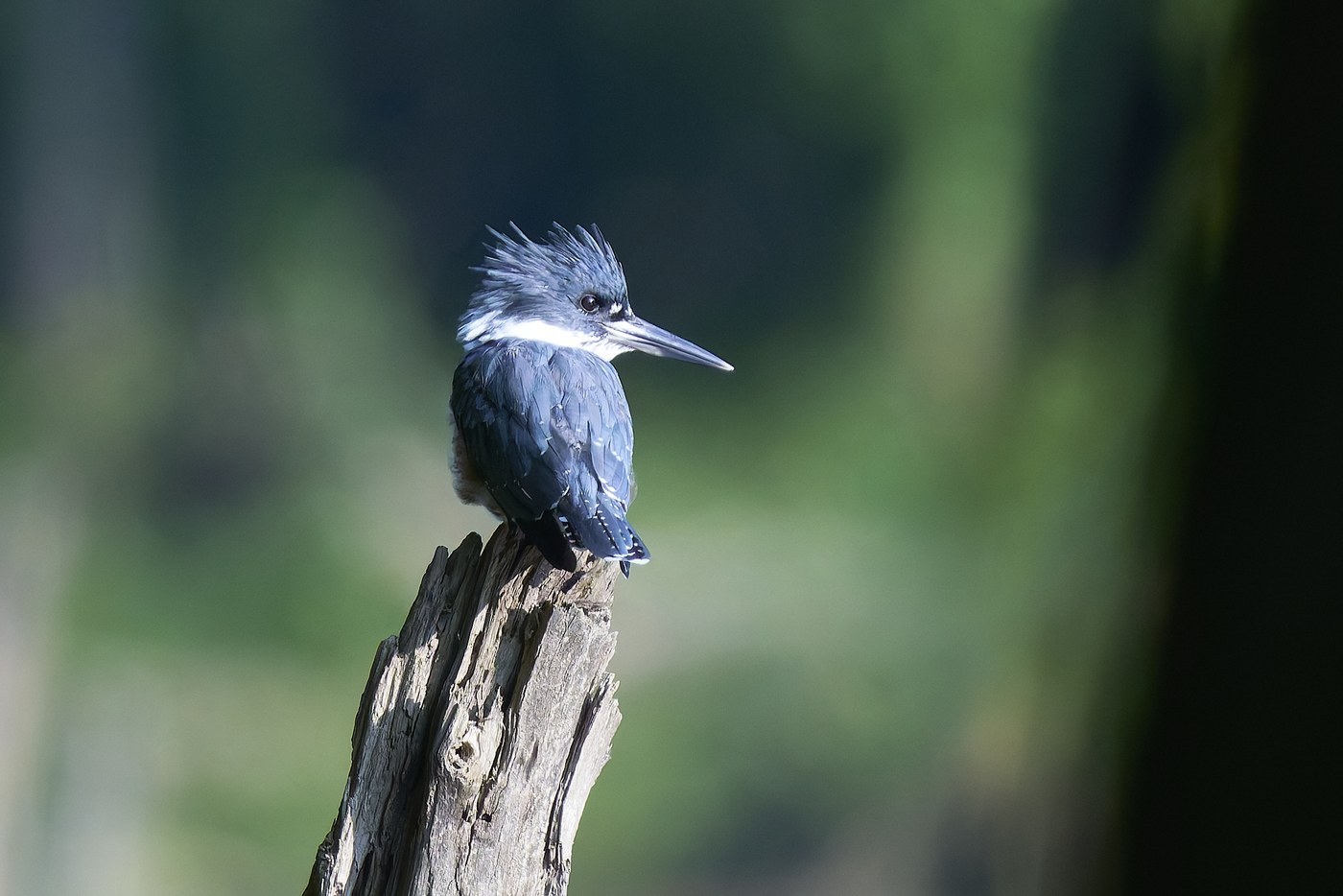
Key Field Marks
- Size & shape: Medium-sized, stocky, large-headed bird (about 28-35 cm) with a short tail, short legs, and a long, heavy, dagger-like bill - a top-heavy silhouette unlike most other waterside birds.
- Plumage: Blue-gray upperparts and head, with a shaggy, ragged crest on the crown that is often raised. Underparts are white with a blue-gray breast band across the chest.
- Sex differences: Unusually for birds, the female is more colorful than the male - females show an additional rufous (rusty-orange) band across the belly/flanks below the blue-gray breast band, which males lack entirely.
- Bill: Long, straight, and heavy, black to blue-gray, adapted for plunge-diving to catch fish.
- Behavior: Perches conspicuously on wires, dead branches, or posts overlooking water, then plunge-dives headfirst to catch prey; also frequently hovers in place over water before diving. Flight is strong and somewhat undulating, often accompanied by loud rattling calls.
Similar Species
- Other North American kingfishers (e.g., Ringed Kingfisher, Green Kingfisher, in areas of range overlap in the southern US): Ringed Kingfisher is notably larger with an all-rufous belly in both sexes and a heavier bill; Green Kingfisher is much smaller and greenish above with a slimmer bill and lacks the shaggy blue-gray crest.
- Herons and other waterside birds: Longer-legged and longer-necked in flight, without the kingfisher's stocky, big-headed, short-tailed shape or characteristic hovering/diving behavior.
- No other widespread North American bird combines the shaggy crest, oversized bill, and blue-gray-and-white plumage of the Belted Kingfisher, making it fairly unmistakable once seen well.
Where & When to See
- Habitat: Found along virtually any body of water with suitable fish prey and nearby earthen banks for nesting - rivers, streams, lakes, ponds, estuaries, and coastlines.
- Range: Breeds across most of North America from Alaska and Canada south through the United States; winters across the southern and coastal United States, Mexico, and Central America where water remains open and ice-free.
- Season: Present year-round in areas with open water; northern breeders migrate south in winter when their waters freeze over, so seasonal presence varies by latitude.
- Best viewing tips: Scan low perches such as snags, wires, and posts directly over or near water; the loud rattling call in flight is often the first clue to its presence even before the bird is spotted.
Voice
- Gives a loud, harsh, mechanical rattling call, often delivered in flight or when disturbed - one of the most distinctive and far-carrying sounds along waterways.
- The rattle is given year-round by both sexes and serves as both a contact and territorial call, unrelated to any true song.
- Listen for this rattling call along any river, lake, or coastal edge as a quick way to confirm the species' presence even at a distance.
Frequently asked questions
How can I tell a male from a female Belted Kingfisher?
Females have an extra rufous (rusty-orange) band across the belly below the blue-gray breast band, while males show only the single blue-gray breast band with no rufous.
What is the easiest way to detect a Belted Kingfisher?
Listen for its loud, harsh, mechanical rattling call, often given in flight, which usually reveals its presence before it is seen perched over water.
Where does the Belted Kingfisher nest?
It nests in burrows dug into earthen banks, typically near water, rather than in trees or on open ground.
Does the Belted Kingfisher migrate?
Northern populations migrate south in winter to find open, ice-free water, while birds in milder climates with year-round open water may remain resident.
What does a Belted Kingfisher eat and how does it hunt?
It primarily eats small fish, which it catches by watching from a waterside perch or hovering over water, then plunge-diving headfirst to seize prey in its bill.