
Bell's Vireo Identification Guide
A small, plain, and vocal vireo of dense shrubby thickets, best identified by its scratchy, run-on song and subtle field marks like faint wingbars and a partial eye-ring.
Read the full Bell's Vireo encyclopedia entry →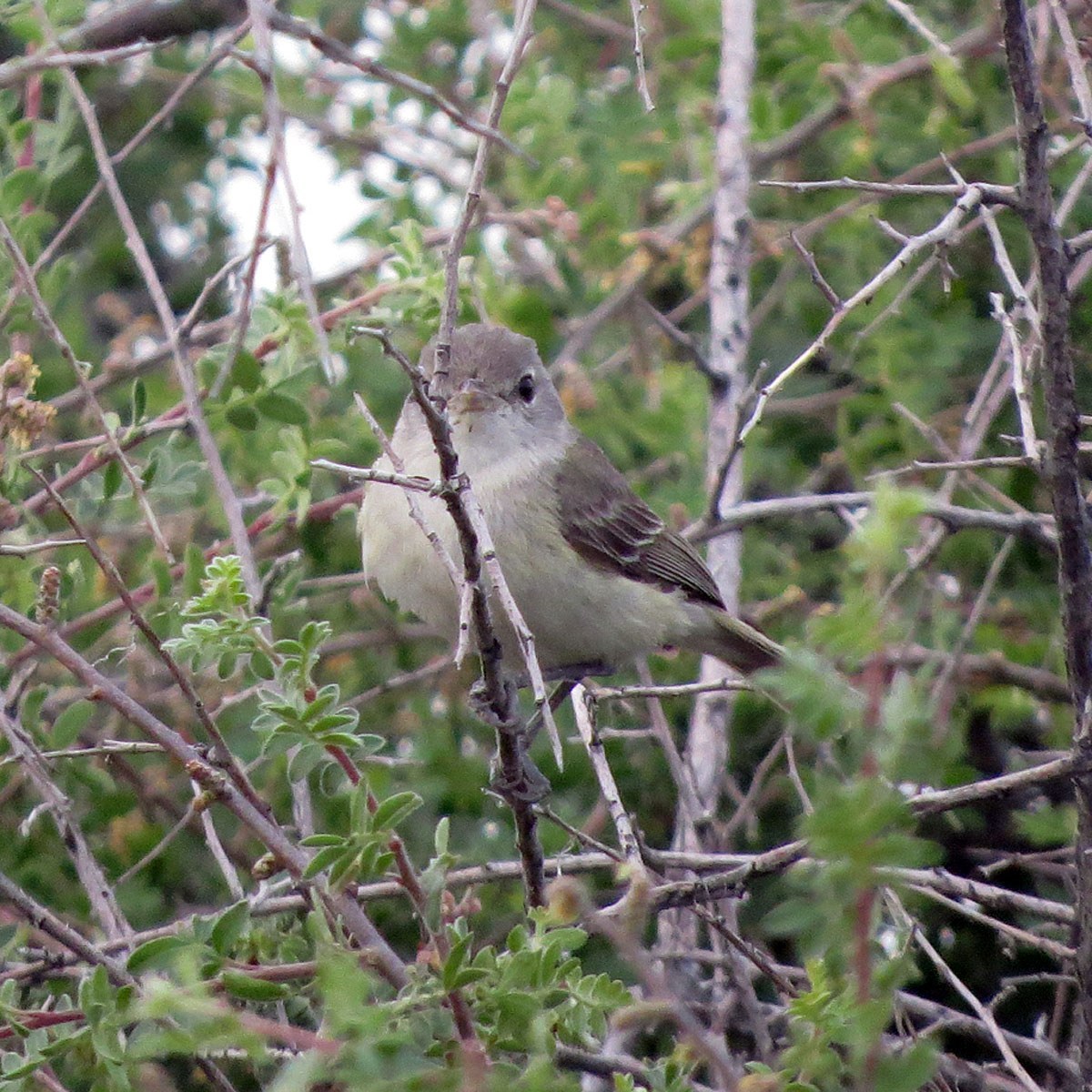
Key Field Marks
- Size & shape: Small vireo (about 11-13 cm), compact and short-tailed relative to other vireos, with a fairly stout, slightly hooked bill typical of the family.
- Plumage: Plain and rather nondescript - grayish-olive above and pale whitish-yellow below, with the underparts often showing a faint wash of pale yellow on the flanks, most noticeable in fresh plumage.
- Face pattern: A subtle, incomplete whitish eye-ring combined with a pale supraloral area gives a 'spectacled' look, though it is far less bold than in some other vireos.
- Wings: Two faint, often indistinct whitish wingbars, with the lower one typically more visible than the upper - useful but subtle when present.
- Behavior: Highly active and restless, constantly moving through dense low vegetation while foraging and often singing persistently, even from within thick cover, making it easier to hear than see.
Similar Species
- White-eyed Vireo: Has a bright yellow spectacle, whiter underparts, bolder white wingbars, and (in adults) a whitish iris; White-eyed Vireo's song is a sharper, more emphatic series compared to Bell's more rambling scratchy song.
- Warbling Vireo: Larger, plainer-faced with no wingbars and no eye-ring, and has a smoother, more musical warbling song quite different from Bell's scratchy delivery.
- Gray Vireo: Grayer overall with minimal yellow wash, longer tail habitually flicked, and found in more arid pinyon-juniper or desert scrub rather than dense riparian thickets.
Where & When to See
- Habitat: Dense low shrubby thickets, willow and mesquite riparian corridors, brushy field edges, and regenerating scrub; strongly tied to thick tangled vegetation near or away from water depending on subspecies and region.
- Range: Breeds across the central and southwestern United States and into Mexico, from the Great Plains and Midwest south through Texas and the Southwest; the southwestern 'least Bell's vireo' subspecies is federally endangered due to riparian habitat loss and cowbird parasitism.
- Season: A neotropical migrant, present in North America mainly from April through September, wintering in Mexico and Central America.
- Best viewing tips: Focus on listening in dense brush during the breeding season; the persistent, scolding song usually reveals a territory long before the bird is glimpsed moving through the thicket.
Voice
- Song is a distinctive, scratchy, run-on jumble of notes often rendered as 'cheedle cheedle chee? cheedle cheedle chew!' with a questioning rise and declarative fall, sung repeatedly and rapidly.
- This chattering, almost argumentative-sounding song is one of the best ways to detect the species, as birds often stay hidden in dense cover.
- Calls include a scolding, harsh chatter given when agitated, especially near the nest or when cowbirds or predators are nearby.
Frequently asked questions
What is the best way to find a Bell's Vireo?
Listen for its distinctive scratchy, run-on song with a rising then falling cadence, often described as sounding like a question followed by an answer, coming from dense low shrubby thickets.
How do I distinguish Bell's Vireo from White-eyed Vireo?
White-eyed Vireo shows a bright yellow spectacle, whiter underparts, and bolder wingbars, while Bell's Vireo is plainer with only a faint partial eye-ring and subtle wingbars.
Why is the least Bell's Vireo considered endangered?
This southwestern subspecies has suffered severe riparian habitat loss and heavy nest parasitism by Brown-headed Cowbirds, leading to its federal endangered status.
Is Bell's Vireo present year-round in the United States?
No, it is a neotropical migrant present roughly from April to September for breeding, then it winters in Mexico and Central America.
Why is Bell's Vireo hard to see even when singing nearby?
It is highly active and stays deep within dense, low, tangled shrub vegetation, so it is usually detected by its persistent song well before it can be visually located.