
Bell's Sparrow Identification Guide
A dry-country sparrow of California and the Great Basin, told from the closely related Sagebrush Sparrow by its darker, grayer plumage, bolder facial pattern, and shrub-hopping behavior.
Read the full Bell's Sparrow encyclopedia entry →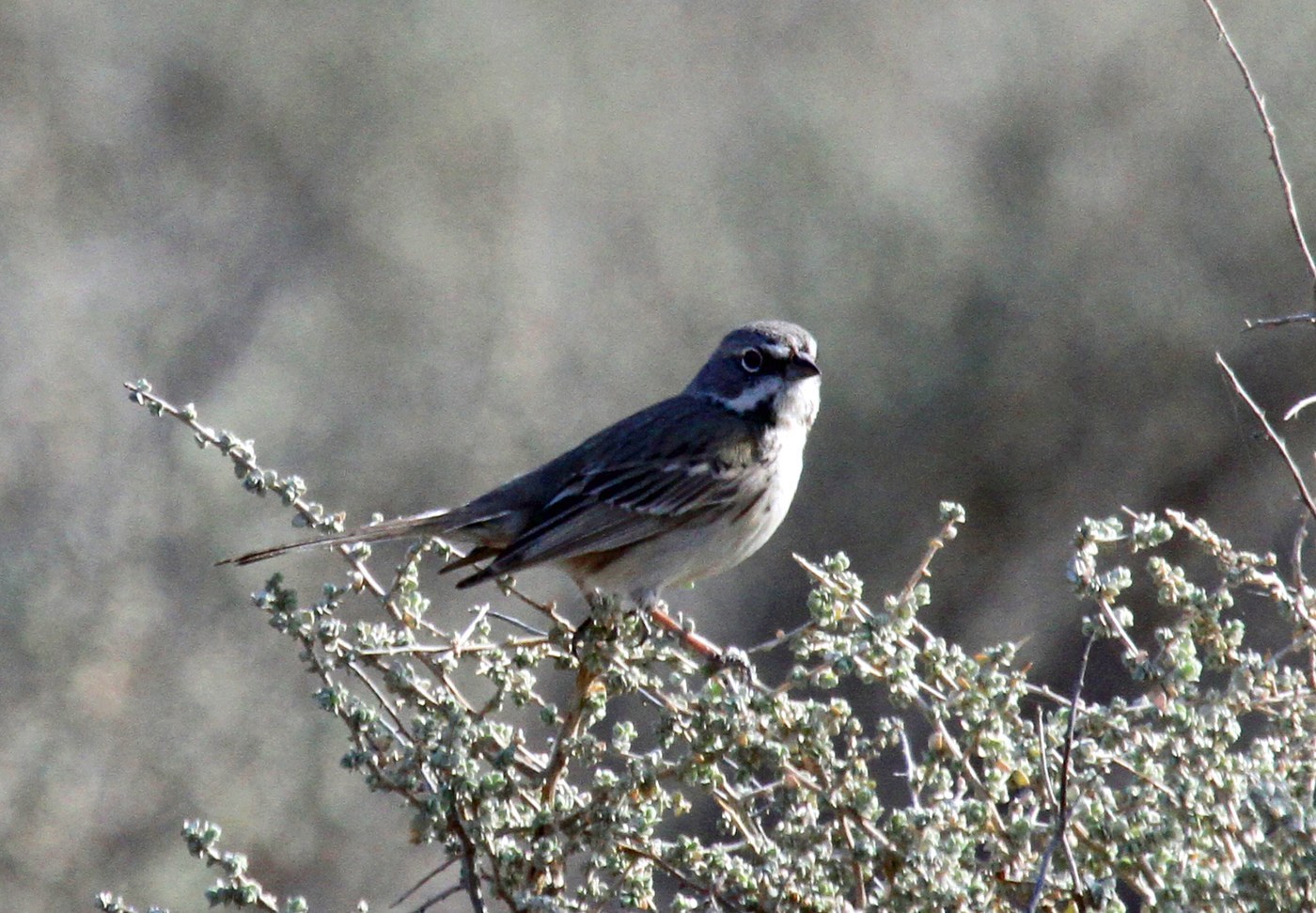
Key Field Marks
- Size & shape: A medium-sized, fairly slim sparrow (about 12-14 cm) with a long tail often held cocked or flicked, a rounded head, and a moderately stout, conical bill.
- Plumage: Overall dark gray-brown upperparts with limited streaking on the back (much reduced compared to many sparrows), a plain unstreaked gray-brown crown, and a distinct dark central breast spot on an otherwise whitish underside.
- Face pattern: Bold facial markings including a dark eye-line, a whitish eye-ring, and a strong dark malar (moustache) stripe bordering a whitish throat - this crisp facial contrast is one of the best marks.
- Bill: Fairly thick-based and conical, dark above and pale below in some subspecies.
- Behavior: Skulking and often runs or hops low through dense shrub cover rather than flying; frequently holds the tail cocked upward, somewhat wren-like. Often perches briefly atop a shrub to sing before dropping back into cover.
Similar Species
- Sagebrush Sparrow: The two were formerly considered one species ('Sage Sparrow') and remain very similar; Sagebrush Sparrow is paler, sandier gray-brown overall, has more distinct back streaking, and a less bold facial pattern with a thinner malar stripe. Range and habitat (sagebrush flats vs. coastal/interior chaparral) are often the most reliable clues.
- Black-throated Sparrow: Has a bold black throat patch and strong white face stripes, quite different from Bell's Sparrow's whitish throat bordered by a dark malar stripe.
- Song Sparrow: Heavily streaked overall with a longer, more rounded tail and streaked flanks, lacking the plain gray-brown back and bold facial contrast of Bell's Sparrow.
Where & When to See
- Habitat: Dense chaparral, coastal sage scrub, and interior scrublands, particularly stands of chamise and other low, dense shrubs in California; some interior populations use saltbush scrub.
- Range: Resident mainly in California, from the Central Valley foothills and Coast Ranges south through Baja California, with some populations in adjacent parts of the Great Basin overlapping former Sage Sparrow range.
- Season: Largely resident, though some interior/higher-elevation populations may move to lower elevations or milder coastal areas in winter.
- Best viewing tips: Walk slowly along the edges of dense chaparral in spring when males are singing from shrub tops; outside the breeding season, birds are far more secretive and best detected by listening for calls from low cover.
Voice
- Song is a bright, varied series of buzzy and tinkling phrases, typically delivered from an exposed shrub perch, faster and more musical than the sparser song of Sagebrush Sparrow.
- Call notes include a sharp 'tsip' or 'chip,' often given as the bird moves furtively through dense cover.
- Song is most frequently heard during the breeding season in spring, providing the best opportunity to locate and confirm this often-secretive species.
Frequently asked questions
How is Bell's Sparrow different from Sagebrush Sparrow?
Bell's Sparrow is darker and grayer with a bolder facial pattern and less back streaking, while Sagebrush Sparrow is paler and sandier with more back streaking; the two were once lumped as 'Sage Sparrow' and habitat/range are often the most reliable clues.
What is the best field mark for Bell's Sparrow?
A dark, mostly unstreaked gray-brown back combined with a bold dark malar stripe framing a whitish throat, plus a habit of cocking its tail, are the most distinctive combination of marks.
Where should I look for Bell's Sparrow?
Search dense chaparral and coastal sage scrub habitats in California, especially chamise-dominated hillsides, walking slowly along shrub edges since the bird tends to stay low and hidden.
Is Bell's Sparrow easy to see?
It can be secretive, often running through cover rather than flying; the best chance to see one well is during spring when males sing from an exposed perch atop a shrub.
Does Bell's Sparrow migrate?
Most populations are resident year-round, though birds from higher or more interior areas may shift to lower elevations or milder habitats outside the breeding season.