
Bean Goose Identification Guide
A large, dark-headed gray goose of the Old World, brown overall with orange or yellow-orange legs and a bill pattern that varies between the two recognized species, Taiga and Tundra Bean Goose.
Read the full Bean Goose encyclopedia entry →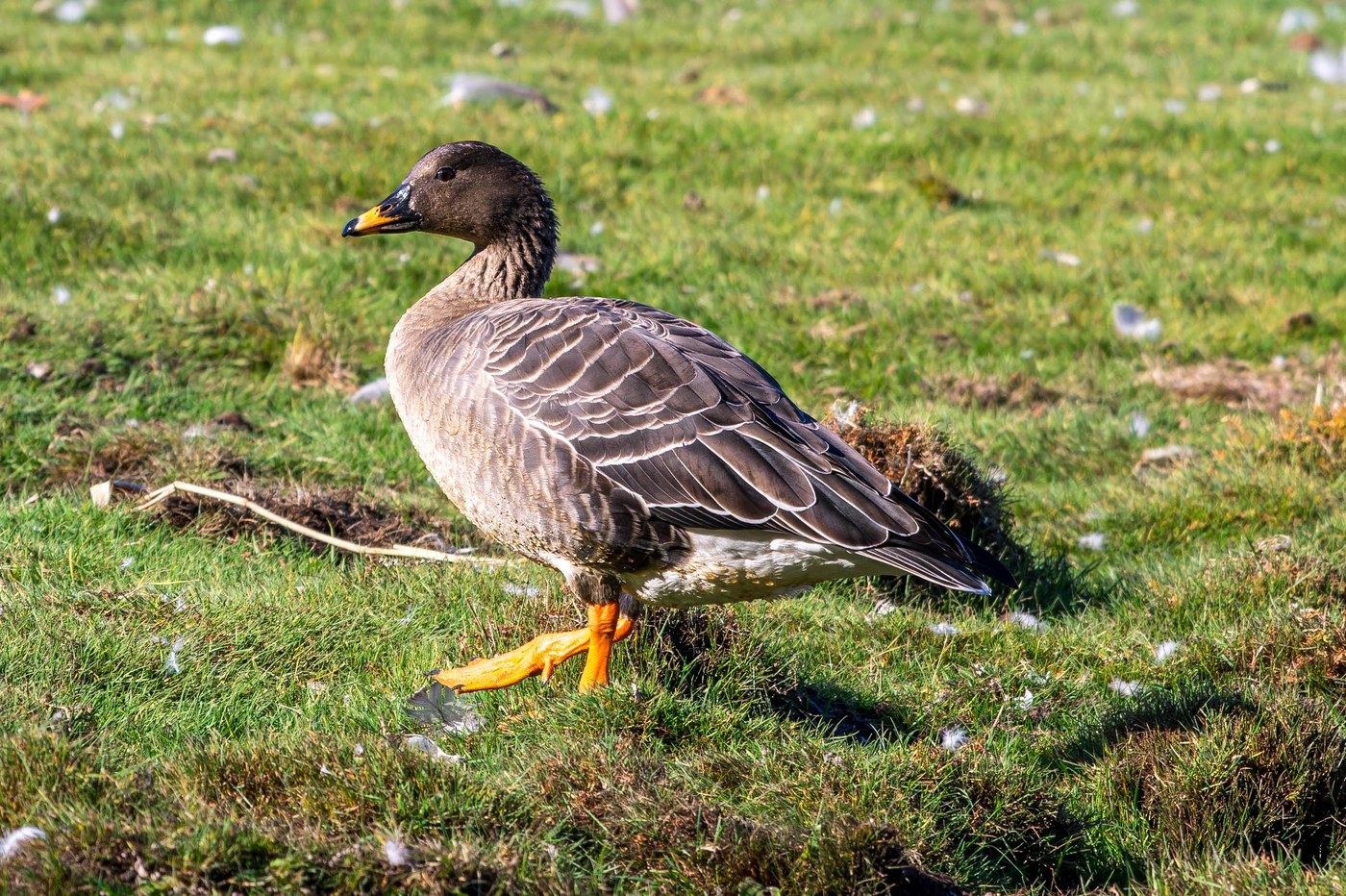
Key Field Marks
- Size & shape: Large goose (66–90 cm depending on subspecies/species), with a fairly long neck; Taiga Bean Goose tends to be larger and longer-necked/longer-billed, while Tundra Bean Goose is smaller, shorter-necked, and shorter-billed with a stubbier bill profile.
- Plumage: Overall dark brown body with paler feather edges giving a scaled look on the back and flanks; head and neck notably darker brown than the body.
- Bill: Black with an orange to yellow-orange band or patch — the exact pattern (extent of orange) varies by subspecies but the black-and-orange combination is distinctive versus the all-dark bill of Brant or the pink bill of Pink-footed Goose.
- Legs: Orange to orange-yellow (a key mark separating it from the pink-legged Pink-footed Goose).
- In flight: Uniformly dark brown wings lacking strong contrast (unlike the pale forewing panel of Greater White-fronted or Pink-footed Goose), giving a rather plain, dark-winged look overall.
Similar Species
- Pink-footed Goose: Has pink (not orange) legs and a mostly pink bill with a black base and tip (rather than the more solidly orange-banded bill of Bean Goose), plus a paler, grayer body and forewing.
- Greater White-fronted Goose: Shows a white band at the base of the bill (absent in Bean Goose) and pink or orange bill, plus dark belly barring in adults — Bean Goose lacks the white facial blaze and belly barring.
- Taiga vs. Tundra Bean Goose: Taiga Bean Goose has a longer neck, larger overall size, and a longer, more wedge-shaped bill with more orange; Tundra Bean Goose is smaller, more compact, with a shorter, stubbier bill showing less orange — these are now generally treated as two separate species.
Habitat & Range
Breeds across the subarctic and Arctic of northern Eurasia — Taiga Bean Goose in boreal forest/taiga zones, Tundra Bean Goose farther north on Arctic tundra. Winters farther south across parts of Europe and East Asia on farmland, grassland, and wetland margins, typically in flocks, sometimes mixed with other gray geese.
Best Time to See
Best found in winter flocks on wintering grounds in temperate Europe and East Asia (autumn through early spring), often grazing on agricultural fields with other goose species; a rare vagrant elsewhere, where careful comparison with similar gray geese is essential.
Voice
A deep, resonant honking, generally lower-pitched than Pink-footed Goose, often given as a two- or three-note "ung-unk" or "kayak-kayak" contact call in flight, especially from flocks in formation.
Frequently asked questions
How do I tell a Bean Goose from a Pink-footed Goose?
Bean Goose has orange (not pink) legs and a black bill with an orange band, versus Pink-footed Goose's pink legs and mostly pink bill with a black base and tip.
What is the difference between Taiga and Tundra Bean Goose?
Taiga Bean Goose is larger with a longer neck and a longer, more wedge-shaped bill showing more orange, while Tundra Bean Goose is smaller and more compact with a shorter, stubbier bill; the two are now usually treated as separate species.
How does Bean Goose differ from Greater White-fronted Goose?
Bean Goose lacks the white facial blaze at the base of the bill and the dark belly barring shown by adult White-fronted Geese.
Where does the Bean Goose breed and winter?
It breeds across subarctic and Arctic northern Eurasia (taiga forest or tundra depending on the species) and winters farther south in temperate Europe and East Asia on farmland and wetlands.