
Bateleur Identification Guide
An unmistakable African eagle with an almost tail-less silhouette, bright red facial skin and legs, and a rocking, acrobatic flight style that gives the species its French name meaning 'tightrope walker.'
Read the full Bateleur encyclopedia entry →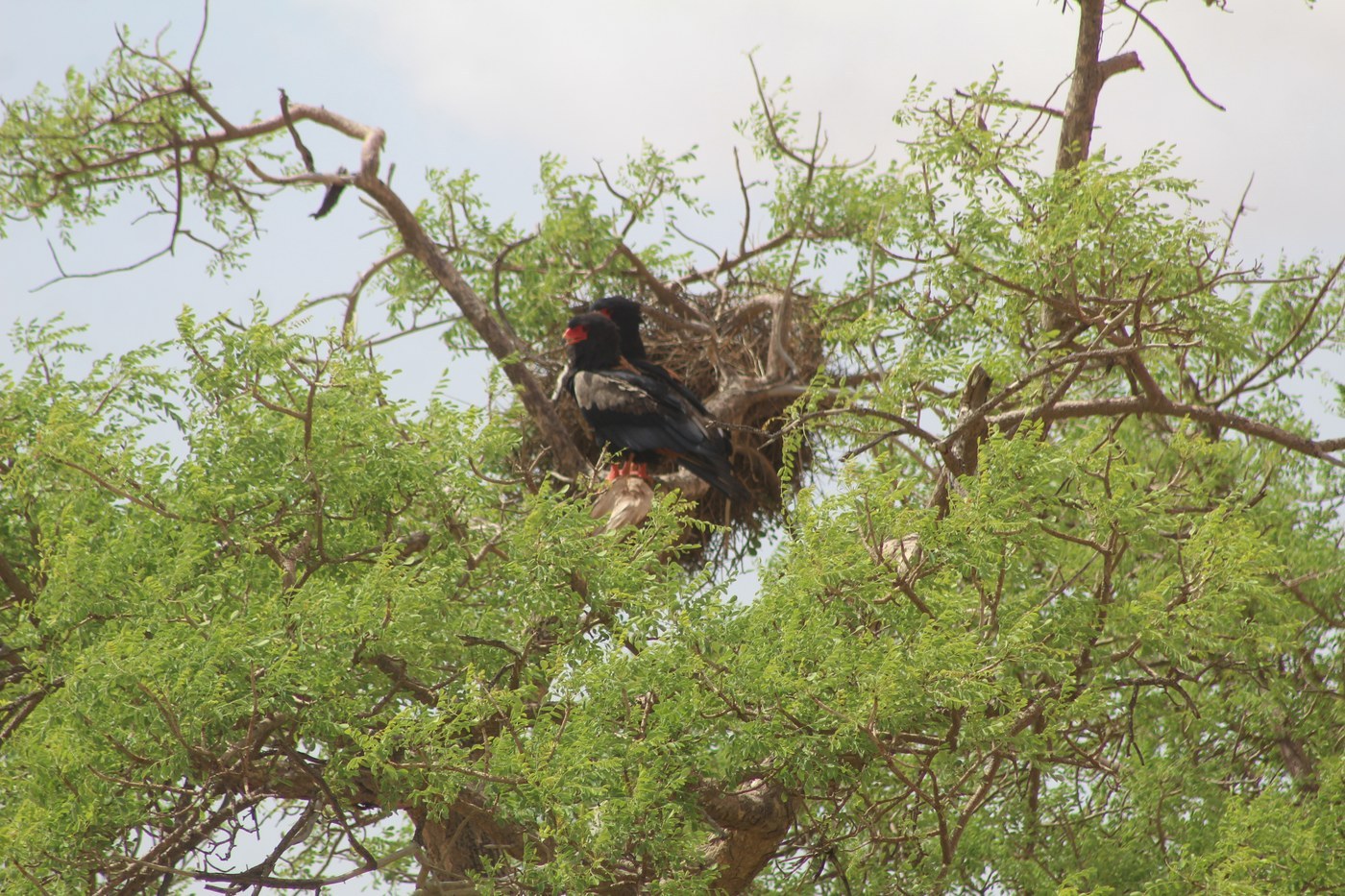
Key Field Marks
- Size & shape: Medium-large eagle (55–70 cm) with an extremely short tail (barely projecting beyond the wingtips at rest) and long, broad wings — the shortest tail relative to body size of any African eagle, producing a distinctive stub-tailed silhouette both perched and in flight.
- Adult plumage: Mostly black with a chestnut-red back and tail (chestnut back also occurs in a rarer pale/buff-backed morph); bare facial skin, legs, and feet are bright red-orange.
- Bill: Hooked, with a bright red-orange cere.
- Juvenile: Entirely brown with a longer-looking tail (since the adult's tail shortens with maturity) and duller, grayish-green facial skin and legs; takes several years to reach full adult plumage.
- Flight: Distinctive "rocking" or "tilting" flight on raised wings held in a shallow V (dihedral), rocking from side to side like a tightrope walker balancing — hence the name; covers huge distances gliding low with minimal flapping, and the stub tail makes the wings appear to extend almost to a point at the rear of the body.
Similar Species
- Martial Eagle: Much larger with a longer tail, spotted underparts, and a shaggy crest — lacks Bateleur's stub tail and rocking flight.
- Snake-eagles (e.g., Black-chested Snake-Eagle): Have proportionally longer tails and lack the red facial/leg skin and rocking flight style.
- Juvenile Bateleur vs. other brown juvenile eagles: Best told by the relatively short (though longer than adult) tail, long wings, and eventual bare facial skin becoming visible with age; behavior (low, rocking glides) is a strong clue even at a distance.
Habitat & Range
Widespread across sub-Saharan Africa in open savanna, woodland, and semi-desert, particularly in protected reserves and national parks; avoids dense forest. Largely resident, though immatures may wander more widely in search of territory.
Best Time to See
Diurnal and often seen year-round in savanna reserves, typically soaring or gliding low over the bush during the day while searching for carrion, snakes, and small prey; most active during the warmer parts of the day when thermals aid its long-distance gliding.
Voice
Generally rather silent away from the nest; when vocal, gives a loud barking "kow-wah" or short guttural yelps, especially during territorial or nest-related interactions.
Frequently asked questions
What makes the Bateleur's flight so distinctive?
It flies with a shallow rocking, side-to-side tilting motion on raised wings — resembling a tightrope walker balancing — combined with an extremely short tail that makes the wings appear to reach almost to the body's rear tip.
How do I tell an adult Bateleur from a juvenile?
Adults are mostly black with a chestnut back/tail, bright red facial skin and legs, and a very short tail; juveniles are uniformly brown with duller grayish facial skin and a proportionally longer tail, gradually acquiring adult features over several years.
Where is the Bateleur found?
Across sub-Saharan Africa in open savanna, woodland, and semi-desert, especially within large protected reserves; it avoids dense forest.
What does the Bateleur eat and how does it hunt?
It forages opportunistically over long gliding flights for carrion, snakes, lizards, and small mammals and birds, using its keen eyesight while covering large territories at low altitude.