
Barred Owl Identification Guide
A large, round-headed woodland owl with soulful dark eyes and brown-and-white barred/streaked plumage, famous for its rhythmic 'who-cooks-for-you' call.
Read the full Barred Owl encyclopedia entry →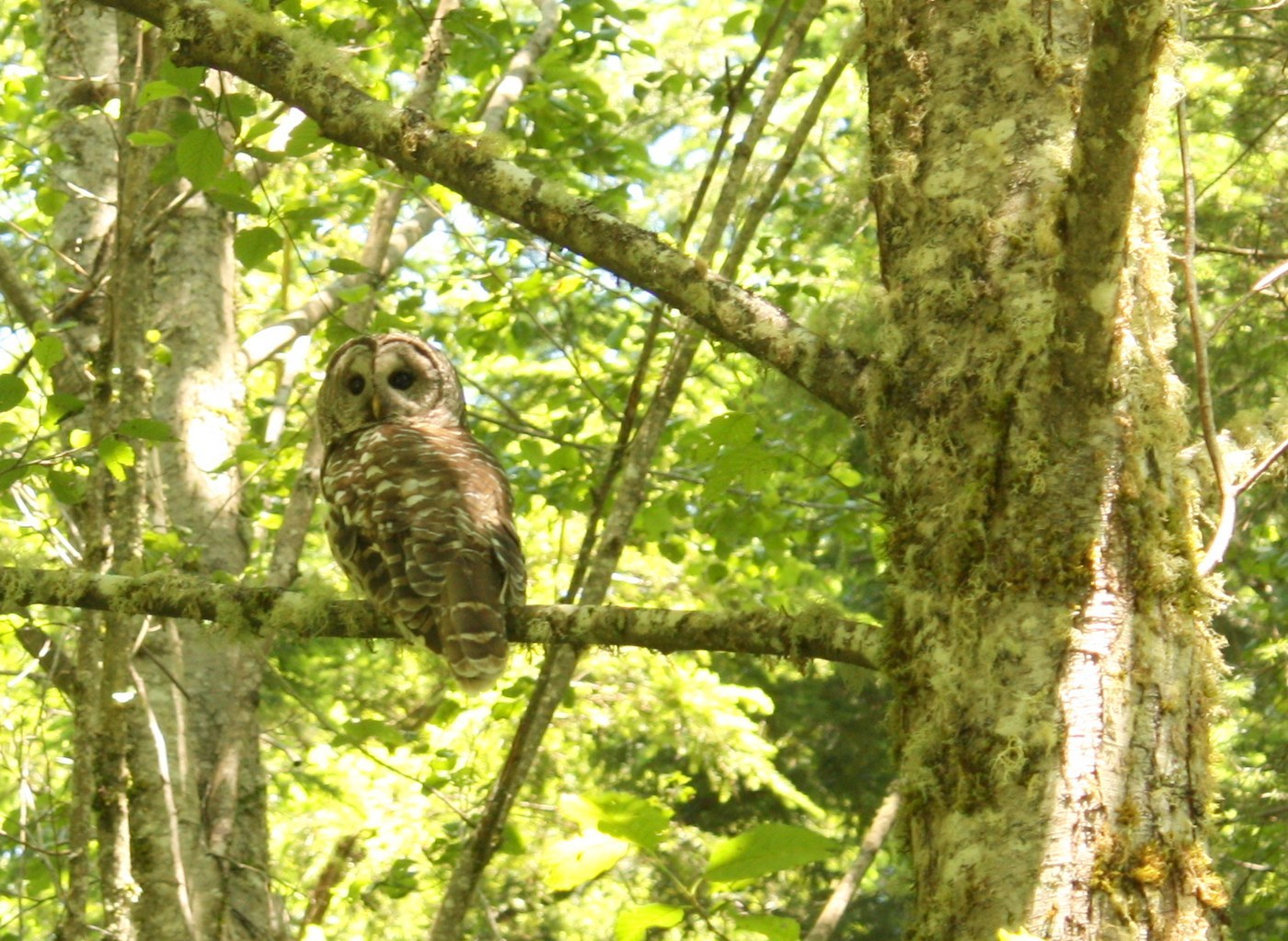
Key Field Marks
- Size & shape: Large owl (43–50 cm, wingspan ~100–125 cm), stocky and round-headed with no ear tufts.
- Eyes: Dark brown to black — distinctive among large North American owls, most of which have yellow eyes.
- Plumage pattern: Brown and white horizontal barring across the upper breast and neck, transitioning to bold vertical brown streaking on the belly and flanks.
- Facial disc: Pale gray-brown, rounded, without ear tufts, framed by fine dark concentric rings.
- Bill: Small, yellowish, mostly hidden by facial feathers.
- Behavior: Roosts close to the trunk in dense foliage during the day; often approachable and can be located by mobbing songbirds or crows.
Similar Species
- Great Horned Owl: Has prominent ear tufts and yellow eyes; Barred Owl lacks tufts entirely and has dark eyes.
- Spotted Owl: Very similar structurally and both lack ear tufts, but Spotted Owl has dark eyes too — separated by pattern (Spotted Owl shows rounded white spots overall rather than the Barred Owl's horizontal breast barring and vertical belly streaking) and by range (Spotted Owl restricted to old-growth forests of the western US, limited overlap where Barred Owl has expanded and hybridizes rarely).
- Great Gray Owl: Much larger with a huge facial disc, yellow eyes, and no barring pattern like Barred Owl's.
Habitat & Range
Native to mature deciduous and mixed forests, especially near swamps, rivers, and wetlands, across eastern North America; has expanded significantly westward through Canada into the Pacific Northwest and California over the past century, now overlapping and competing with the threatened Spotted Owl. Non-migratory and highly territorial year-round.
Best Time to See
Active mainly at night but often calls and can be seen at dusk, dawn, and even midday, especially on overcast days; year-round resident, so no strong seasonal pattern, though calling activity often increases in late winter during courtship.
Voice
The classic mnemonic "Who cooks for you? Who cooks for you all?" — a rhythmic series of 8–9 hooting notes; also gives a wide range of other sounds including caterwauling, gurgles, barks, and duetting pairs calling back and forth, especially at dusk.
Frequently asked questions
How do I tell a Barred Owl from a Great Horned Owl?
Barred Owl has no ear tufts and dark brown eyes, while Great Horned Owl has prominent ear tufts and yellow eyes.
What does the Barred Owl's call sound like?
Its classic call is rendered as 'Who cooks for you? Who cooks for you all?' — a rhythmic 8-9 note hooting series, though it also makes many other sounds including caterwauling.
How is Barred Owl different from Spotted Owl?
Both lack ear tufts and have dark eyes, but Barred Owl shows horizontal barring on the breast and vertical streaking on the belly, while Spotted Owl has more uniform rounded white spotting; ranges differ, with Barred Owl now expanding into Spotted Owl range in the Pacific Northwest.
What habitat does the Barred Owl prefer?
Mature deciduous and mixed forests, especially near swamps, rivers, and other wetlands, across eastern North America and increasingly the Pacific Northwest.