
Barnacle Goose Identification Guide
A small, boldly patterned goose with a black neck and breast, white face, and gray-and-black barred back, breeding in the Arctic and wintering in tight, noisy flocks.
Read the full Barnacle Goose encyclopedia entry →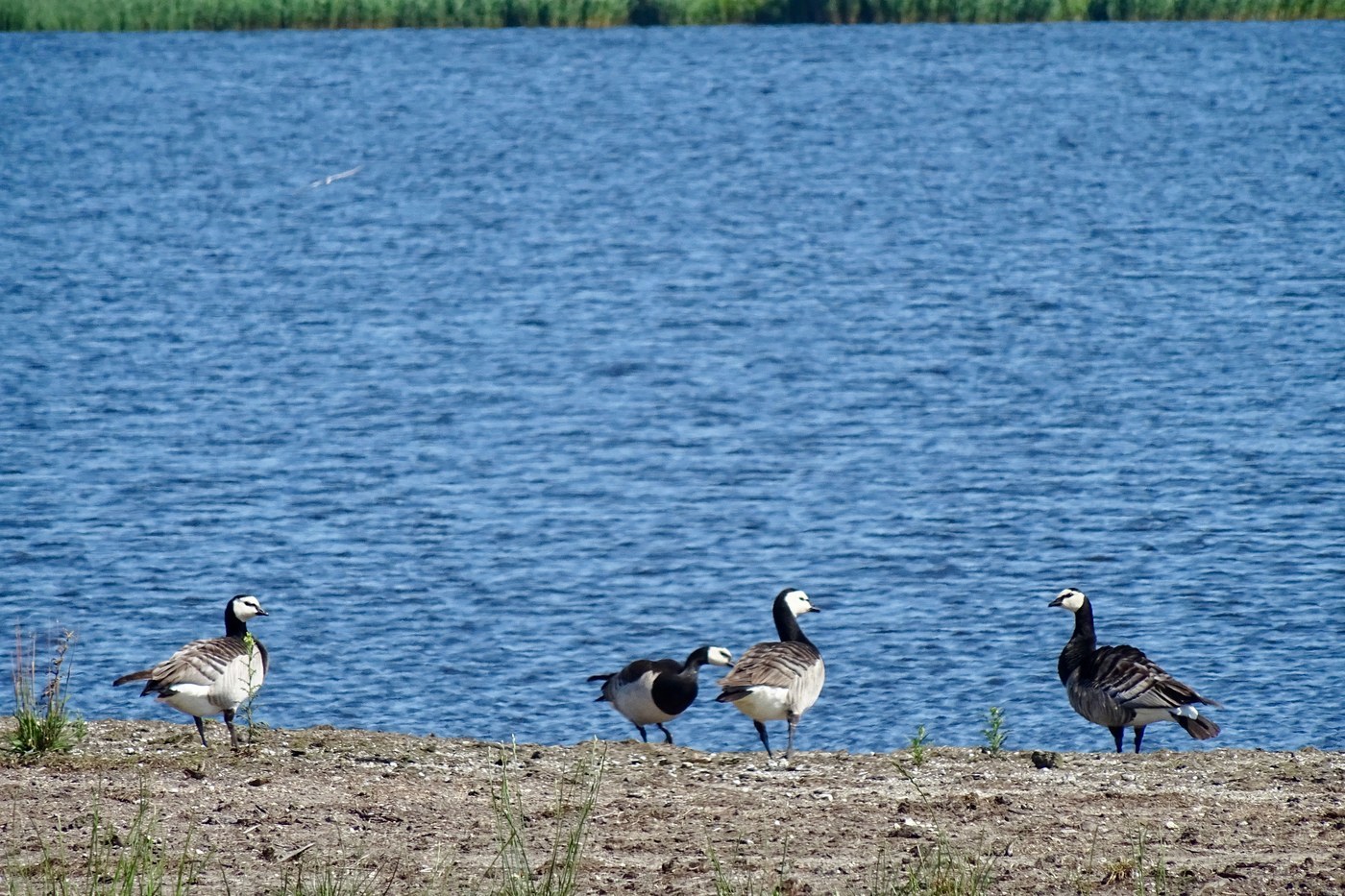
Key Field Marks
- Size & shape: Small, compact goose (58–70 cm) with a short bill and stocky build — noticeably smaller than a Canada Goose.
- Head & neck: Black crown, nape, neck, and breast contrasting sharply with a clean white face (extending onto the forehead and cheeks) — the black-and-white "harlequin" head pattern is diagnostic.
- Body: Pale silvery-gray back and flanks finely barred with black and white, giving a scaly, "barred" look; black bill, tail, and undertail coverts; whitish belly.
- Legs: Black.
- Flight: Flies in tight, fast-moving flocks, often in lines or loose V's, showing a strongly barred gray back and black neck/breast contrasting with the white face and pale body.
Similar Species
- Canada Goose: Much larger with a long black neck, white chinstrap (not full white face), and brown (not barred gray) body — easily separated by size and neck pattern.
- Brant (Brent Goose): All-dark goose with a small white neck-flare mark (not a full white face), dark breast extending onto the belly, and lacks the barred gray back.
- Cackling Goose: Small like Barnacle Goose but has the Canada Goose head/neck pattern (black neck with white chinstrap), not a white face.
Habitat & Range
Breeds on Arctic cliffs and tundra in Greenland, Svalbard, and northern Russia; winters in large flocks on coastal grasslands, salt marshes, and estuaries in northwestern Europe (especially the UK, Ireland, and the Netherlands). A rare but regular vagrant elsewhere, sometimes appearing with Canada Goose flocks in North America (origin of some individuals may be uncertain due to captive populations).
Best Time to See
Best looked for in large wintering flocks from late fall through early spring on coastal pastures and estuarine grasslands; breeding birds are seen on remote Arctic cliffs in summer.
Voice
A high-pitched, yapping, almost dog-like or tern-like "kaw-kaw-kaw" or barking call, higher and more clipped than the deep honk of a Canada Goose; flocks in flight are notably noisy with constant chattering barks.
Frequently asked questions
How do I tell a Barnacle Goose from a Canada Goose?
Barnacle Goose is smaller with an entirely white face and black crown/neck/breast, while Canada Goose has a mostly black head with only a white chinstrap and a brown body.
What does the Barnacle Goose's back look like?
The back and flanks are pale silvery-gray finely barred with black, giving a distinctive scaly or barred pattern unlike the plain brown back of a Canada Goose.
Where can I see Barnacle Geese?
Large wintering flocks gather on coastal grasslands and salt marshes in northwestern Europe (UK, Ireland, Netherlands); they breed on Arctic cliffs in Greenland, Svalbard, and northern Russia.
What does a Barnacle Goose sound like?
It gives a high, yapping, dog-like bark, quite different and higher-pitched than the deep honking of a Canada Goose.