
Bar-tailed Godwit Identification Guide
A long-billed migratory shorebird famous for record nonstop flights, separated from Black-tailed Godwit by its barred tail and lack of a bold wing stripe.
Read the full Bar-tailed Godwit encyclopedia entry →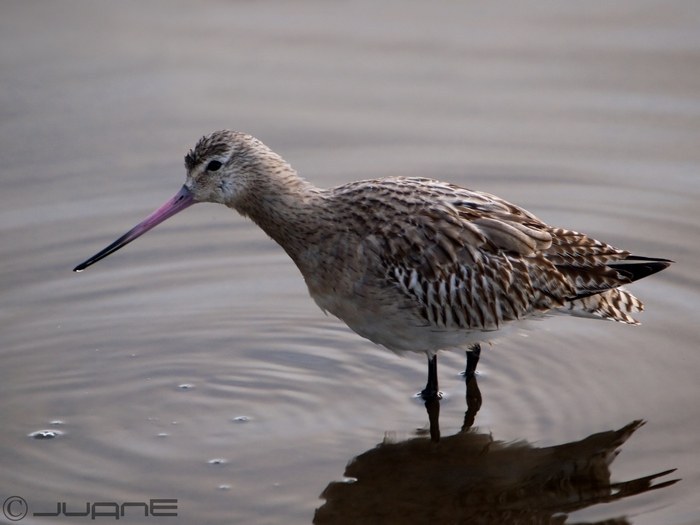
Key Field Marks
- Size & shape: A large shorebird (37–41 cm) with a long, slightly upturned bill and relatively short legs for a godwit — the legs barely extend beyond the tail tip in flight, unlike the longer-legged Black-tailed Godwit.
- Breeding plumage: Males become deep brick-orange to chestnut-red on the head, neck, and underparts; females show a paler, more muted version of the same rufous tone and are noticeably larger with longer bills.
- Nonbreeding plumage: Plain grayish-brown above and dull whitish below with light streaking on the breast — much less patterned than many other shorebirds.
- Bill: Long, subtly upcurved, pink-based with a dark tip — the upward curve is more subtle than in Marbled Godwit and less pronounced than an avocet's.
- In flight: Shows a finely barred tail (rather than a bold black band) and lacks the broad white wing stripe of Black-tailed Godwit, showing instead plain brownish wings with a white rump/lower back wedge.
Similar Species
- Black-tailed Godwit: In flight shows a bold white wing stripe and a sharply defined black tail band on a white tail base — both features absent in Bar-tailed Godwit, which shows plain wings and a finely barred tail. Black-tailed Godwit also has longer legs that project well beyond the tail in flight.
- Marbled Godwit: Warmer, more heavily mottled buff-brown plumage overall and a bicolored (pink-and-black) bill, found mainly in the Americas where Bar-tailed Godwit is a rare vagrant.
- Hudsonian Godwit: Darker overall with a bold black underwing and white wing stripe, unlike Bar-tailed's plain wings.
Where & When to See It
- Breeds on Arctic tundra across northern Scandinavia, Russia, and Alaska.
- Winters on coastal mudflats and estuaries across a huge range spanning Western Europe, Africa, South and Southeast Asia, Australia, and New Zealand, depending on breeding population.
- One population (breeding in Alaska, wintering in New Zealand) holds the record for the longest known nonstop bird migration, flying directly across the Pacific Ocean for over 11,000 km without stopping.
- Look for it on tidal flats, estuaries, and sandy or muddy coastlines, often probing deeply in soft mud or sand for invertebrates.
Voice
- Calls include a sharp, nasal "kirruc" or "kip-kip" given in flight and on the ground; generally quieter than the more vocal Black-tailed Godwit outside the breeding season.
Frequently asked questions
How do you tell Bar-tailed Godwit from Black-tailed Godwit in flight?
Bar-tailed Godwit shows plain brownish wings and a finely barred tail, while Black-tailed Godwit shows a bold white wing stripe and a sharply defined black tail band — Black-tailed's legs also project further beyond the tail.
Why is the Bar-tailed Godwit famous for migration?
One population that breeds in Alaska and winters in New Zealand is known to make the longest recorded nonstop flight of any bird, crossing the Pacific Ocean for more than 11,000 kilometers without landing.
What does a breeding male Bar-tailed Godwit look like?
It develops deep brick-orange to chestnut-red plumage on the head, neck, and underparts, considerably richer in color than the paler breeding females.
Where can you see Bar-tailed Godwits in winter?
They winter on coastal mudflats and estuaries across a wide range including Western Europe, Africa, South and Southeast Asia, Australia, and New Zealand, depending on the breeding population.