
Bar-headed Goose Identification Guide
A pale gray goose famous for its high-altitude Himalayan migration, identified by two bold black bars across the back of its white head.
Read the full Bar-headed Goose encyclopedia entry →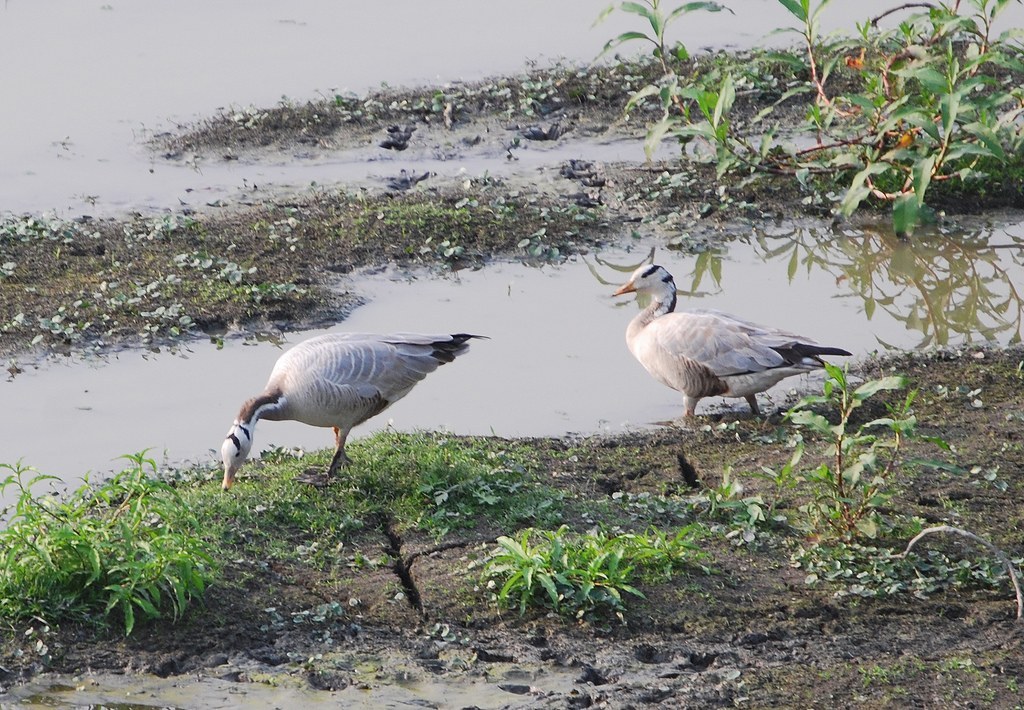
Key Field Marks
- Size & shape: A medium-sized goose (71–76 cm) with a pale, slender build and a relatively short neck for a goose of its size.
- Head: Predominantly white head crossed by two distinctive black bars — one across the crown/nape and one lower on the hindneck — a pattern unique among geese.
- Body: Pale, silvery gray overall, palest on the head and neck sides, with a darker gray back and a thin white stripe running down the side of the neck.
- Bill & legs: Orange-yellow bill with a black nail (tip); orange-yellow legs and feet.
- In flight: Pale gray wings appear almost silvery, with the head bars remaining visible at a distance.
Similar Species
- Greylag Goose: Overall pale gray as well, but lacks the black head bars entirely, has a heavier orange or pink bill without a strong black tip pattern, and lacks the neck stripe.
- Snow Goose: White-morph birds can suggest a pale goose at a distance, but Snow Goose has black wingtips (not visible on a folded wing at rest) and lacks the head bars; ranges rarely overlap.
Behavior & Notable Biology
- Renowned for migrating directly over or very near the Himalayas between breeding and wintering grounds, flying at extreme altitudes — among the highest-altitude flights documented for any bird — aided by physiological adaptations for oxygen use in thin air.
- Highly social, forming large flocks on lakes, rivers, and agricultural fields, especially in winter.
- Grazes on grasses, grain, and other vegetation, often feeding in fields adjacent to wetlands.
Where & When to See It
- Breeds on high-altitude lakes and wetlands of the Central Asian plateau, including Mongolia, western China, and the Tibetan Plateau.
- Winters mainly on wetlands, lakes, and reservoirs of the Indian subcontinent, from Pakistan and northern India south to parts of peninsular India and Myanmar.
- Passage migrants may be seen crossing high mountain passes in autumn and spring during the famous Himalayan crossing.
Voice
- A nasal, honking call typical of geese, generally described as slightly higher-pitched and more clipped than the calls of Greylag Goose.
Frequently asked questions
What is the most distinctive field mark of the Bar-headed Goose?
Two bold black bars crossing an otherwise white head — one over the crown and one lower on the hindneck — are unique to this species among geese.
Why is the Bar-headed Goose famous?
It is renowned for migrating at extremely high altitudes over or near the Himalayas, among the highest-altitude flights recorded for any bird, aided by physiological adaptations that allow it to function in low-oxygen conditions.
Where does the Bar-headed Goose spend the winter?
It winters mainly on lakes, rivers, and wetlands across the Indian subcontinent, including northern and peninsular India, Pakistan, and Myanmar.
How is Bar-headed Goose different from Greylag Goose?
Bar-headed Goose has the diagnostic black head bars and a thin white neck stripe, which Greylag Goose entirely lacks; Greylag also has a heavier, differently colored bill.