
Bank Swallow Identification Guide
The smallest North American swallow, identified by its plain brown upperparts and a crisp brown breast band across otherwise white underparts.
Read the full Bank Swallow encyclopedia entry →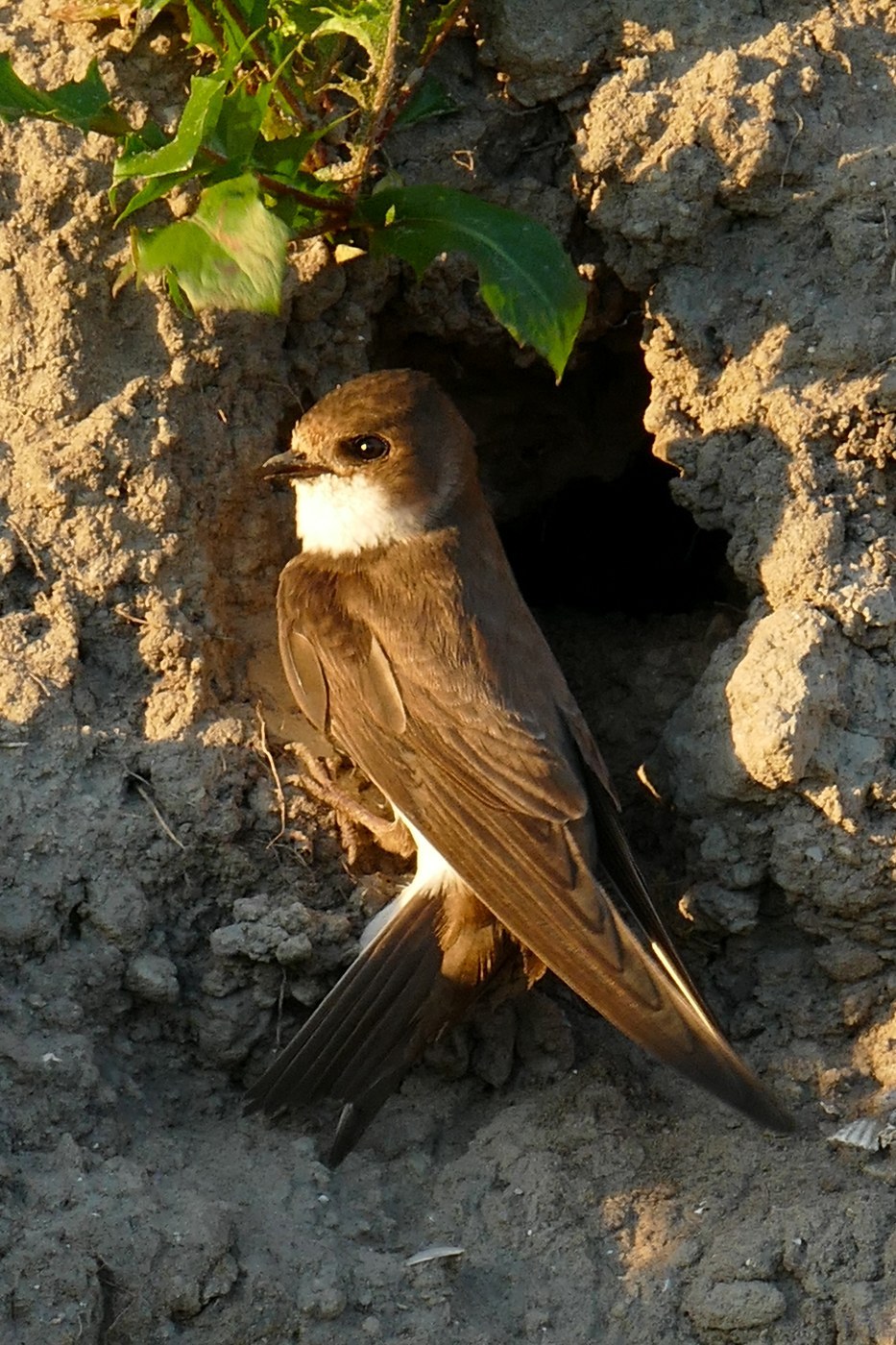
Key Field Marks
- Size & shape: The smallest swallow in North America (about 12 cm), with a slim body, narrow pointed wings, and a slightly notched tail.
- Upperparts: Uniform plain brown from crown to rump, with no gloss or iridescence.
- Underparts: White throat and belly interrupted by a distinct, well-defined brown breast band that extends as a thin line down the center of the breast in many individuals — the single best field mark.
- Flight: Quick, fluttery, and somewhat erratic wingbeats compared to the smoother glides of larger swallows; often flies low over water or open ground.
Similar Species
- Northern Rough-winged Swallow: Similar plain brown upperparts, but underparts show a diffuse, smudgy brownish wash across the throat and upper breast rather than a sharply defined band, and it lacks the crisp white throat contrast of Bank Swallow.
- Tree Swallow (immature): Shows a duller brownish breast band-like smudge in some immatures, but Tree Swallow is larger, with a more solid white below and glossy blue-green (not plain brown) upperparts in adults.
Behavior
- Highly colonial, nesting in dense colonies of burrows excavated into vertical sandy or earthen banks, cliffs, and quarry faces, often numbering dozens to hundreds of nest holes.
- Feeds on flying insects caught on the wing, typically foraging low over water, wetlands, and open fields near the nesting colony.
- Gregarious outside the breeding season too, forming large pre-migratory flocks.
Where & When to See It
- Breeds across much of North America, Europe, and Asia (called Sand Martin in the Old World) wherever suitable eroding banks, bluffs, or artificial sand/gravel pit faces occur near water.
- A long-distance migrant; North American breeders winter mainly in South America, and birds are typically present on breeding grounds from spring through late summer.
- Look for colonies along river bluffs, coastal cliffs, and sand or gravel quarries during the breeding season.
Voice
- A dry, harsh, buzzy twittering and chattering, often given in a constant low chatter around the colony; flight call is a short, rough "brrt" or "tschrrp."
Frequently asked questions
What is the main field mark of a Bank Swallow?
A crisp, well-defined brown breast band across an otherwise white throat and belly, combined with plain brown (not glossy) upperparts, distinguishes it from other small swallows.
How do you tell a Bank Swallow from a Northern Rough-winged Swallow?
Bank Swallow has a sharply defined brown breast band on a white throat, while Northern Rough-winged Swallow has a diffuse, smudgy brownish wash across the throat with no crisp band.
Where does the Bank Swallow nest?
It nests colonially in burrows it excavates into vertical sandy or earthen banks, river bluffs, coastal cliffs, or artificial sand and gravel pit faces.
Is Bank Swallow the same bird as the Sand Martin?
Yes, Bank Swallow and Sand Martin are the same species; Sand Martin is simply the name used in Europe, Asia, and Africa, where Bank Swallow is the North American name.