
Band-tailed Pigeon Identification Guide
A large western pigeon told from the Rock Pigeon by its white nape crescent, yellow bill, and pale terminal tail band.
Read the full Band-tailed Pigeon encyclopedia entry →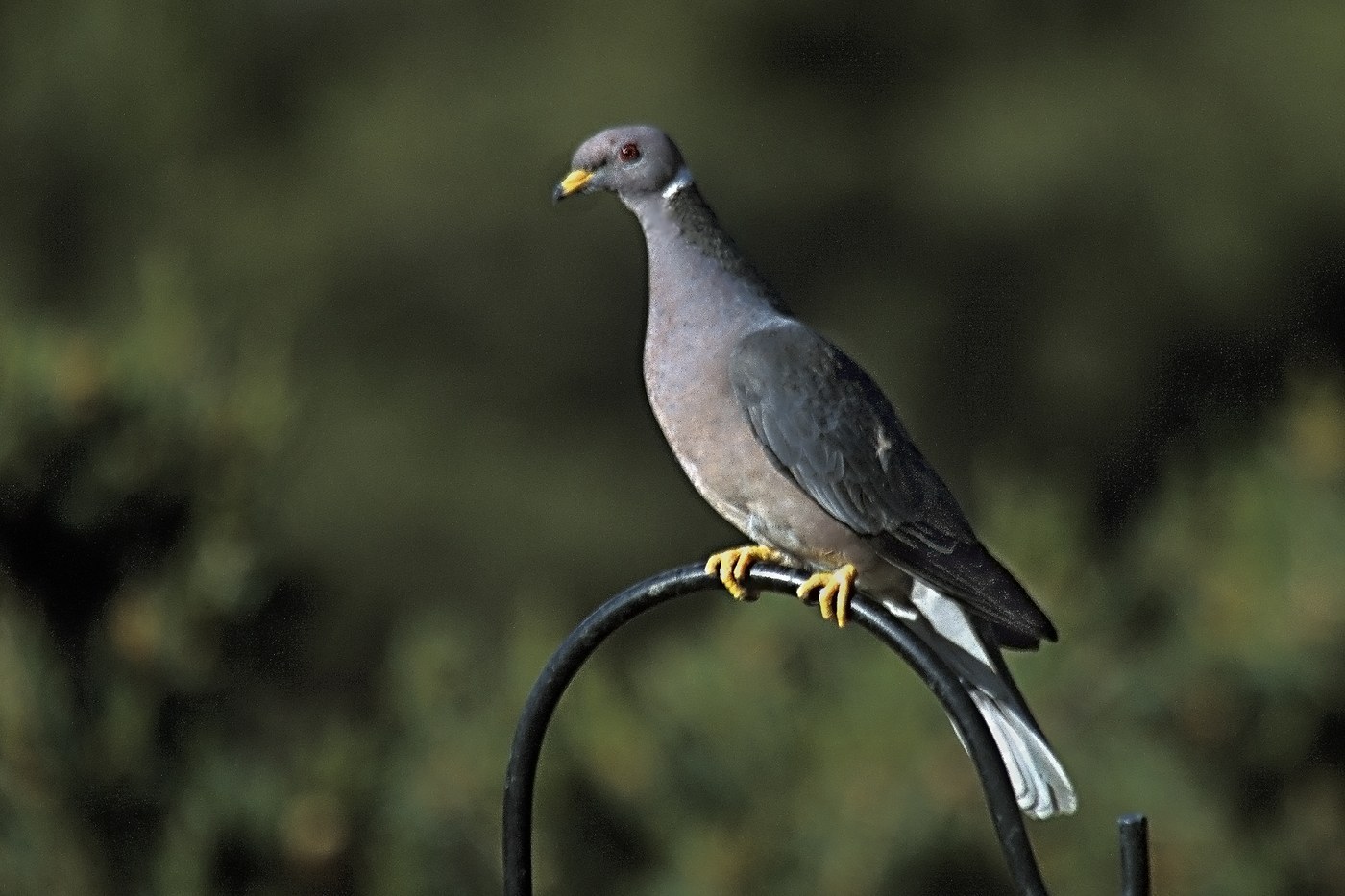
Key Field Marks
- Size & shape: A large, plump pigeon (33–38 cm), noticeably bigger and longer-tailed than a Rock Pigeon/street pigeon, with a small head and a long, broad tail.
- Head & neck: Purplish-pink head and breast; a crisp, thin white crescent across the back of the neck (nape), above an iridescent, bronzy-green patch on the hindneck.
- Bill & legs: Bright yellow bill with a black tip; yellow legs and feet — a useful mark at any distance.
- Body: Plain grayish body overall, without the varied patchwork of colors typical of feral Rock Pigeons.
- Tail: In flight, shows a pale gray band across the tip of an otherwise darker tail — the source of the species' name, best seen from below or as the bird flares its tail.
Similar Species
- Rock Pigeon (feral/street pigeon): Smaller, shorter-tailed, and highly variable in plumage (grays, whites, browns, iridescent patches) but never shows the clean white nape crescent, yellow bill, or pale tail band of Band-tailed Pigeon.
- Mourning Dove: Much smaller and slimmer with a long pointed (not broad, banded) tail edged in white spots, and lacks the yellow bill.
Where & When to See It
- Found along the Pacific coast and interior mountains of western North America, from British Columbia south through the western U.S. into Mexico and Central America, with a separate population in the southern Rockies/Southwest.
- Favors coniferous and mixed oak-conifer forests, especially where oaks (for acorns) or fruiting trees are present; often seen in flocks feeding in treetops or visiting mineral springs.
- Northern and high-elevation populations migrate south for winter; coastal populations, especially in California, are largely resident.
Voice
- A deep, resonant, owl-like hooting, often given as a repeated two- or three-syllable "whoo-whoo" or "who, who-whoo," audible from a considerable distance and easily mistaken for an owl by inexperienced listeners.
Frequently asked questions
How do you tell a Band-tailed Pigeon from a common city pigeon?
Band-tailed Pigeon is larger with a plain grayish body, a bright yellow bill, yellow legs, and a distinctive thin white crescent on the back of the neck — features never shown by the highly variable feral Rock Pigeon.
Why is it called a Band-tailed Pigeon?
In flight it shows a pale gray band across the tip of the tail, contrasting with a darker tail base, which gives the species its name.
What does a Band-tailed Pigeon sound like?
It gives a deep, resonant hooting call reminiscent of an owl, often a repeated two-note "whoo-whoo" that carries well through forest.
What habitat does the Band-tailed Pigeon prefer?
It favors coniferous and oak woodlands in the mountains and along the Pacific coast of western North America, often feeding on acorns, berries, and other tree fruits.