
Bananaquit Identification Guide
A small, active tropical nectar-feeder identified by its curved bill, bold white eyebrow stripe, and bright yellow underparts.
Read the full Bananaquit encyclopedia entry →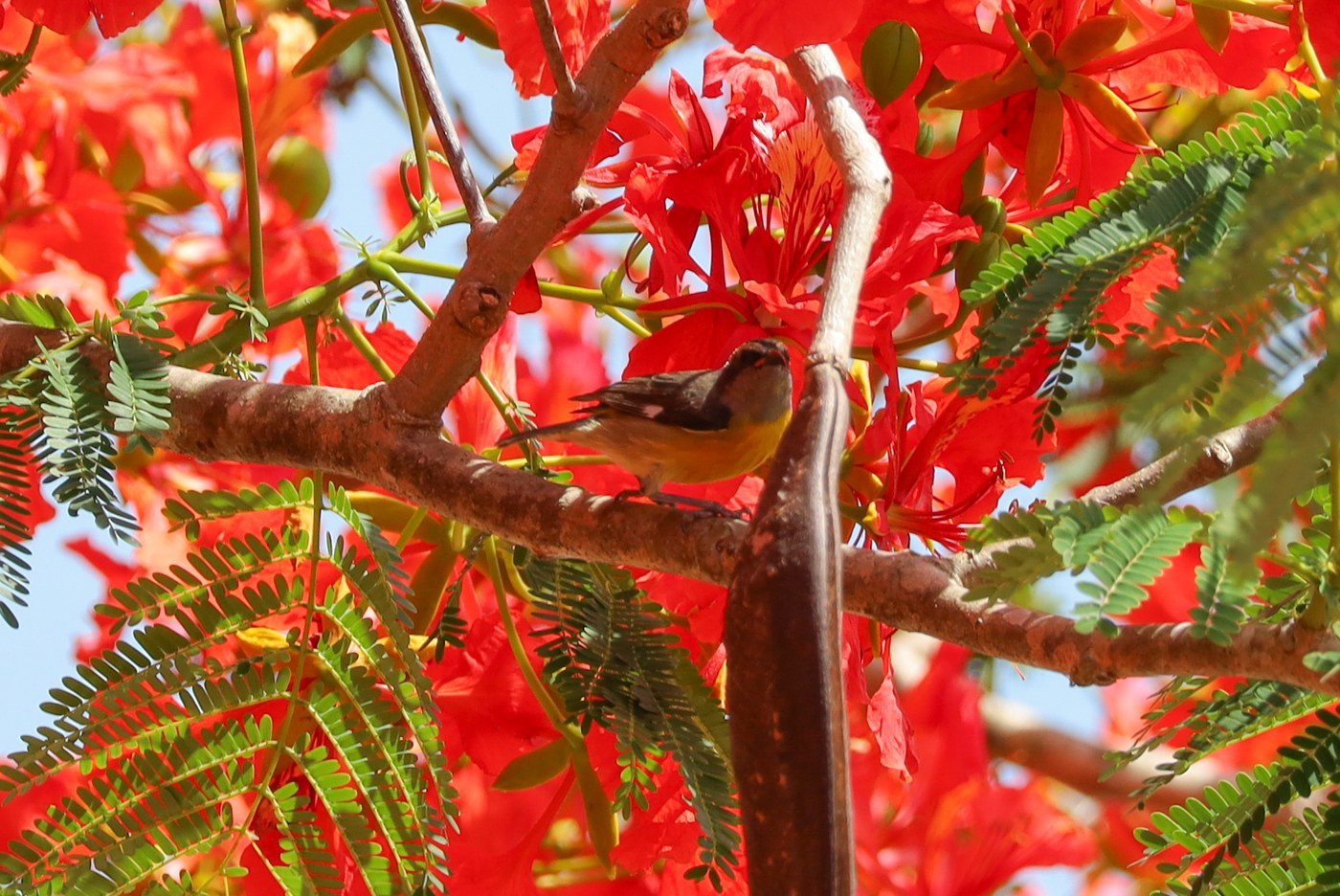
Key Field Marks
- Size & shape: Tiny and compact (about 10–11 cm), constantly on the move, with a short tail and a thin, distinctly downcurved bill adapted for piercing flowers to reach nectar.
- Head: Blackish-gray crown and face broken by a bold, bright white supercilium (eyebrow stripe) running from the bill over the eye — the single most useful field mark.
- Underparts: Bright yellow breast and belly, brightest on the chest.
- Upperparts: Gray to blackish-olive back; a small white patch at the base of the primaries is often visible on the folded wing.
- Throat: Grayish, contrasting subtly with the yellow breast below.
- Some populations (e.g., on certain Caribbean islands) show an all-black or melanistic morph lacking the typical yellow and white pattern.
Behavior
- Extremely active and acrobatic, often hanging upside-down or clinging at odd angles to probe flowers for nectar; also takes small insects and visits fruit and sugar-water feeders readily.
- Builds a distinctive globular, domed nest with a side entrance, often used for roosting as well as breeding.
- Frequently seen alone or in pairs, rarely in large flocks, and often quite tame around people in gardens and resorts.
Similar Species
- Few songbirds share its range that closely resemble it; various warblers and euphonias in the Neotropics are yellow below but lack the Bananaquit's combination of a curved bill and bold white eyebrow stripe.
- The black morph found on some islands can be confused with other small dark birds, but the curved bill and characteristic hyperactive foraging behavior remain useful clues.
Where & When to See It
- Widespread and common resident of the Caribbean, and Central and South America, found from sea level to mid-elevation in gardens, forest edges, scrub, and mangroves.
- Non-migratory; present year-round throughout its range.
- One of the most frequently encountered songbirds for visitors to the Caribbean, often coming readily to hummingbird feeders and sugar bowls.
Voice
- A thin, high-pitched, buzzy and wheezy song, often a rapid jumble of insect-like notes and trills, quite unmusical compared to many songbirds; call notes are sharp, high "tsip" notes.
Frequently asked questions
What is the easiest way to identify a Bananaquit?
Look for a small, active bird with a thin downcurved bill, a bold white eyebrow stripe on a dark face, and bright yellow underparts.
Are all Bananaquits yellow and gray?
Most are, but some island populations include an all-black melanistic morph that lacks the typical yellow and white pattern, so behavior and bill shape become the key clues in those areas.
What does a Bananaquit eat?
It feeds mainly on flower nectar using its curved bill, supplemented with small insects and soft fruit, and it readily visits sugar-water and fruit feeders.
Does the Bananaquit migrate?
No, it is a non-migratory, year-round resident throughout its Caribbean, Central American, and South American range.