
Baltimore Oriole Identification Guide
A flame-orange and black songbird of eastern deciduous woodlands, told from similar orioles by its solid black hood and orange (not chestnut) underparts.
Read the full Baltimore Oriole encyclopedia entry →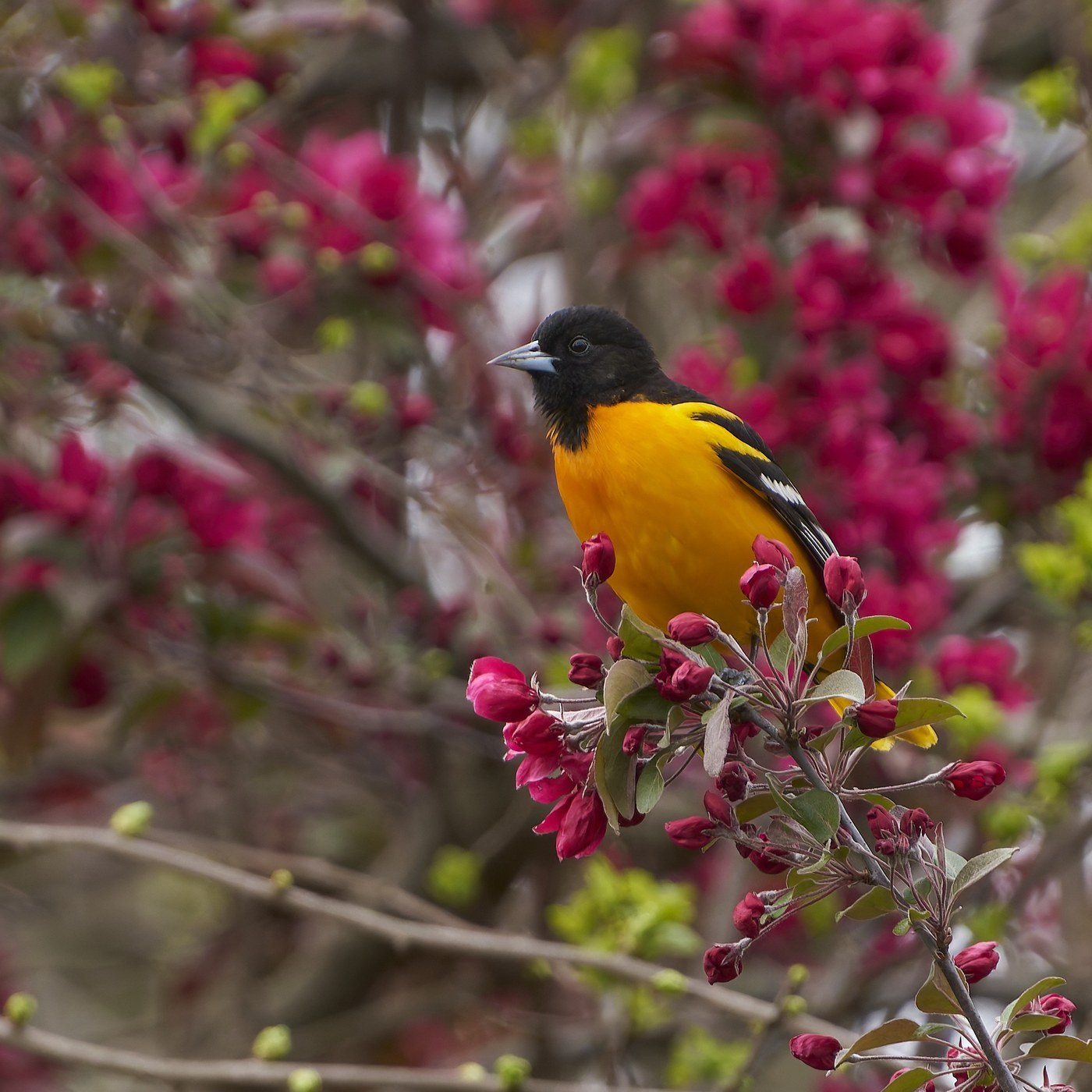
Key Field Marks
- Size & shape: A medium-sized songbird (about 18 cm) with a slim, slightly downcurved, pointed bill and a fairly long tail — larger and more slender than most sparrows or finches.
- Adult male: Brilliant flame-orange underparts, rump, and shoulder patch contrasting with a solid black hood, back, wings, and central tail; white-edged black wings show a single bold white wing bar and white flight-feather edges.
- Adult female / immature male: Duller and more variable — olive-brown to dull orange-yellow body with a grayish to olive back, two whitish wing bars, and a duskier (not solid black) head; some older females show partial black hooding.
- Bill: Sharply pointed, silvery-gray, slightly downcurved — built for probing flowers and fruit as well as gleaning insects.
Similar Species
- Orchard Oriole: Smaller and more compact, with adult males showing deep chestnut (not orange) underparts against a black hood; females are yellow-green rather than orange-yellow.
- Bullock's Oriole: Western counterpart with a range that overlaps in a narrow Great Plains hybrid zone; males show an orange face with a black eye-line and black crown (rather than a fully black hood) and a larger white wing patch.
- American Robin: Sometimes confused by beginners due to orange underparts, but the robin is uniformly gray-brown above with no black hood and a much shorter, straight yellow bill.
Where & When to See It
- Breeds across the eastern and central United States and southern Canada in open deciduous woodland, woodland edges, orchards, and shade trees in parks and neighborhoods; often builds its distinctive hanging, woven pouch nest at the tip of a slender branch.
- Migrates to Florida, the Caribbean, Mexico, and Central/northern South America for winter, with spring arrivals in its breeding range typically in April–May.
- Attracted to backyard feeders offering orange halves, grape jelly, or nectar during migration and the breeding season.
Voice
- A rich, clear series of loud, whistled flute-like phrases, often described as sounding like a cheerful, somewhat disjointed melody; also gives a distinctive dry, chattering rattle as a call note.
Frequently asked questions
How do you tell a Baltimore Oriole from an Orchard Oriole?
Male Baltimore Orioles are flame-orange below, while male Orchard Orioles are a much darker chestnut-red; Orchard Oriole is also noticeably smaller and more compact overall.
What does a female Baltimore Oriole look like?
Females are duller than males, with an olive-yellow to dull orange body, a grayish-olive back, and two whitish wing bars, lacking the male's solid black hood.
Where does the Baltimore Oriole build its nest?
It weaves a distinctive hanging, sock-like pouch nest suspended from the tip of a slender branch, usually high in a deciduous tree such as an elm or maple.
What is the best way to attract Baltimore Orioles to a yard?
Offering orange halves, grape jelly, or sugar-water nectar feeders during spring migration and summer is a reliable way to draw them in, in addition to planting native flowering and fruiting trees.