
Baglafecht Weaver Identification Guide
An African highland weaver identified by its glossy black hood, pale eye, and black-and-yellow scalloped back.
Read the full Baglafecht Weaver encyclopedia entry →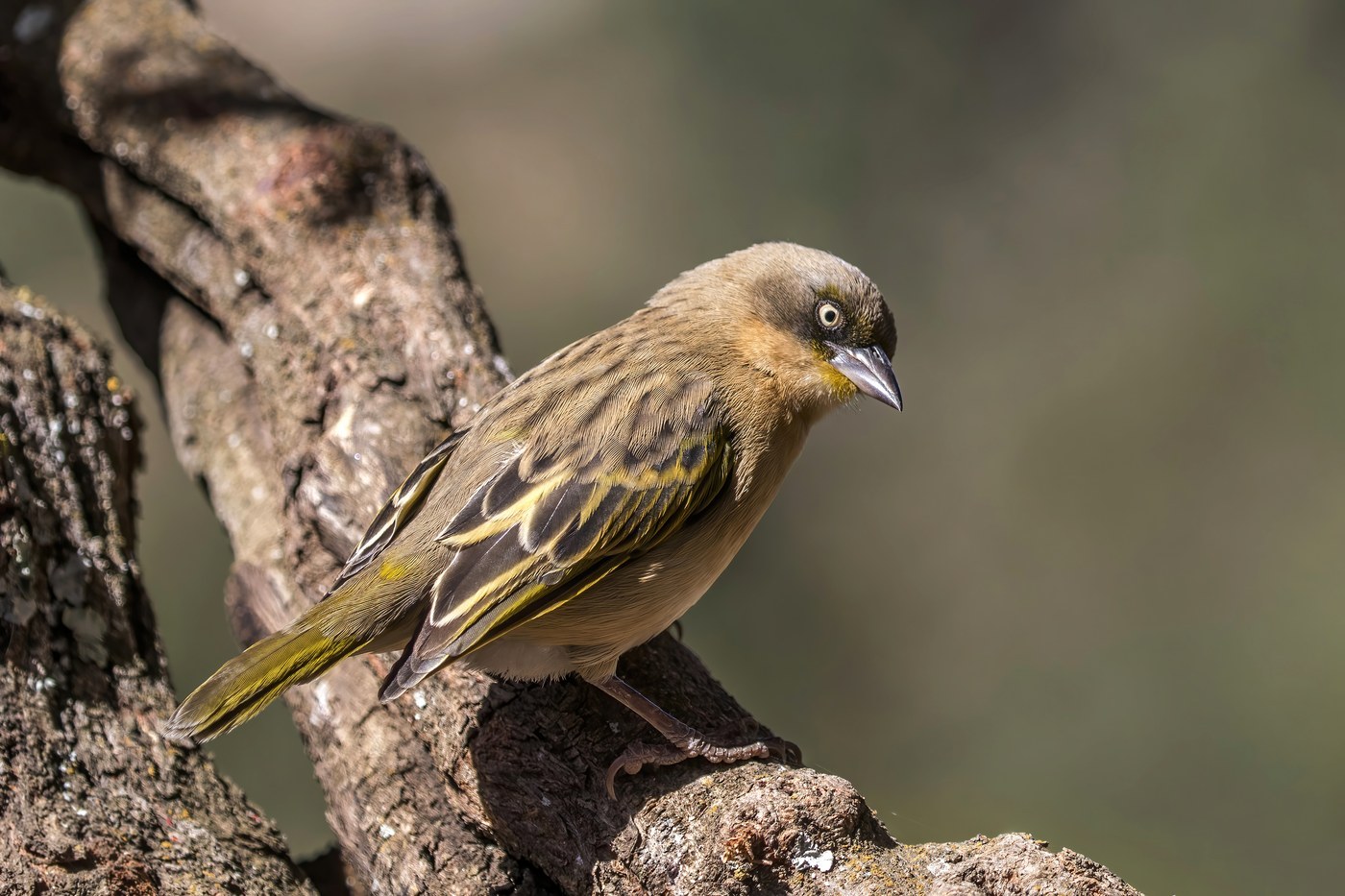
Key Field Marks
- Size & shape: A medium-sized weaver (about 14–15 cm) with the typical stout, conical weaver bill and a compact body.
- Head: Adult males typically show a full glossy black hood covering the head and throat (the extent varies by subspecies, with some showing a yellow forehead or forecrown); a distinctive pale (whitish to straw-colored) eye stands out against the dark head.
- Upperparts: Black feathers broadly edged with yellow-olive on the back and wings, creating a scaled or scalloped look rather than a solid color.
- Underparts: Bright yellow below the black hood.
- Female/immature: Duller and more olive overall, with a less extensive black hood or a mostly greenish head, but retaining the pale eye.
Behavior
- Builds the typical woven, retort-shaped weaver nest, often suspended from the tip of a branch; not usually as densely colonial as some other weaver species, though small loose groups nest together.
- Forages actively in trees and shrubs for insects, nectar, and fruit; often joins mixed-species foraging flocks.
- Vocal and active, frequently seen in gardens, forest edges, and hedgerows rather than deep forest interior.
Similar Species
- Village Weaver / Spectacled Weaver and other yellow weavers: Most other common weavers show only a black facial mask or eye-line rather than a full solid black hood, and lack the Baglafecht's pale eye combined with scalloped black-and-yellow back.
- The combination of full black hood, pale eye, and scaled back pattern is distinctive once these features are seen together.
Where & When to See It
- Found in East and Central African highlands, including the mountains and plateaus of Ethiopia, Kenya, Uganda, Rwanda, Burundi, and Tanzania, with an isolated population in parts of Cameroon/Nigeria highlands.
- Favors forest edge, montane scrub, gardens, and cultivated land at moderate to high elevation, generally avoiding lowland forest interior.
- Resident year-round with no long-distance migration; some local altitudinal movement may occur.
Voice
- Gives a range of harsh, chattering, weaver-typical calls and buzzy chuckling notes, usually not as loud or sustained as the choruses of colonial weaver species.
Frequently asked questions
What is the most reliable field mark for a Baglafecht Weaver?
A full black hood over the head and throat combined with a pale (whitish) eye and a black-and-yellow scalloped back separates it from most other African weavers.
Where is the Baglafecht Weaver found?
It is a bird of East and Central African highlands, from Ethiopia south through Kenya, Uganda, and Tanzania, typically at moderate to high elevation.
Does the Baglafecht Weaver nest in large colonies like other weavers?
It is less strongly colonial than many weaver species, often nesting singly or in small loose groups rather than the large dense colonies typical of some other weaver species.
How can you tell a female Baglafecht Weaver from a male?
Females and immatures are duller with a reduced or greenish head pattern rather than the male's full glossy black hood, but they retain the diagnostic pale eye.