
Bachman's Sparrow Identification Guide
A plain, secretive sparrow of southeastern pine woods, best located by its clear whistled song rather than by sight.
Read the full Bachman's Sparrow encyclopedia entry →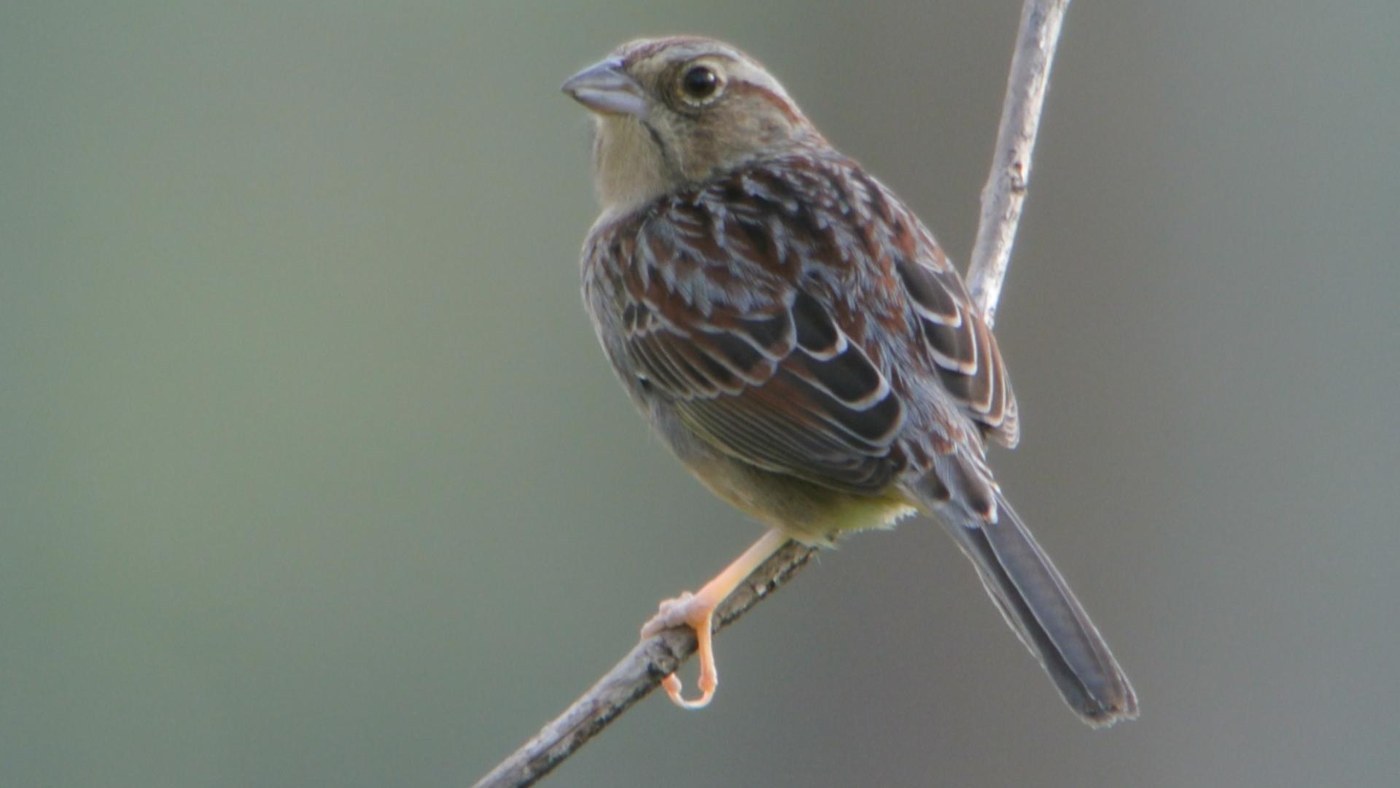
Key Field Marks
- Size & shape: A fairly large, plump sparrow (about 14–15 cm) with a large bill, flat head, and a long, rounded tail that it often flicks or spreads.
- Plumage: Overall plain grayish-buff below with minimal streaking on an unmarked buffy breast; back and crown streaked reddish-brown and gray/black, giving a warm, rufous-toned appearance.
- Face: Fairly plain, with a subtle pale eyering and a grayish supercilium; lacks the bold facial pattern of many sparrows.
- Bill: Notably large and conical for a sparrow of its size, pale pinkish-gray.
- Behavior: Extremely skulking — spends most of its time walking or running on the ground under grass and pine litter, rarely perching in the open except to sing.
Similar Species
- Botteri's Sparrow & Cassin's Sparrow: Both are other Peucaea sparrows of similar plain build, but their ranges (Southwest/south Texas grasslands) do not overlap with Bachman's Sparrow's southeastern pine-belt range.
- Grasshopper Sparrow: Smaller, shorter-tailed, with a flatter head and a buffy, unstreaked breast, but found in open grassland rather than pine understory.
- Field Sparrow: Smaller, with a bright pink bill and a plain rusty cap, and it lacks Bachman's heavier bill and unstreaked buffy underparts.
Where & When to See It
- A specialist of mature, open pine woodland with a dense grassy or wiregrass understory, especially longleaf pine savanna maintained by fire — its range has contracted with the loss of this habitat.
- Resident across much of the coastal plain and Piedmont of the southeastern United States; northern populations are more migratory and withdraw southward in winter.
- Best detected in spring and summer when territorial males sing persistently from low, semi-open perches.
Voice
- One of the most distinctive songs of any American sparrow: a clear, sweet, single whistled note followed by a rapid trill on a different pitch, often rendered as "seeee-tootootootootoo."
- Song pitch and trill speed vary between individuals, but the two-part whistle-then-trill structure is diagnostic.
Frequently asked questions
What is the best way to find a Bachman's Sparrow?
Listen for its song — a clear whistled note followed by a trill on a different pitch — since the bird itself stays hidden in dense grass under open pine woodland and is rarely seen well without patience.
What habitat does Bachman's Sparrow require?
It depends on mature, fire-maintained pine woodland with an open canopy and a thick grassy or wiregrass ground layer, such as longleaf pine savanna.
How can you separate Bachman's Sparrow from Botteri's or Cassin's Sparrow?
Range is the simplest clue: Bachman's Sparrow occupies the southeastern U.S. pine belt, while Botteri's and Cassin's are birds of southwestern and south Texas grasslands, so the three rarely if ever overlap.
Is Bachman's Sparrow migratory?
Populations in the northern and interior parts of the range are partially migratory and move south for winter, while birds in the Deep South and Florida tend to be year-round residents.