
Australian White Ibis Identification Guide
A large white wading bird with a bald black head and long downcurved bill, now equally at home scavenging in city parks as in natural wetlands.
Read the full Australian White Ibis encyclopedia entry →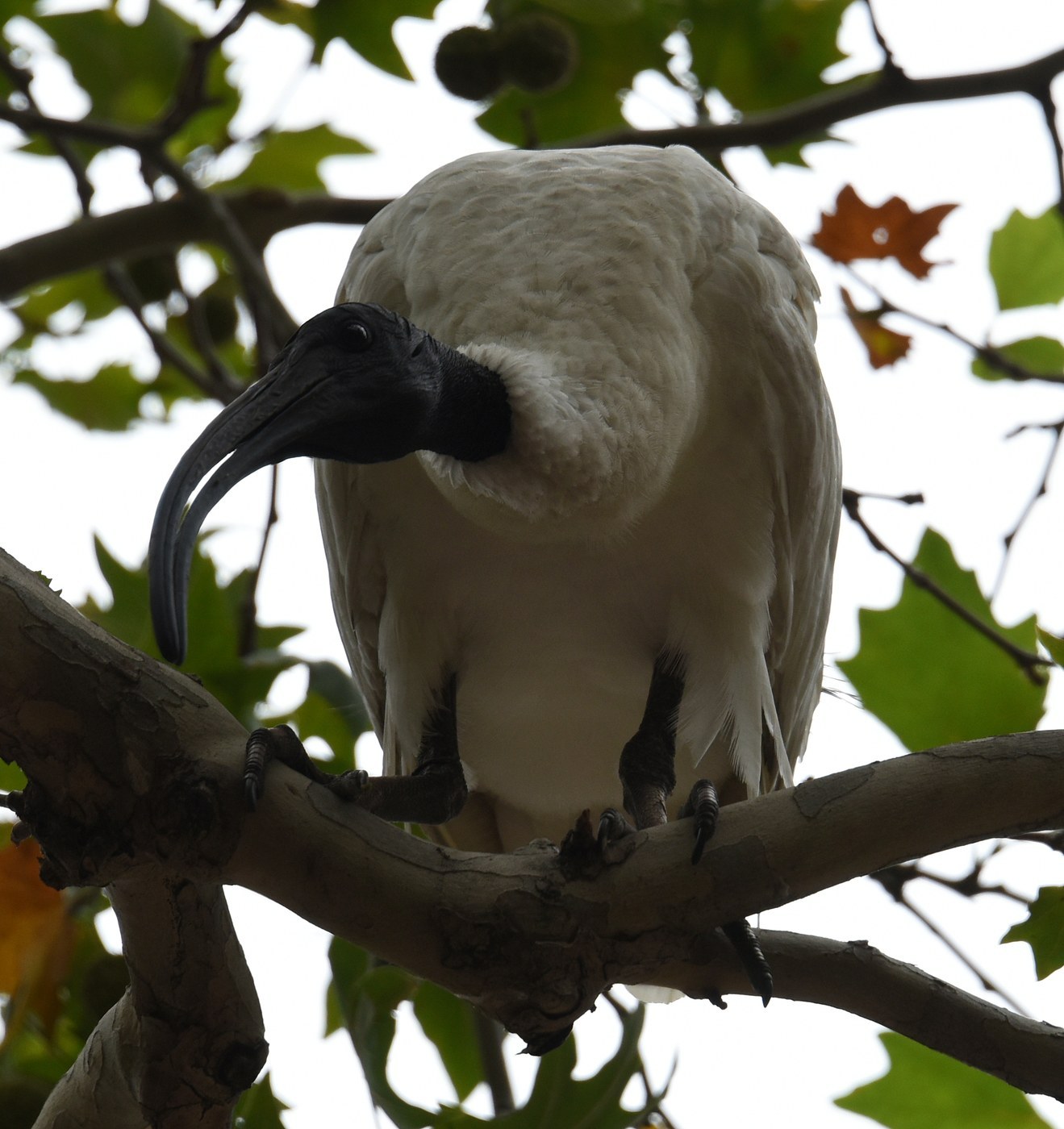
Key Field Marks
- Size & shape: A large wading bird (about 65–75 cm) with long legs, a long neck, and a distinctively long, downcurved black bill well suited to probing mud and refuse alike.
- Plumage: Body plumage is predominantly white, with black tips visible on some flight feathers, and ornamental plume-like feathers with a dark, glossy tinge on the lower back/tail area, most developed in breeding adults.
- Head & bill: The head and upper neck are bare, black, and featherless — a key mark separating it at a glance from feather-headed waterbirds; the bill is long, thin, and strongly downcurved, black in color.
- Behavior: Forages by probing in mud, shallow water, grass, and increasingly in urban rubbish bins and picnic areas, giving rise to its informal nickname; often seen in noisy colonial roosts and nesting colonies, sometimes mixed with other waterbirds.
Separating It From Similar Species
- Straw-necked Ibis: Shows a glossy black-and-iridescent-green back and wings (versus the White Ibis's white body), plus distinctive straw-like yellow neck plumes — readily separable at any distance by the dark body alone.
- Egrets and herons: All egrets have fully feathered heads and straight (not downcurved) bills, immediately distinguishing them from the bare-headed, downcurved-billed ibis.
- Sacred Ibis (African relative): Very similar in appearance and closely related, but Sacred Ibis is essentially restricted to Africa and parts of the Middle East, not naturally occurring in Australia, so range alone prevents confusion in most contexts.
Where & When to See It
- Habitat: Naturally a wetland species of swamps, mudflats, and shallow lakes, but now extremely common and conspicuous in urban parks, gardens, and rubbish areas across many Australian cities, especially along the east coast.
- Range: Found across most of Australia except the driest interior, plus parts of New Guinea and eastern Indonesia; urban populations have expanded significantly in cities like Sydney, Brisbane, and Melbourne in recent decades.
- Season: Resident year-round in most areas; some local and regional movement occurs in response to wetland conditions, with birds concentrating at reliable food and water sources during dry periods.
Voice & Song Cues
- Generally rather quiet away from colonies, giving occasional low grunting or harsh croaking notes.
- Breeding colonies can be noisy with a variety of grunts, honks, and bill-clattering sounds exchanged between adults and between adults and chicks.
Frequently asked questions
What is the most distinctive feature of the Australian White Ibis?
Its bare, featherless black head and neck combined with a long, thin, downcurved black bill on an otherwise white body is unmistakable.
How do I tell Australian White Ibis from Straw-necked Ibis?
Straw-necked Ibis has a glossy black-and-green back and wings with straw-like yellow neck plumes, while Australian White Ibis has an all-white body.
Why is the Australian White Ibis often called the 'bin chicken'?
Urban populations have adapted to scavenge food from rubbish bins and picnic areas in Australian cities, leading to this informal nickname, though it remains a fully wild native species.
Is the Australian White Ibis the same as the Sacred Ibis seen in some other countries?
No, it is a distinct but closely related species; Sacred Ibis occurs naturally in Africa and parts of the Middle East, not Australia.