
Australian Ringneck Identification Guide
A slender, long-tailed parrot of dry Australian woodlands, identified by a narrow yellow collar across the hindneck despite dramatic color variation between regional forms.
Read the full Australian Ringneck encyclopedia entry →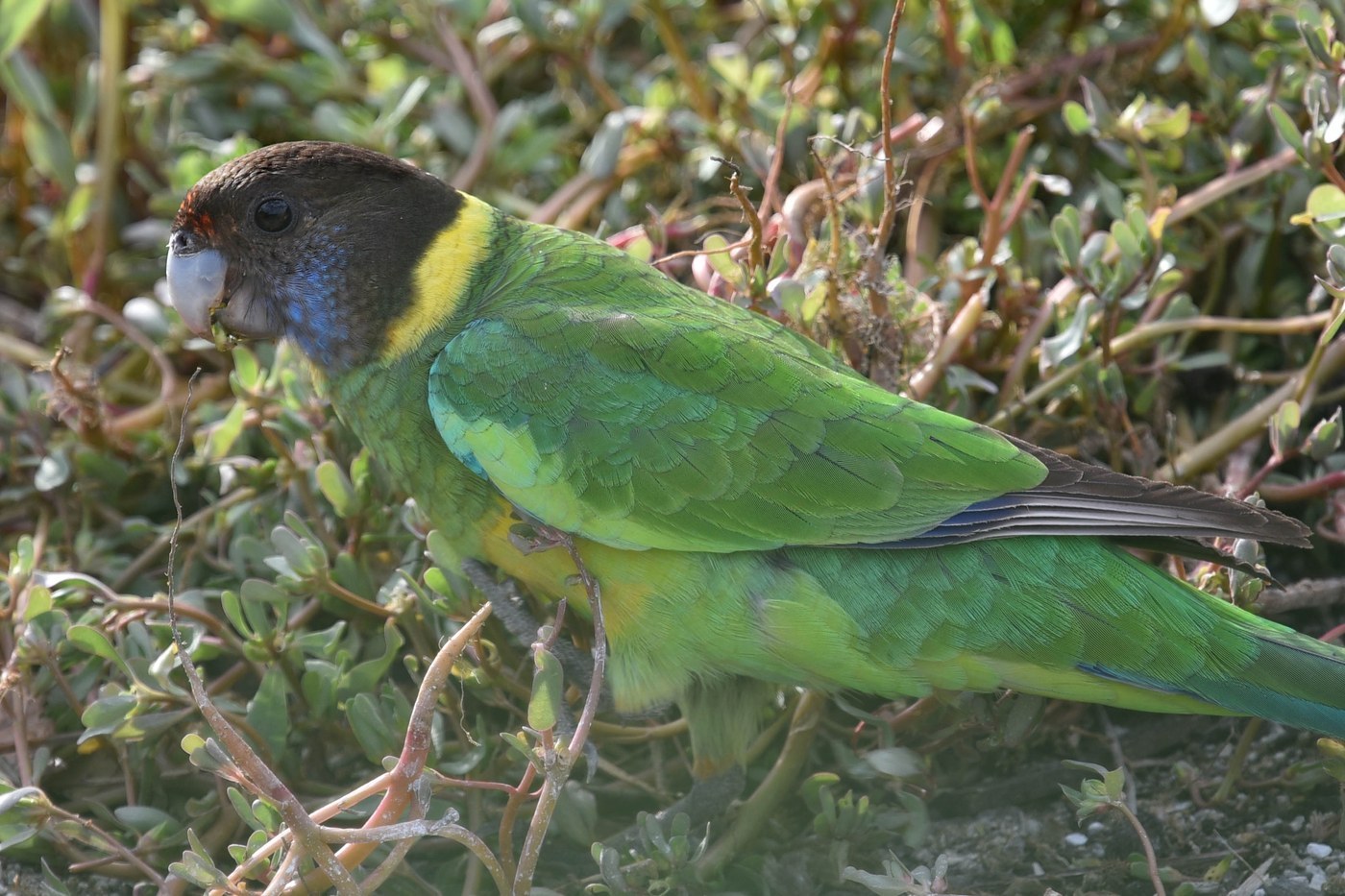
Key Field Marks
- Size & shape: A medium-sized parrot (about 33–38 cm) with a slim body, long tapering tail, and a relatively small, neat bill.
- Plumage: The defining feature across all forms is a narrow yellow band or collar across the back of the neck, contrasting with the surrounding body color. Beyond that, plumage varies dramatically by region: the Port Lincoln form has a dark blackish-green head and yellow underparts; the Twenty-eight form (southwest) has a red frontal band and green body; the Mallee form is mostly green with a blue face; and the Cloncurry form is paler overall with a more uniform yellow-green wash.
- Bill & face: Small, pale, horn-colored bill; face pattern also varies by form, with some showing blue cheek patches and others plainer green or dark heads.
- Behavior: Often seen in pairs or small flocks feeding quietly on the ground on seeds, or perched in eucalypts; flight is fast and direct, typically low, showing the long tail clearly.
Separating It From Similar Species
- Regional ringneck forms from each other: All share the diagnostic yellow hindneck collar; beyond that, geographic location is the best guide since the forms occupy largely separate (though sometimes intergrading) ranges across southern and central Australia.
- Other rosellas and parrots: Rosellas typically show scalloped or scaled back patterns and different head markings and lack the clean yellow nuchal collar; Regent Parrot and other similarly colored species lack the ringneck's specific collar mark and have different tail proportions.
- Regent Parrot: Both can appear yellow-green, but Regent Parrot lacks the sharply defined yellow collar and has a different, more uniformly yellow body with black flight feathers rather than the ringneck's more patterned regional plumages.
Where & When to See It
- Habitat: Dry eucalypt woodland, mallee scrub, acacia woodland, and farmland with scattered trees across much of inland and southern Australia.
- Range: Widespread across mainland Australia away from the wettest coastal strips and the most arid deserts, with distinct regional forms occupying different parts of this broad range — southwestern WA (Twenty-eight/Port Lincoln intergrades), southern/central Australia (Mallee, Port Lincoln), and northwestern Queensland (Cloncurry).
- Season: Resident year-round with little seasonal movement, though some local nomadism tracks food and water availability in arid parts of the range.
Voice & Song Cues
- Calls include a metallic, ringing "chink-chink" or clinking contact note given in flight, along with harsher screeching alarm calls.
- The flight call carries well over open woodland and is often the first indication of a passing bird or flock before it comes into view.
Frequently asked questions
What single feature identifies any Australian Ringneck regardless of region?
A narrow yellow collar across the back of the neck is present in all regional forms and is the species' most reliable diagnostic mark.
Why do Australian Ringnecks look so different in different parts of Australia?
The species includes several distinct regional forms (Port Lincoln, Twenty-eight, Mallee, Cloncurry) that vary considerably in head, face, and body color, though all share the yellow nuchal collar.
How do I tell an Australian Ringneck from a Regent Parrot?
Regent Parrot lacks the sharply defined yellow hindneck collar and shows a more uniformly yellow body with black flight feathers, unlike the more patterned, form-specific plumage of ringnecks.
What kind of habitat should I search for Australian Ringnecks?
Dry eucalypt woodland, mallee scrub, and farmland with scattered trees across inland and southern Australia are the most productive habitats.