
Australian Raven Identification Guide
A large, all-black corvid best separated from Australia's other crows and ravens primarily by its long, drawn-out wailing call and shaggy throat hackles.
Read the full Australian Raven encyclopedia entry →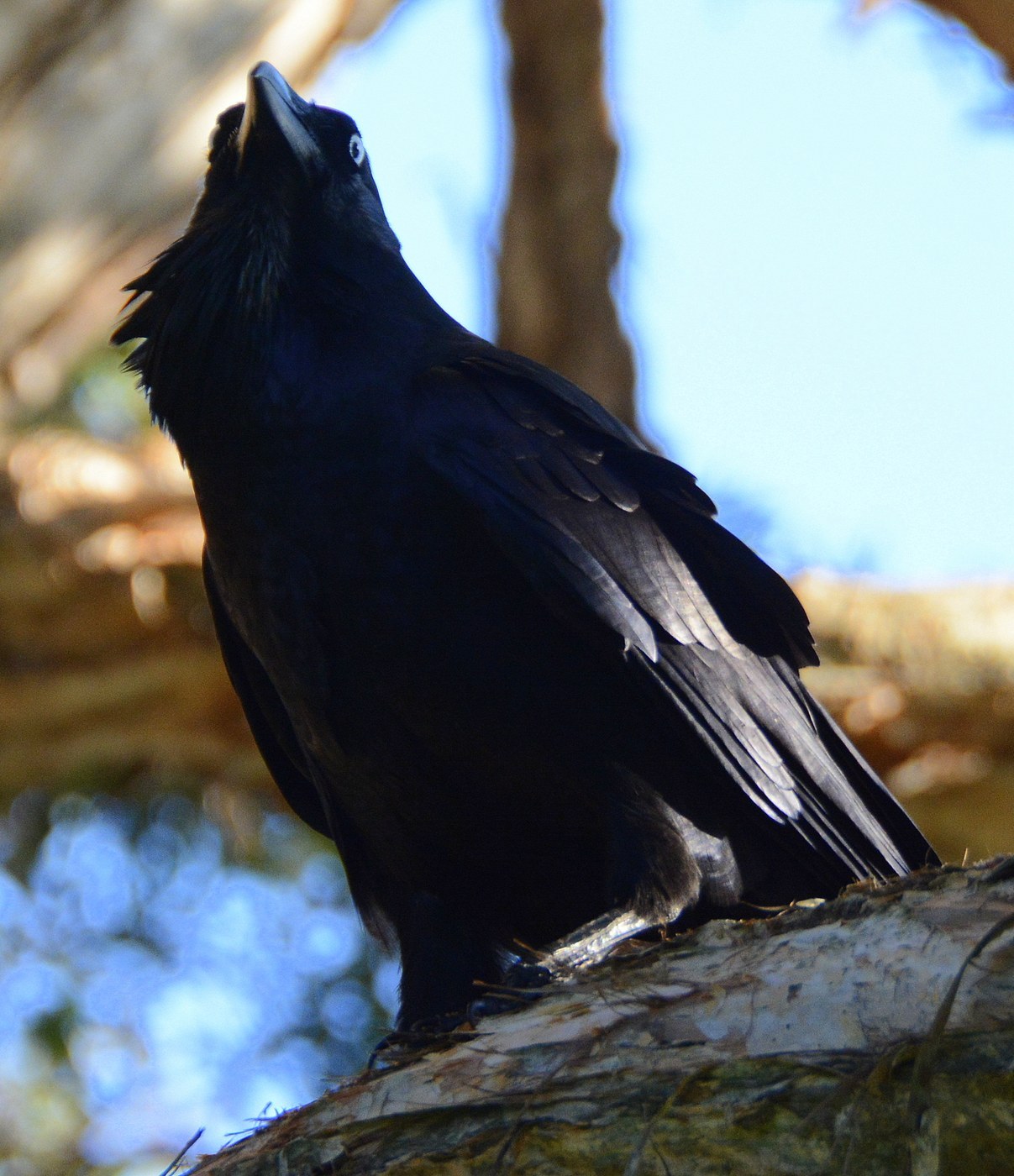
Key Field Marks
- Size & shape: A large corvid (about 48–53 cm) with a heavy bill, broad wings, and a moderately long, slightly wedge-shaped tail; overall structure is similar to Australia's other crows and ravens, making call and habitat important supplementary clues.
- Plumage: Entirely glossy black with a bluish-purple sheen in good light; adults show noticeably long, shaggy throat hackles (elongated feathers on the throat) that are often visible, especially when calling.
- Bare parts: Pale, whitish to greyish-white iris (eye) surrounded by a bluish-grey eye-ring, a useful mark at close range shared with several other Australian corvids, so not diagnostic alone.
- Behavior: Usually encountered singly, in pairs, or small family groups rather than large flocks; often perches prominently and throws its head back and puffs its throat hackles while giving its distinctive wailing call.
Separating It From Similar Species
- Little Raven / Forest Raven / Torresian Crow / Little Crow: Because all Australian Corvus species look extremely similar in the field (all-black, pale eye), the call is the most reliable way to distinguish them — Australian Raven's call is a slow, drawn-out, wailing "aah-aah-aaaah" that trails off, distinctly different from the shorter, harsher, more nasal calls of the crow species and the different cadence of Little and Forest Ravens.
- Throat hackles: Australian Raven typically shows more prominent, longer throat hackles than the crow species, visible when the bird calls or in a strong side profile, though this can be subtle in the field.
- Range and habitat overlap: Where ranges overlap with Little Crow or Torresian Crow, habitat preference (open woodland and farmland favored by Australian Raven versus more urban/coastal habits in some crow populations) can offer a secondary clue, but call remains the most dependable feature.
Where & When to See It
- Habitat: Open woodland, farmland, grassland, urban parks, and coastal areas; adaptable to a wide range of open and semi-open habitats across its range.
- Range: Southern and eastern mainland Australia, from southwestern Western Australia across South Australia, Victoria, New South Wales, and into southern Queensland; largely absent from the tropical north and central deserts, where other corvid species predominate.
- Season: Resident year-round with no regular migration; pairs typically hold permanent territories.
Voice & Song Cues
- The diagnostic call is a slow, mournful, drawn-out wail, often transcribed as "aah, aah, aaaaah," with the final note trailing off and falling in pitch — quite different from the shorter, more clipped calls of Australia's crow species.
- Calling birds often visibly puff out their throat hackles and lower the head/raise the tail during the call, adding a helpful visual cue alongside the sound.
Frequently asked questions
How can I tell an Australian Raven from a crow if they look almost identical?
Focus on the call: Australian Raven gives a slow, drawn-out wailing call with a falling final note, distinctly different from the shorter, harsher calls of Australia's crow species.
Do all Australian corvids have pale eyes?
Yes, most adult Australian ravens and crows share a pale iris, so eye color alone cannot be used to separate Australian Raven from similar species.
What are throat hackles and why do they matter for identification?
Throat hackles are elongated feathers on the throat that Australian Raven shows prominently, especially when calling; they are generally longer and more obvious than in the similar crow species.
Where in Australia is the Australian Raven found?
It occurs across southern and eastern mainland Australia in open woodland, farmland, and urban habitats, but is largely absent from the tropical north and central deserts.