
Australian Pelican Identification Guide
An enormous white waterbird with the longest bill of any living bird, easily told by its pink-and-blue bill and bold black-and-white wing pattern in flight.
Read the full Australian Pelican encyclopedia entry →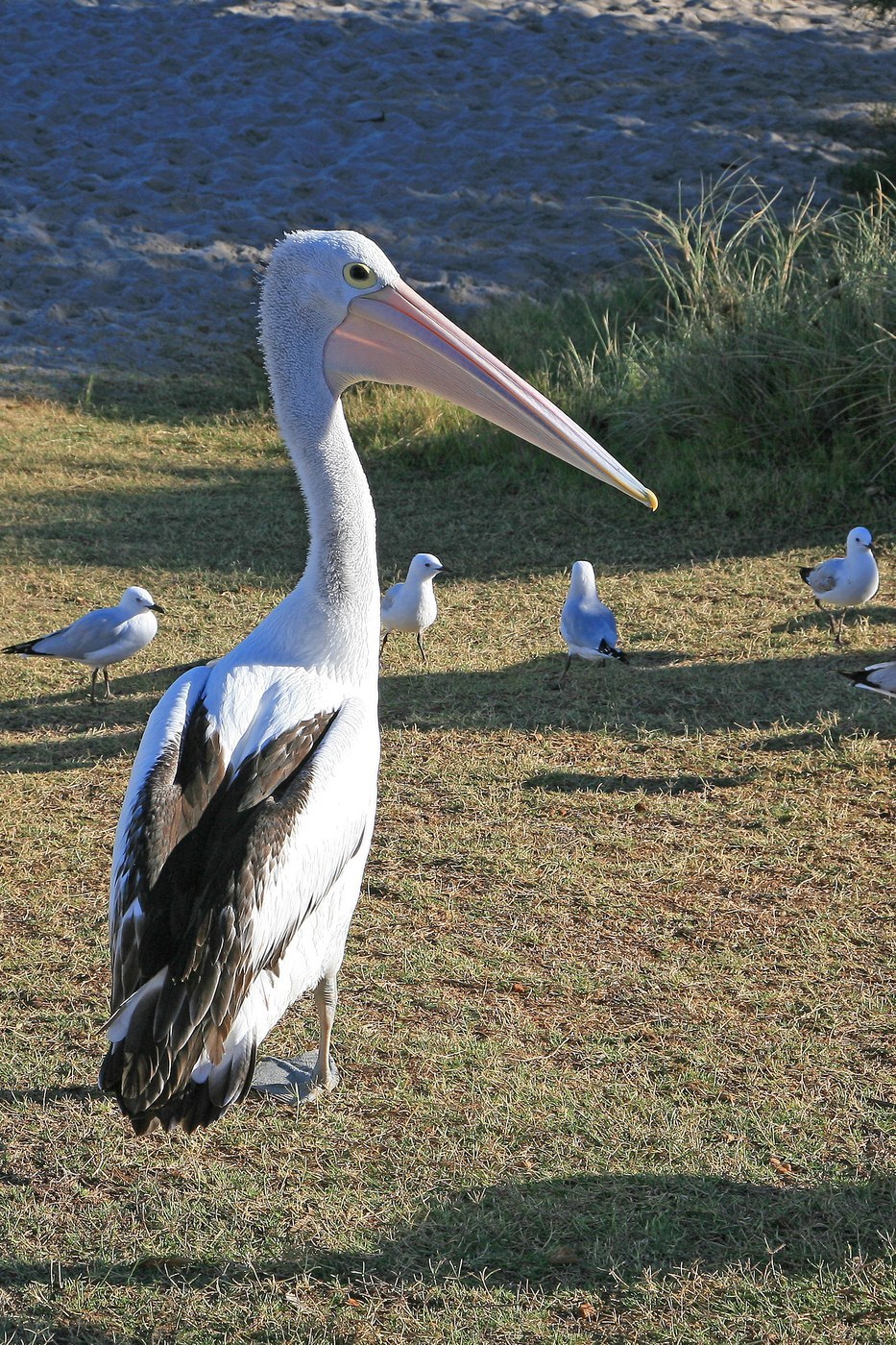
Key Field Marks
- Size & shape: A huge waterbird (up to around 170–190 cm long, with a wingspan over 2.3 m) with an enormous bill, a large gular pouch, a thick neck, and broad, long wings built for soaring.
- Plumage: Predominantly white body with a black back and black flight feathers, creating a strongly contrasting black-and-white pattern especially obvious in flight from below and above.
- Bill & face: The huge bill is pale pink with a blue tip and a pink-and-orange gular pouch during breeding; the pale eye and pinkish bare skin around the eye add to the distinctive facial look.
- Behavior: Often seen floating buoyantly on water, soaring high on thermals in flocks with the neck retracted (unlike herons/cranes which extend the neck), and occasionally cooperatively herding fish into shallow water before scooping them up in the expandable pouch.
Separating It From Similar Species
- Other pelican species: The Australian Pelican is the only pelican species regularly found in Australia, so within its normal range confusion with other pelicans is minimal; the combination of extremely long bill, black-and-white body, and pink-blue bill is unique among Australian waterbirds.
- Egrets and other large white waterbirds: Egrets are far smaller, slimmer-billed, and lack the pelican's massive pouch-bearing bill and black flight feathers; in flight, egrets extend the neck fully while pelicans hold the neck folded back in an S-shape against the body.
- Swans and other large waterbirds: Swans lack the enormous bill and black-and-white wing pattern; pelicans are readily told by silhouette alone even at a distance.
Where & When to See It
- Habitat: Large lakes, rivers, estuaries, coastal lagoons, and wetlands across Australia, including inland ephemeral lakes that fill after rain, plus harbors and coastal waters.
- Range: Found throughout Australia wherever suitable water bodies occur, plus New Guinea, Indonesia, and parts of the western Pacific; highly nomadic, moving long distances in response to rainfall and wetland conditions, especially into inland Australia after flooding.
- Season: Present year-round in coastal and permanent wetland areas; large influxes occur inland after major rain events, with birds departing again as temporary wetlands dry out.
Voice & Song Cues
- Generally rather quiet away from breeding colonies, but can produce low grunting or growling calls, especially in colonies or when threatened.
- Chicks and displaying adults at breeding colonies are noisier, with various croaking and bill-clattering sounds; away from colonies, birds are usually silent in flight.
Frequently asked questions
What is the single most obvious feature of an Australian Pelican?
Its enormous pink bill with a blue tip, combined with a strongly black-and-white body pattern, makes it unmistakable.
How does an Australian Pelican fly compared to a heron or egret?
Pelicans fly with the neck folded back in an S-shape and often soar in flocks on thermals, whereas herons and egrets extend the neck straight out in flight.
Why do Australian Pelicans sometimes appear far inland?
They are highly nomadic and travel long distances to exploit temporary inland wetlands and lakes that fill after significant rainfall, then move on as these dry out.
Are there other pelican species to confuse with the Australian Pelican in Australia?
No — it is the only pelican species regularly occurring in Australia, so any pelican seen there can be safely identified as this species.