
Australian Owlet-nightjar Identification Guide
A tiny, big-eyed nocturnal bird of Australian woodlands that peers out from tree hollows by day, combining owl-like eyes with a nightjar-like wide bill.
Read the full Australian Owlet-nightjar encyclopedia entry →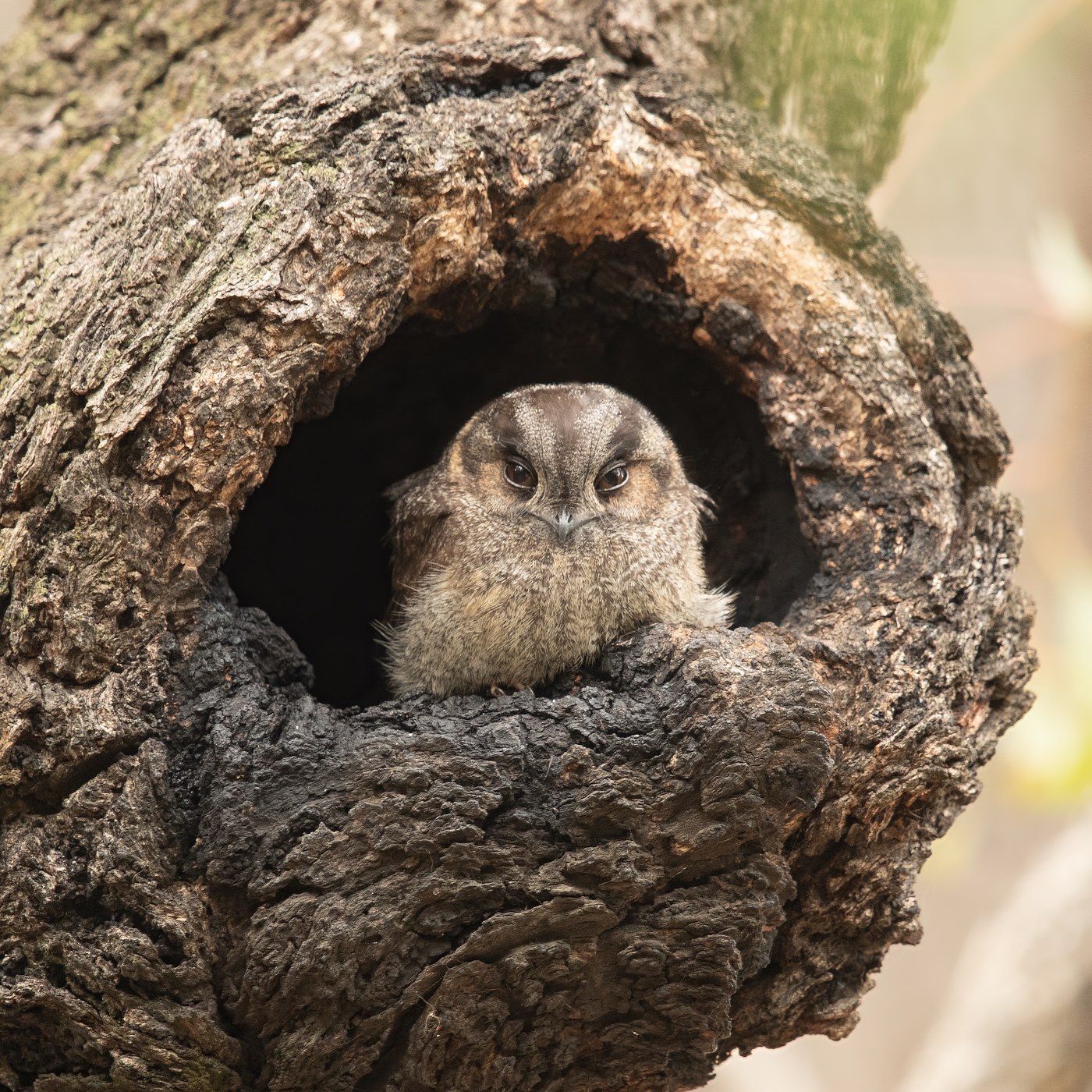
Key Field Marks
- Size & shape: A very small nocturnal bird (about 20–25 cm including a longish tail), with a large rounded head, big forward-facing dark eyes, and a flattened, wide-based bill fringed with rictal bristles.
- Plumage: Soft grey-brown, finely mottled and vermiculated plumage overall, providing excellent camouflage against tree bark; shows a distinct dark line running through the eye and a paler face, with a long, slightly graduated tail often held cocked or angled while perched at a hollow entrance.
- Behavior: Strictly nocturnal and rarely seen in flight during the day; most sightings come from spotting a bird peering out of a tree hollow entrance in daylight, its round head and large eyes visible in the opening. At night it hunts insects both by aerial sallies and by dropping to the ground, more varied than typical true nightjars.
Separating It From Similar Species
- Tawny Frogmouth: Much larger and bulkier with a broad, heavy, hooked-tipped bill and a habit of freezing upright on an exposed branch mimicking a broken stump, rather than peering from a tree hollow; frogmouth eyes are yellow, not the owlet-nightjar's dark eyes.
- True nightjars (e.g., Spotted Nightjar, White-throated Nightjar): Nightjars roost flat on the ground or along a branch rather than in a tree hollow, have proportionally longer wings adapted for sustained aerial hunting, and lack the owlet-nightjar's rounded, owl-like head shape.
- Small owls (e.g., Southern Boobook): Owls have strongly hooked bills and forward-set eyes with a more solidly disc-shaped face; owlet-nightjar has a flatter, wide bill more like a nightjar's and a less pronounced facial disc.
Where & When to See It
- Habitat: Woodlands, forests, and timbered watercourses across almost all of Australia, wherever suitable tree hollows for daytime roosting are available.
- Range: Found throughout mainland Australia and Tasmania in suitable wooded habitat; it is Australia's most widespread nocturnal bird after some owl species.
- Season: Resident year-round with no significant migration; most easily found at dusk as it becomes active or by day if a roosting hollow is known.
Voice & Song Cues
- Calls include a distinctive, repeated churring, chattering, or dog-like yapping series of notes given mainly around dusk and through the night, often the best way to detect the species' presence.
- The call carries well in quiet woodland at night and is quite different from the softer boobook hoot or the harsher frogmouth's low grunting call.
Frequently asked questions
How do I find an Australian Owlet-nightjar during the day?
Look for its round head and large dark eyes peering out from the entrance of a tree hollow, which is the most common way this strictly nocturnal bird is seen in daylight.
What is the main difference between an Owlet-nightjar and a Tawny Frogmouth?
The frogmouth is much larger with a heavy hooked bill, yellow eyes, and roosts upright on an open branch, while the owlet-nightjar is tiny, dark-eyed, and roosts hidden inside tree hollows.
Is the Australian Owlet-nightjar an owl?
No — despite its owl-like face and eyes, it belongs to the nightjar family (Caprimulgiformes), not to true owls, though it shares some nocturnal adaptations with both groups.
What call should I listen for at night to detect this species?
A repeated churring or yapping, dog-like chatter around dusk and after dark is the most reliable audio cue for locating an Australian Owlet-nightjar.