
Australian Magpie Identification Guide
A familiar, bold black-and-white songbird of Australian parks and farmland, known for its rich carolling song and territorial breeding-season swooping.
Read the full Australian Magpie encyclopedia entry →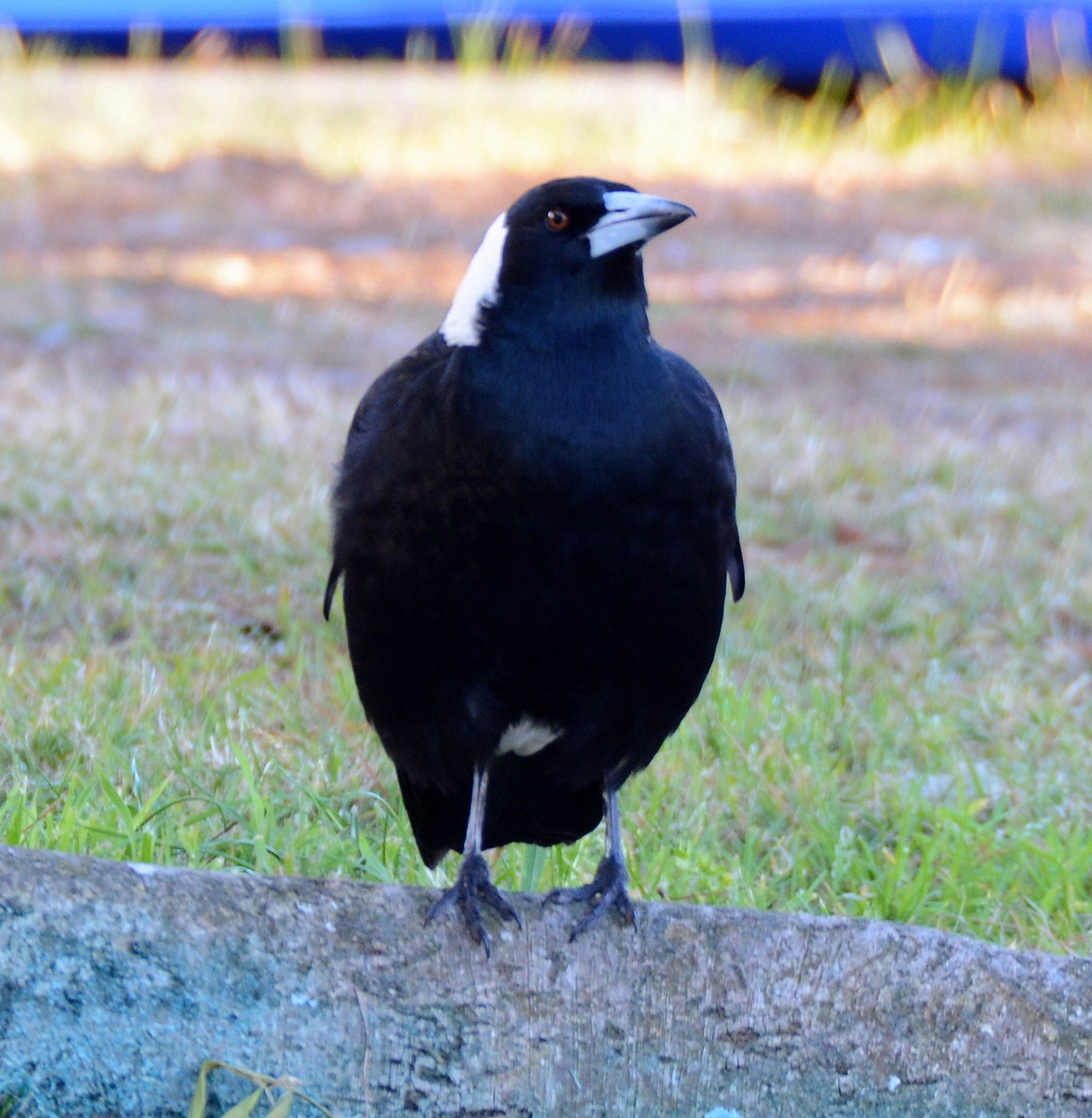
Key Field Marks
- Size & shape: A medium-large, robust songbird (about 37–43 cm) with a strong, straight, pointed bill, longish legs, and an upright stance when foraging on the ground.
- Plumage: Bold black-and-white pattern that varies geographically — most forms show a white nape and back (or just nape, depending on race), white shoulder patches, and black underparts, head, wings, and tail; the exact black/white pattern differs among the several recognized subspecies groups.
- Bare parts: Bill is bluish-white with a black tip; eye is red to reddish-brown, a useful mark at close range.
- Behavior: Forages mainly on the ground, walking and probing for invertebrates; highly territorial, especially in the breeding season when some individuals (mainly males) swoop at passersby near nests; often seen in family groups defending a permanent territory.
Separating It From Similar Species
- Magpie-lark (Mudlark/Peewee): Much smaller, more slender, with a different black-and-white face pattern (white eyebrow/throat pattern in males, white throat in females) and a thinner bill; lacks the magpie's heavy bill and red eye.
- Pied Butcherbird / Grey Butcherbird: Butcherbirds have a heavier, strongly hooked bill for taking prey, different black-and-white patterning (more solid black hood in Pied Butcherbird), and a fluty, distinct song; magpies have a straighter bill and different plumage pattern.
- Regional magpie forms: Black-backed forms (north and east) versus white-backed forms (southeast, including Tasmania) can look quite different, but all share the same overall structure, red eye, and blue-white black-tipped bill.
Where & When to See It
- Habitat: Open woodland, farmland, parks, golf courses, and suburban gardens with short grass for foraging and scattered trees for nesting — one of Australia's most familiar urban and rural birds.
- Range: Found across almost all of mainland Australia and Tasmania, generally absent only from the most densely forested or driest desert regions.
- Season: Resident year-round; the well-known swooping behavior is concentrated in the breeding season (roughly Australian winter–spring, August to October) when nests contain eggs or young.
Voice & Song Cues
- Renowned for a rich, complex, and highly musical carolling song, a fluting, warbling sequence often given by multiple birds in a group in a form of duetting or chorusing, especially at dawn.
- Also gives a variety of harsher alarm and contact calls; the carolling song is one of the most distinctive and beloved bird sounds across Australia.
Frequently asked questions
How do I tell an Australian Magpie from a Magpie-lark?
The magpie is much larger and heavier-billed with a red eye, while the Magpie-lark is smaller, slimmer, has a different facial pattern, and lacks the magpie's stout bill.
Why do some Australian Magpies swoop at people?
A minority of magpies, mostly males, swoop to defend their nest during the breeding season (roughly August to October) when eggs or chicks are present nearby.
Do all Australian Magpies look the same?
No — there are black-backed and white-backed regional forms that differ in how much white shows on the back and nape, though all share the same bill, eye color, and overall shape.
What is the best way to identify a magpie by sound?
Listen for its rich, warbling, flute-like carolling song, often performed by several birds together, which is quite different from the calls of similar black-and-white species.