
Australian King Parrot Identification Guide
A large, long-tailed parrot of eastern Australian forests, with males showing a scarlet head and underparts against green wings and a striking blue rump.
Read the full Australian King Parrot encyclopedia entry →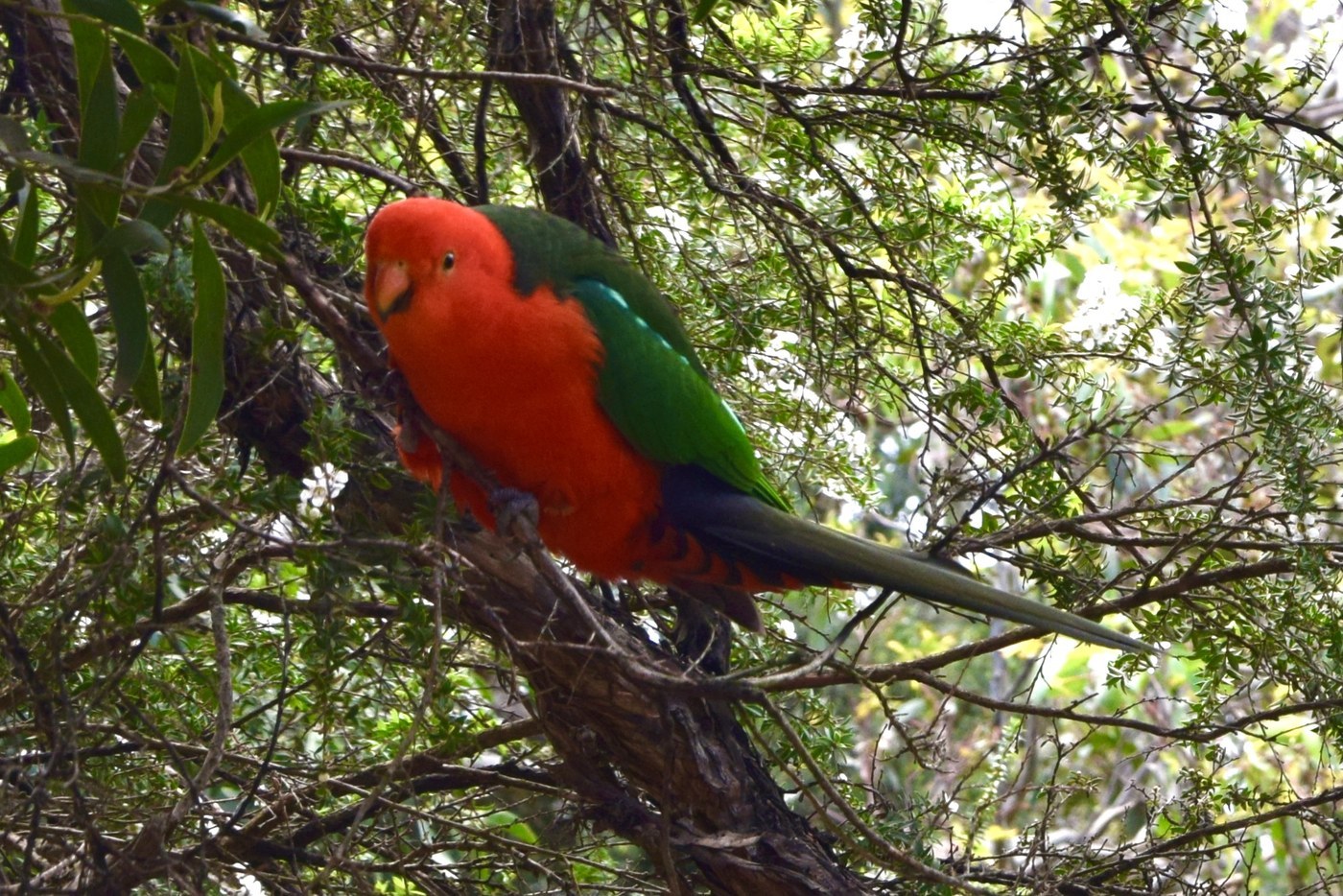
Key Field Marks
- Size & shape: A large parrot (about 40–43 cm including a long, broad tail) with a robust body, proportionally long tail, and a strong, hooked bill.
- Male plumage: Bright red head, neck, and underparts contrast sharply with a green back and wings; a pale blue-green patch is visible on the lower back/rump, and the tail is blackish-green above.
- Female plumage: Head and upperparts are entirely green (no red on the head), with red confined to the lower breast, belly, and undertail; some females show a subtly duller green than males on the back.
- Behavior: Often seen in pairs or small family groups, moving between the mid- and upper canopy, feeding quietly on seeds, fruit, and blossoms; flight is fast and direct with a distinctive long-tailed silhouette.
Separating It From Similar Species
- Crimson Rosella: Smaller and more colorful overall with blue cheek patches and a scalloped black-and-red back pattern; lacks the king parrot's clean two-tone red-head/green-body split and has a shorter, differently shaped tail.
- Red-winged Parrot: Smaller, with a shorter tail and a prominent red wing patch on an otherwise green body — quite different from the king parrot's solid red head and underparts.
- Female king parrot vs. other green parrots: The combination of an all-green head with red confined strictly to the lower underparts, plus the long tail and large size, separates female king parrots from similarly green species like female rosellas or lorikeets.
Where & When to See It
- Habitat: Wet eucalypt forest, rainforest edges, and well-vegetated gardens and parks, particularly in gullies and along forest edges; frequently visits bird feeders and orchards near forest habitat.
- Range: Eastern Australia from around Cooktown in far north Queensland south through New South Wales to Victoria, generally along the Great Dividing Range and coastal forests.
- Season: Resident year-round in most of its range, though some altitudinal movement occurs, with birds descending to lower elevations in winter in cooler southern parts of the range.
Voice & Song Cues
- Flight call is a sharp, metallic "crassak" or ringing "peel-peel" note repeated as birds fly overhead, often the first indication of a pair passing between trees.
- Also gives softer contact and feeding calls between paired or family birds while foraging quietly in foliage.
Frequently asked questions
How do I tell a male from a female Australian King Parrot?
Males have an entirely red head and underparts against green wings, while females have a fully green head with red restricted to the lower breast and belly.
What distinguishes King Parrot from Crimson Rosella?
King Parrot shows a clean split between a red head/underparts and green back/wings, a longer tail, and lacks the rosella's blue cheek patches and scalloped back pattern.
Where is the best habitat to find Australian King Parrots?
Wet eucalypt forest and rainforest edges along eastern Australia's Great Dividing Range, including well-treed gardens near forest, are the most reliable places.
What call should I listen for to detect a passing King Parrot?
A sharp, ringing metallic call given in flight is often heard before the bird is seen crossing between trees.