
Australasian Swamphen Identification Guide
A large, boldly colored wetland rail with a deep-blue body, red frontal shield, and a habit of flicking its white tail as it walks.
Read the full Australasian Swamphen encyclopedia entry →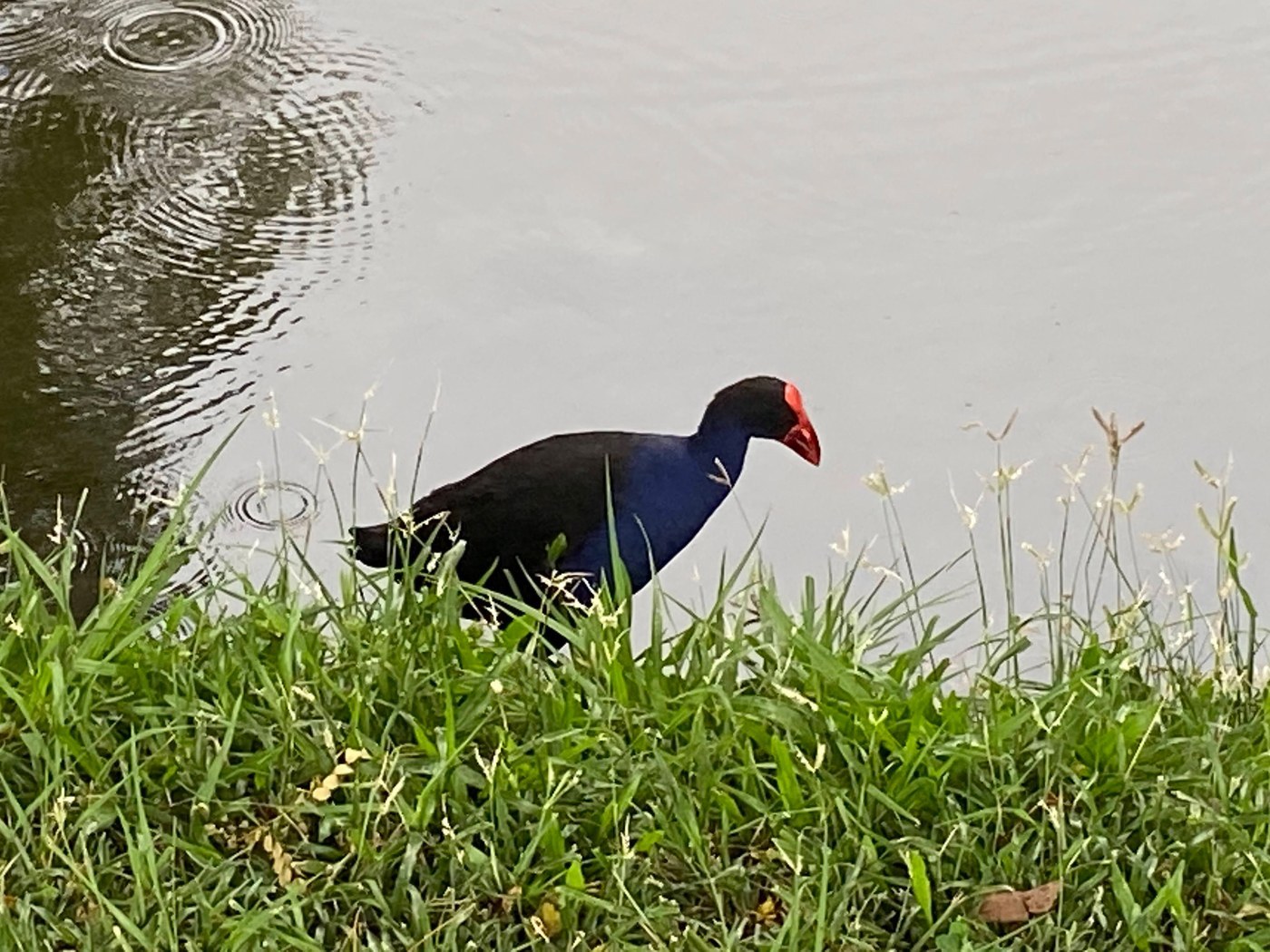
Key Field Marks
- Size & shape: A large, chunky rail (about 45–50 cm) with long legs, big feet, a short cocked tail, and a heavy, laterally compressed bill topped by a fleshy frontal shield.
- Plumage: Deep purple-blue head, neck, and underparts contrast with a blackish back and wings; the undertail coverts are bright white and are frequently flicked up and down, especially when walking or alarmed.
- Bill, shield & legs: Thick red bill continuous with a red frontal shield on the forehead; legs and long toes are red to orange-red, well suited for walking over floating vegetation.
- Behavior: Walks deliberately through reedbeds and open wetland margins, often holding food in one foot while feeding with the bill; flicks its white tail almost constantly, a useful signaling behavior for birders.
Separating It From Similar Species
- Purple Gallinule / other Porphyrio swamphens: Now generally treated as a full species split from the broader "Purple Swamphen" complex; Australasian Swamphen is distinguished by range (Australia, New Zealand "Pukeko" form, New Guinea) and typically shows a more blackish back versus the more uniformly blue-backed forms found elsewhere.
- Dusky Moorhen / Eurasian Coot: Both are much smaller, all-dark or all-black waterbirds without the swamphen's vivid blue-purple coloring or red shield; coot has a white (not red) frontal shield.
- Purple-naped Lory or other unrelated blue birds: Habitat and overall shape (heavy rail body, long red legs) immediately separate swamphen from any unrelated blue-plumaged species.
Where & When to See It
- Habitat: Freshwater wetlands, swamps, lake margins, and reedbeds with dense emergent vegetation; increasingly also found on grassy parkland and golf courses adjacent to water in Australia and New Zealand.
- Range: Widespread across Australia (except the driest interior), New Zealand (where it is known as the Pukeko), New Guinea, and nearby Pacific islands.
- Season: Resident and non-migratory throughout its range, present year-round; some local movement in response to wetland drying.
Voice & Song Cues
- A range of loud, harsh calls including booming, trumpeting, and cackling notes, often given in alarm or as contact calls between family group members.
- Also produces softer grunting and clucking sounds while foraging; the loud explosive calls carry well across open wetlands and often draw attention before the bird is seen.
Frequently asked questions
What is the most reliable field mark for Australasian Swamphen?
The combination of a deep purple-blue body, red bill and frontal shield, red legs, and a constantly flicked white undertail is diagnostic.
Is the New Zealand Pukeko the same bird as the Australasian Swamphen?
Yes, the Pukeko is the New Zealand population/subspecies of the Australasian Swamphen, sharing the same key field marks.
How do I tell a swamphen from a coot on the same wetland?
Coots are smaller, entirely blackish-grey with a white (not red) frontal shield and lobed toes, lacking the swamphen's blue-purple body and red bill/legs.
What habitat should I search for Australasian Swamphens?
Look along the reedy edges of freshwater wetlands, swamps, and lakes, as well as adjacent grassy areas like parks, where they often forage in the open.