
Australasian Gannet Identification Guide
A large, cigar-shaped seabird of Australian and New Zealand coasts, identified by its white body, black flight-feather tips, and buff-yellow head.
Read the full Australasian Gannet encyclopedia entry →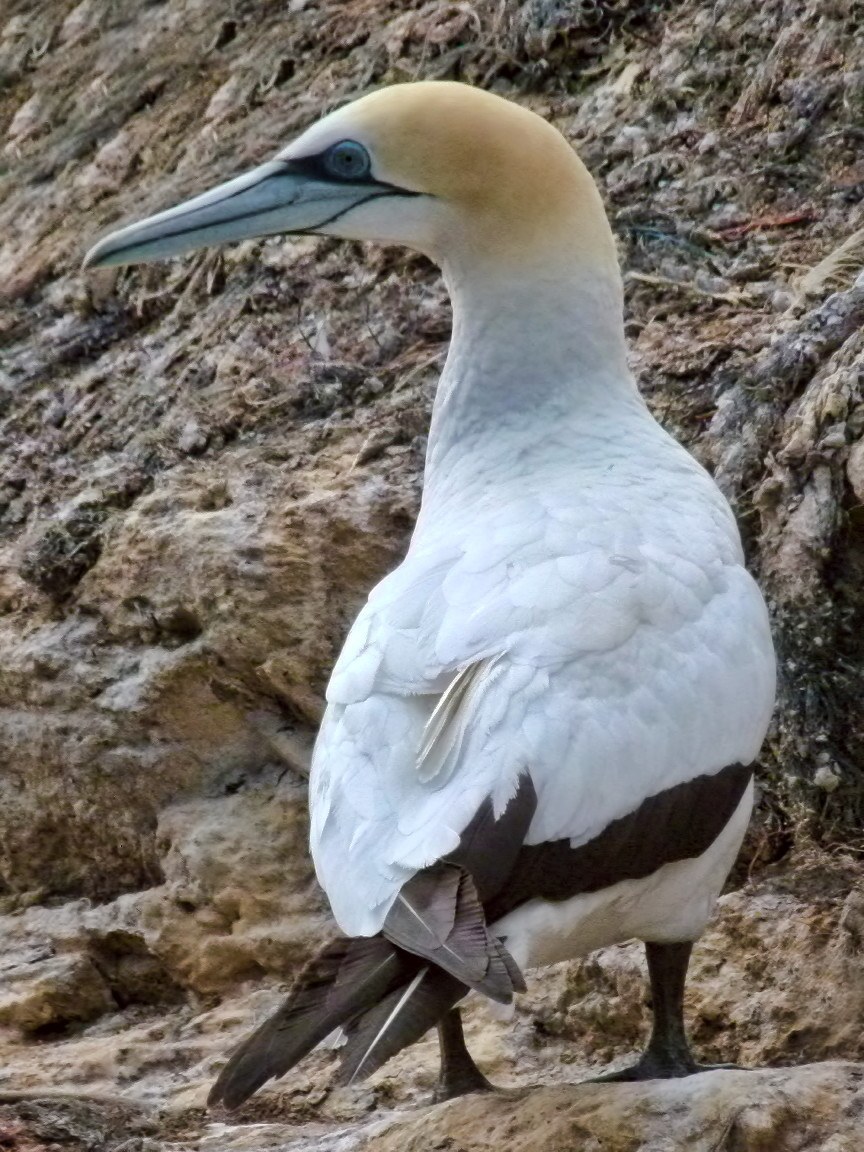
Key Field Marks
- Size & shape: A large seabird (about 84–91 cm, wingspan around 170–180 cm) with a long pointed bill, cigar-shaped body, pointed wings, and a wedge-shaped tail; flight is powerful with a mix of flapping and gliding low over water.
- Plumage: Adults are mostly bright white with a buff-yellow wash on the crown and hindneck, black secondaries and primaries visible as a solid black trailing/tip pattern on the otherwise white wing, and central black tail feathers.
- Bill & face: Long, straight, blue-grey bill with fine black lines along the base, and a pale blue eye-ring around a dark eye set in a bare blackish face patch.
- Behavior: Spectacular plunge-diver, folding wings back and dropping from height straight into schools of fish; often seen in loose feeding flocks or long lines flying to and from breeding colonies.
Separating It From Similar Species
- Cape Gannet: Very similar but shows a black line running down the throat (gular stripe) that Australasian Gannet lacks, and slightly more extensive black in the secondaries; ranges barely overlap, with Cape Gannet centered on southern Africa.
- Northern Gannet: Larger overall with a more solidly black wingtip pattern that extends further up the wing and typically shows less contrast in the secondaries; ranges do not naturally overlap with Australasian Gannet.
- Immatures: Juveniles are mottled dark brown overall, gradually whitening over several years to adult plumage — separated from adult by overall brown, speckled appearance rather than clean white-and-black.
- Boobies (e.g., Australian/Brown Booby): Boobies are smaller, browner-bodied with white bellies in adults, and lack the gannet's combination of buff head and clean black-tipped white wings.
Where & When to See It
- Habitat: Open ocean and coastal waters, foraging over schooling baitfish; breeds colonially on offshore islands, headlands, and a few mainland sites with cliff or flat open ground.
- Range: Coastal waters of southern Australia, Tasmania, and New Zealand, with major breeding colonies in Bass Strait, around Tasmania, and in New Zealand (e.g., Cape Kidnappers, Muriwai).
- Season: Present year-round near colonies; birds disperse more widely at sea outside the breeding season (roughly Australian/NZ spring–summer breeding, with post-breeding dispersal in autumn–winter).
Voice & Song Cues
- Largely silent at sea, but noisy at breeding colonies with harsh, repeated "urrah" or croaking calls used in greeting and territorial displays between mated pairs and neighboring nests.
- Listen for a raucous chorus rising from cliffside or island colonies, quite different from the quiet flight calls (or silence) typical away from breeding grounds.
Frequently asked questions
How do I tell Australasian Gannet from Cape Gannet?
Check the throat: Cape Gannet shows a black gular stripe running down the center of the throat that Australasian Gannet lacks; the two also have largely separate ranges.
What does an immature Australasian Gannet look like?
Juveniles are mottled dark brown all over, quite unlike the clean white adult, and take a few years to gradually molt into full adult plumage.
Where is the best place to see Australasian Gannets up close?
Established breeding colonies such as those in Bass Strait/Tasmania in Australia or Cape Kidnappers and Muriwai in New Zealand offer reliable close views during the breeding season.
What behavior helps identify a gannet from a distance at sea?
Its spectacular high plunge-dive — folding wings and dropping vertically into the water after fish — is distinctive among seabirds sharing its range.