Atlantic Puffin Identification Guide
A stocky, clown-faced North Atlantic seabird instantly recognized by its enormous triangular, brightly banded bill and whirring flight.
Read the full Atlantic Puffin encyclopedia entry →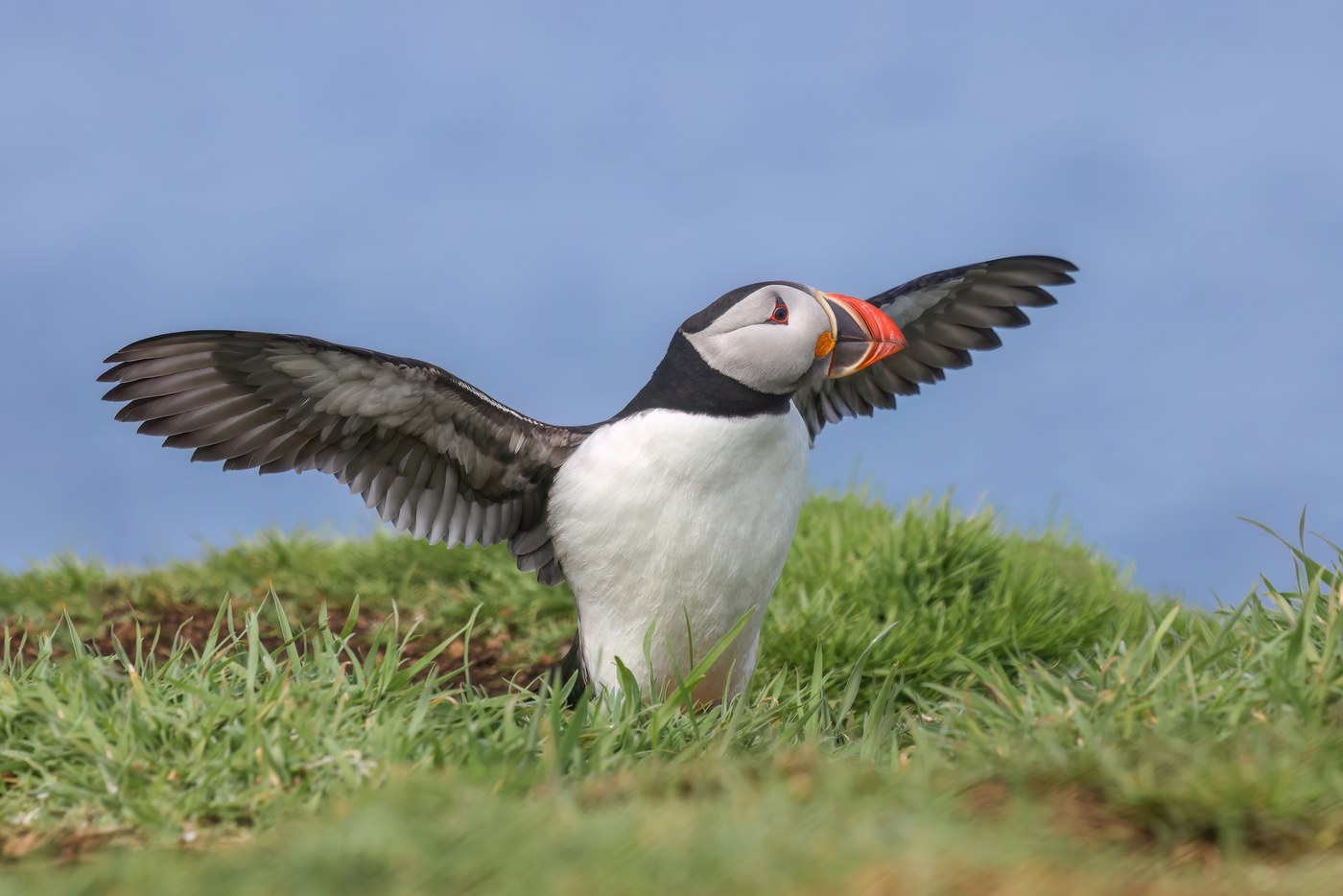
Key Field Marks
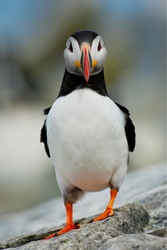
- Stocky, short-necked, short-winged seabird (an auk), about 28-30 cm (11-12 in) long, with black upperparts, a black collar, and clean white underparts and face.
- Breeding-season bill is the signature feature: large, laterally flattened, and triangular, boldly banded in blue-gray, yellow, and orange, with a bright orange-red tip.
- Face is white to pale gray with a dark, heavy-lidded eye patch giving a distinctive "clown-faced" look; legs and feet are bright orange.
- In non-breeding (winter) plumage, the outer bill plates are shed, leaving a smaller, duller, grayer bill, and the face becomes duskier gray rather than clean white.
Behavior
- Flies with rapid, whirring wingbeats on short, stubby wings — built more for underwater "flight" (swimming with wings) while diving for fish than for aerial efficiency.
- Excellent diver, using its wings to swim underwater in pursuit of small schooling fish such as sand lance and capelin; famous for carrying multiple fish crosswise in its bill back to the nest burrow.
- Nests in burrows dug into grassy clifftops and offshore islands, often in dense colonies alongside other seabirds.
Separating from Similar Species
- Razorbill: has a thin, deep, black bill with a single white vertical band, quite different from the puffin's massive, multicolored triangular bill.
- Common Murre / Thick-billed Murre: slender, pointed bills and browner-toned upperparts, lacking the puffin's bulky bill and clean black-and-white pattern.
- Horned Puffin / Tufted Puffin: Pacific species with little to no range overlap with Atlantic Puffin, and each has its own distinct bill pattern and (in Tufted Puffin) head plumes.
Habitat & Range
- Breeds in colonies on coastal cliffs and islands around the North Atlantic, including Maine and eastern Canada, Iceland, the Faroe Islands, the British Isles, and Norway.
- Spends the nonbreeding season far out at sea, often well offshore and rarely visible from land, only returning to colonies to breed.
- Best observed at breeding colonies from late spring through summer, or on pelagic boat trips.
Voice
- Gives a low, growling "arr" or purring call at the nest burrow and in colonies; largely silent while at sea.
Frequently asked questions
What is the easiest way to identify an Atlantic Puffin?
Look for the large, triangular bill boldly banded in blue-gray, yellow, and orange, paired with a white face, black upperparts, and bright orange legs.
Does the Atlantic Puffin's bill look the same all year?
No, the bright banded outer bill plates are shed after the breeding season, leaving a smaller, duller, grayer bill in winter, along with a duskier face.
Where can I see Atlantic Puffins?
At breeding colonies on cliffs and islands around the North Atlantic (such as Maine, eastern Canada, Iceland, the UK, and Norway) from late spring through summer; in winter they are far out at sea and rarely seen from shore.
How is an Atlantic Puffin different from a Razorbill?
Atlantic Puffin has a massive, multicolored triangular bill, while Razorbill has a thin, deep black bill marked with a single white vertical band.
Atlantic Puffin identified by the community
Recent Atlantic Puffin sightings identified with Bird Identifier.