
Asian Koel Identification Guide
A large, often-heard-more-than-seen Asian cuckoo — glossy all-black males and boldly spotted brown females — famous for its loud, rising 'ko-el' call.
Read the full Asian Koel encyclopedia entry →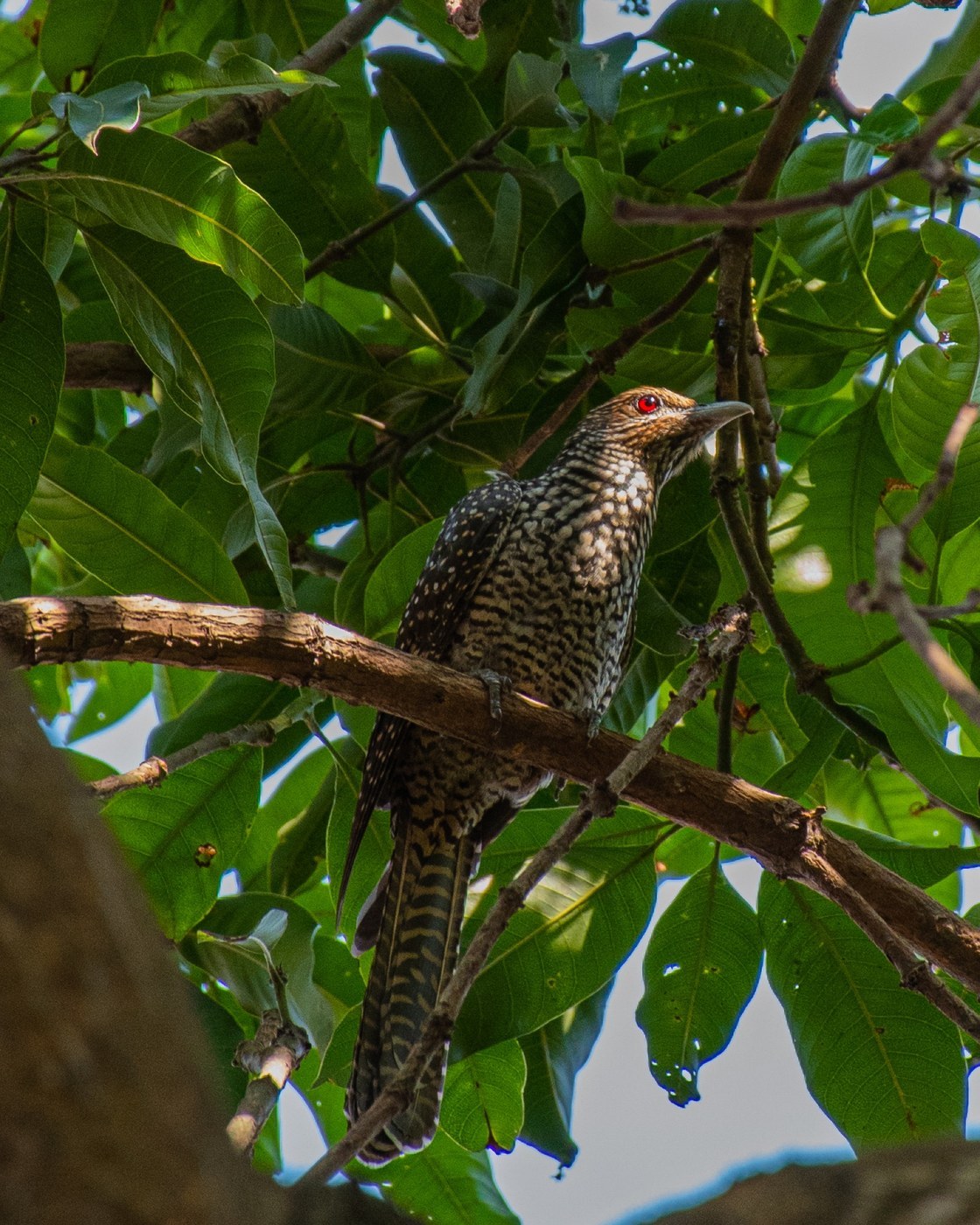
Key Field Marks
- Large cuckoo, noticeably bigger and longer-tailed than a typical songbird, with a bright red eye in both sexes and a pale greenish-gray, slightly downcurved bill.
- Adult male: glossy all-black plumage with a faint bluish-green sheen in good light — easily mistaken for a crow at a glance, but slimmer-bodied with a longer tail and that distinctive red eye.
- Adult female: strikingly different from the male — dark brown above liberally spotted with white or buff, and barred/streaked below with white and dark brown; also shows the red eye.
- Long tail and relatively slim body distinguish it in flight from crows, which have broader wings and shorter, squarer tails.
Behavior
- A brood parasite: lays its eggs in the nests of crows (particularly House Crow and Jungle Crow), which then raise the koel chicks.
- Despite its loud, far-carrying voice, it is a skulking bird that spends much of its time hidden in dense leafy canopy, making it much easier to hear than to see.
- Males call persistently and loudly, especially at dawn and dusk during the breeding season, often from a concealed perch.
Separating from Similar Species
- Male Asian Koels are sometimes mistaken for crows at a distance, but show a slimmer build, longer tail, red (not dark) eye, and a paler, more slender bill than any crow.
- Female's bold white spotting and barring is distinctive and unlike any crow or other common cuckoo in its range.
Habitat & Range
- Found across South Asia and Southeast Asia, with an additional distinct population/race in Australia; generally resident, though some populations show local seasonal movements.
- Favors wooded gardens, groves, forest edge, and urban and suburban areas with tall trees — closely tied to the presence of host crow species.
Voice
- The signature call is a loud, repeated, rising "ko-EL, ko-EL" or "ku-OO, ku-OO," increasing in pitch and intensity, often repeated many times in a row, especially by calling males at dawn.
- Females give a sharp, rapid, chattering "kik-kik-kik-kik" call.
Frequently asked questions
Why is the Asian Koel hard to see even though it's easy to hear?
It is a skulking bird that spends most of its time hidden in dense leafy canopy, so its loud call carries much farther than the bird is willing to show itself.
How can I tell a male Asian Koel from a crow?
Male koels are glossy black like crows but are slimmer, longer-tailed, and have a bright red eye and a paler, slimmer bill, unlike a crow's stout black bill and dark eye.
Why do Asian Koels lay eggs in crow nests?
Asian Koels are brood parasites; they do not build their own nests but instead lay eggs in the nests of crows, which then raise the koel chicks.
What does an Asian Koel sound like?
Males give a loud, repeated, rising 'ko-el, ko-el' call that increases in pitch and volume, especially at dawn during the breeding season; females give a sharp chattering call.