
Ash-throated Flycatcher Identification Guide
A pale, crested desert-and-scrubland flycatcher with a gray throat, faint lemon-wash belly, and rufous edges to the tail.
Read the full Ash-throated Flycatcher encyclopedia entry →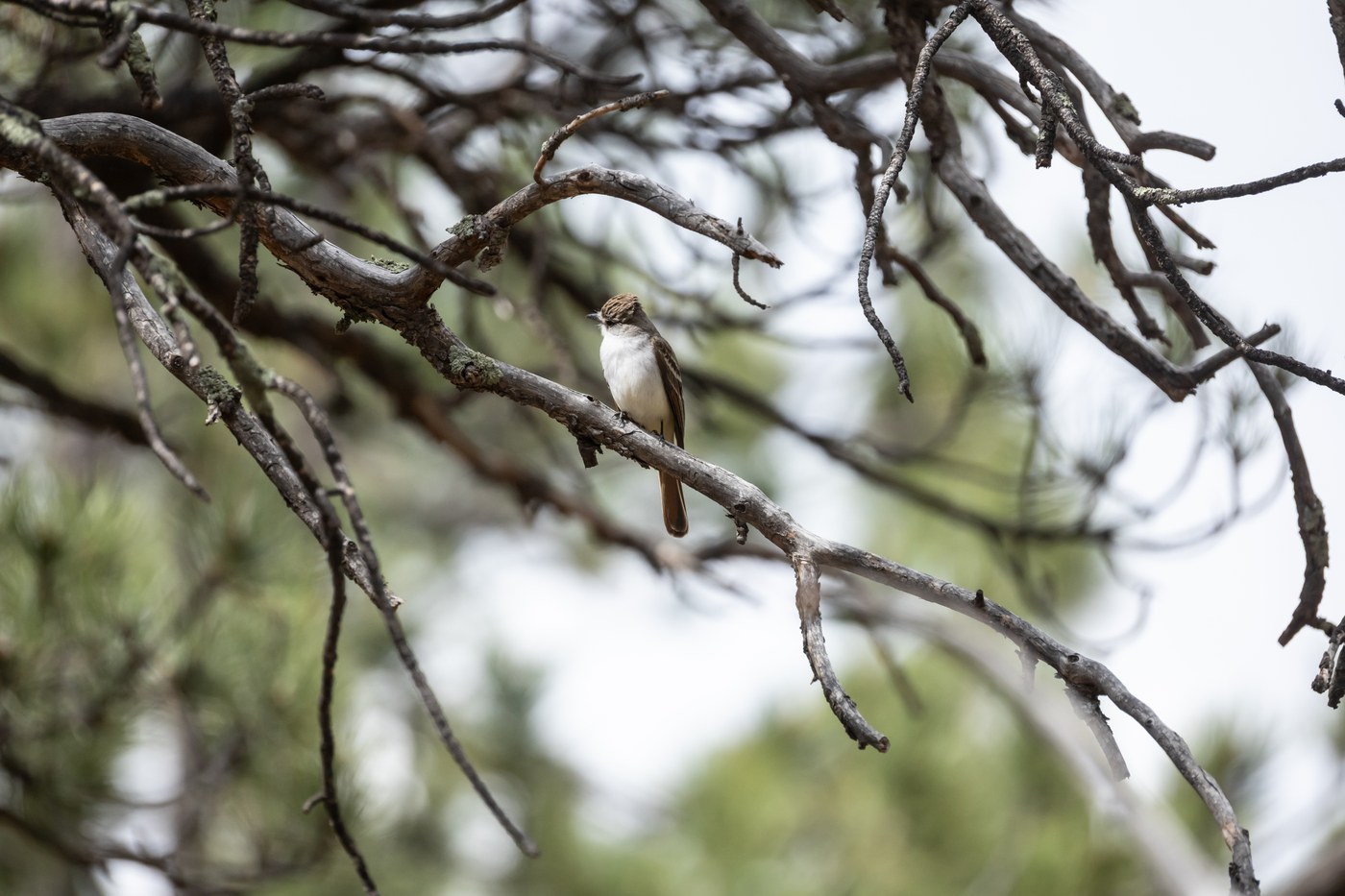
Key Field Marks
- Medium-sized crested flycatcher (genus Myiarchus), with a bushy peaked crown, brownish-gray back, pale gray throat and breast, and a subtle pale lemon-yellow wash on the belly (much less bright than in some related species).
- Tail shows rufous edges and inner webs, most visible from below or when the tail is spread in flight.
- Wings show two whitish wingbars and pale edging on the flight feathers.
- Bill is black, straight, and relatively short and slim for a Myiarchus flycatcher.
Separating from Similar Species
- Great Crested Flycatcher: brighter lemon-yellow belly, more extensively rufous tail, and a mostly eastern range with little overlap.
- Brown-crested Flycatcher: larger overall with a noticeably bigger, thicker bill and more extensively rufous tail feathers (rufous reaches nearer the tip); found in similar southwestern habitats, so voice and bill size are key.
- Dusky-capped Flycatcher: smaller, lacks rufous in the tail, has a shorter bill, and gives a distinctive plaintive, descending whistle rather than the harsh calls of Ash-throated.
- Voice is often the most reliable way to separate Myiarchus flycatchers in the field when plumage differences are subtle.
Habitat & Range
- Breeds across the arid and semi-arid West, from desert scrub and mesquite grassland to oak woodland, chaparral, and riparian edges.
- Migratory: arrives in the Southwest in spring, departs in fall to winter mainly in Mexico and Central America, though small numbers regularly winter along the US Gulf Coast and in California.
- Nests in cavities, including old woodpecker holes, nest boxes, and even unconventional sites like pipes or fence posts.
Voice
- Gives a rough, rolling "ka-brick" call and a sharp "prrrt" or "wheep" — distinctive and often the quickest way to detect the species even before it's seen.
Frequently asked questions
How do I tell Ash-throated Flycatcher from Great Crested Flycatcher?
Ash-throated has a paler, more subtle yellow belly wash and less rufous in the tail, and it occurs mainly in the arid West, while Great Crested Flycatcher is brighter yellow below and mostly an eastern species.
What does an Ash-throated Flycatcher sound like?
It gives a rough, rolling 'ka-brick' call and a sharp 'prrrt' or 'wheep,' quite different from the mournful whistle of Dusky-capped Flycatcher.
Where does the Ash-throated Flycatcher breed?
Across arid and semi-arid habitats of the western United States, including desert scrub, mesquite grassland, oak woodland, and chaparral.
Does Ash-throated Flycatcher nest in cavities?
Yes, it is a cavity nester, using old woodpecker holes, nest boxes, and sometimes unusual man-made cavities.