
Apostlebird Identification Guide
A dusty gray-brown Australian songbird famous for moving through the outback in noisy, cooperative family groups of about a dozen birds.
Read the full Apostlebird encyclopedia entry →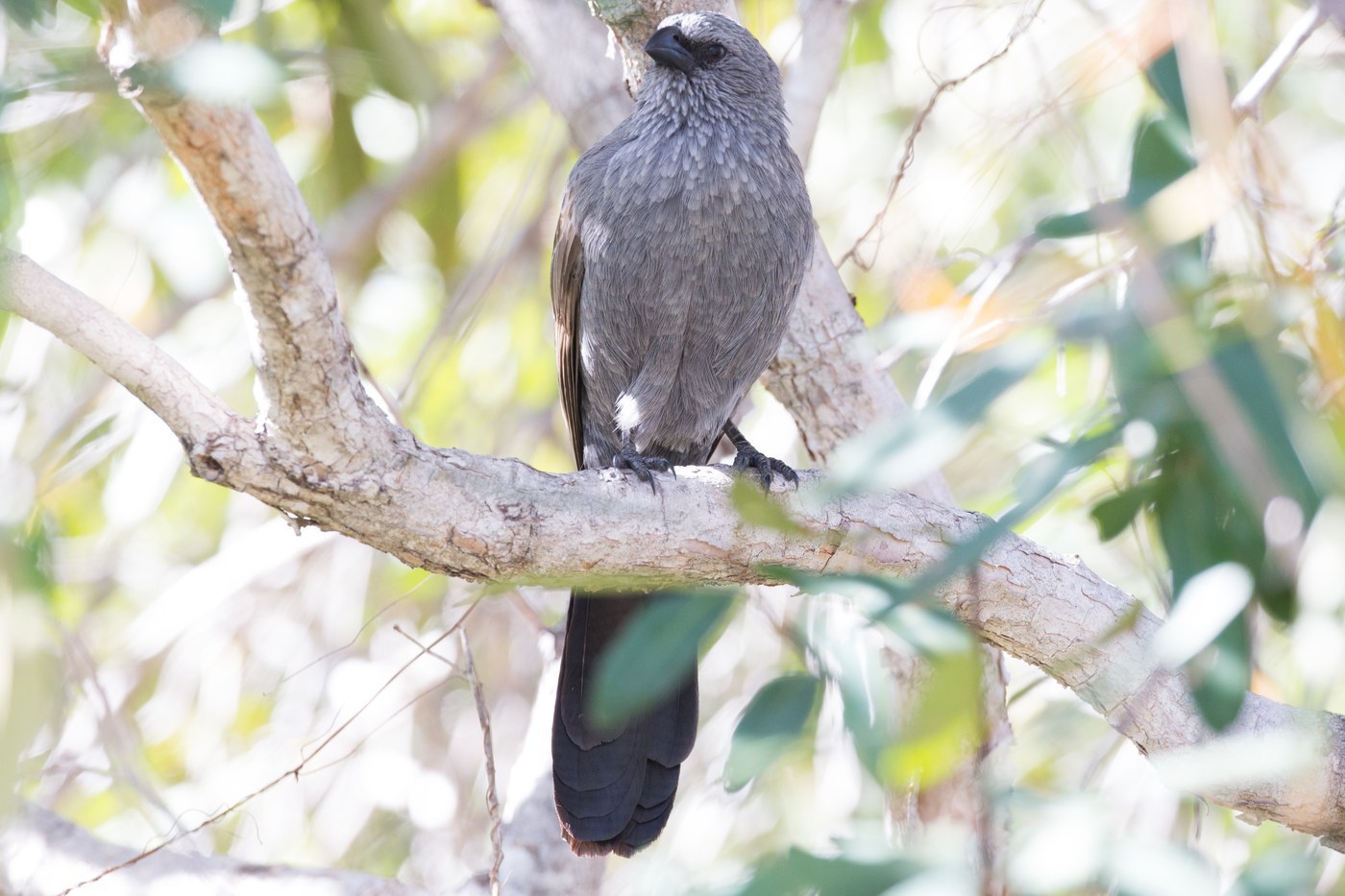
Key Field Marks
- Medium-sized, all sooty gray-brown bird, about 33 cm (13 in) long, with a long tail and a stout, sturdy black bill.
- Plumage is uniformly drab gray-brown with slightly paler feather edges giving a faintly scaled look; wings and tail are darker.
- Eye is dark reddish-brown in adults (duller in juveniles).
- Overall shape is somewhat crow- or babbler-like: compact body, long tail, and a slightly shaggy look to the head feathers.
Behavior
- Extremely social — Apostlebirds live and forage in tight family groups traditionally said to number about twelve ("the apostles"), typically ranging from 6 to 20 birds.
- Cooperative breeders: multiple group members help build the nest, incubate, and feed young.
- Builds a distinctive bulky, bowl-shaped mud nest reinforced with grass, often placed on a horizontal branch, and constructed communally by the group.
- Forages mostly on the ground, walking and hopping while probing leaf litter and soil for insects and seeds; groups move and feed together, keeping up constant chatter.
Separating from Similar Species
- White-winged Chough: the other main cooperatively breeding "mudnester" of similar habitat and social behavior, but the Chough is larger, glossier black, has a longer downcurved bill, a bright red eye, and shows a bold white wing patch in flight — Apostlebird is smaller, uniformly dull gray-brown, with no white in the wing.
- Gray Currawong and other gray birds are much larger, with strong black-and-white patterning and a heavier hooked bill, unlike the plain Apostlebird.
- Apostlebird's constant group chattering and ground-foraging flocks are themselves a strong behavioral clue.
Habitat & Range
- Endemic to inland eastern Australia, found across open woodland, farmland, scrubby grazing country, and areas near watercourses with scattered trees.
- Non-migratory resident; family groups hold and defend territories year-round.
Voice
- Noisy and constantly vocal in groups: harsh chattering, squeaking, and scolding notes exchanged as the flock forages and moves together.
Frequently asked questions
Why is it called an Apostlebird?
The name comes from its habit of moving in family groups traditionally said to number around twelve, like the biblical apostles, though group size actually ranges from about 6 to 20 birds.
How do I tell an Apostlebird from a White-winged Chough?
Apostlebird is smaller and uniformly dull gray-brown with no white in the wings, while White-winged Chough is larger, glossier black, has a longer curved bill, and shows a bold white wing patch in flight.
What color are an Apostlebird's eyes?
Adults have dark reddish-brown eyes; juveniles show duller eye color until they mature.
Where do Apostlebirds live?
They are found only in inland eastern Australia, in open woodland, farmland, and scrub, usually in noisy, cooperative family groups.