
Aplomado Falcon Identification Guide
A slim, long-tailed grassland falcon with a bold facial pattern and a dark belt across an otherwise pale, buffy underside.
Read the full Aplomado Falcon encyclopedia entry →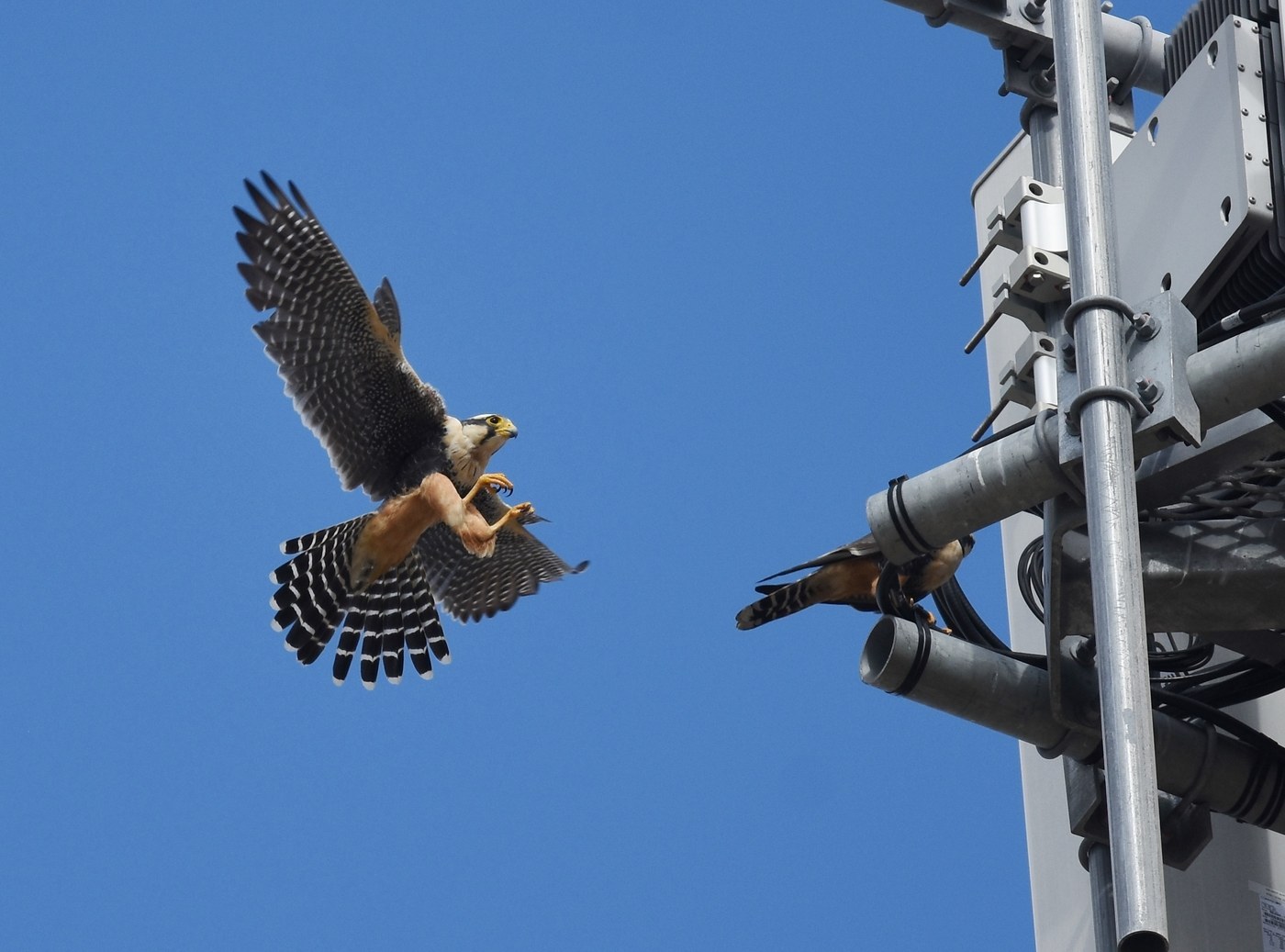
Key Field Marks
- Slender, long-winged, long-tailed falcon, about 15-17 inches (38-43 cm) long — noticeably slimmer and longer-tailed than a Peregrine.
- Head shows a bold pattern: white supercilium (eyebrow) meeting over the bill, dark cheek patch/mustache, and white throat.
- Upperparts blue-gray; upper breast and sides form a solid black band or "belt"; lower belly and thighs are warm buffy-orange to rufous, contrasting sharply with the pale breast above the belt.
- In flight, the long tail and wings give a distinctive silhouette, with strongly barred tail and dark underwings.
Behavior
- Often hunts in pairs, coursing low and fast over open ground, sometimes flushing prey cooperatively.
- Takes small birds, large insects, and occasionally small mammals or reptiles.
- Perches on yuccas, fence posts, utility poles, or scattered shrubs in open country.
Separating from Similar Species
- Peregrine Falcon: bulkier, broader-winged, with a solid dark hood and no black belly band or rufous thighs; underparts are barred, not divided into a clean belt-and-buffy-belly pattern.
- Prairie Falcon: larger and paler brown overall, with dark axillary ("armpit") patches visible in flight, lacking the crisp black chest band.
- Merlin: much smaller and stockier, without the strong facial pattern or belted underparts.
- The combination of white eyebrow, black chest belt, and rufous thighs is unique among North American falcons.
Habitat & Range
- Found in open grassland, savanna, and desert grassland with scattered yucca, mesquite, or agave for perching and nesting (often reusing old raven or hawk stick nests).
- In the United States, occurs mainly in reintroduced populations in southern Texas (and a small reintroduced population in southern New Mexico/Arizona); far more numerous through Mexico, Central America, and much of South America.
- Non-migratory in most of its range, staying near breeding territories year-round.
Voice
- Gives sharp, cackling "kek-kek-kek" alarm calls near the nest, along with whining and chittering notes between mates.
Frequently asked questions
What is the easiest field mark for Aplomado Falcon?
Look for the bold white eyebrow, dark cheek patch, and a black band across the upper chest that separates a white throat from a rufous-orange belly and thighs.
Where in the US can I find Aplomado Falcons?
The most reliable US location is coastal grassland in southern Texas, where a reintroduced population persists; sightings elsewhere in the Southwest are rare.
How does an Aplomado Falcon differ from a Peregrine Falcon?
Aplomado Falcons are slimmer with longer tails, have a distinct black chest belt and rufous thighs, and lack the Peregrine's solid dark hood and heavily barred underparts.
Do Aplomado Falcons hunt alone?
They frequently hunt in pairs, coursing low over open terrain and sometimes cooperating to flush and catch birds.