
Anna's Hummingbird Identification Guide
A stocky, year-round West Coast hummingbird whose males flash an iridescent rose-pink gorget that extends up over the crown.
Read the full Anna's Hummingbird encyclopedia entry →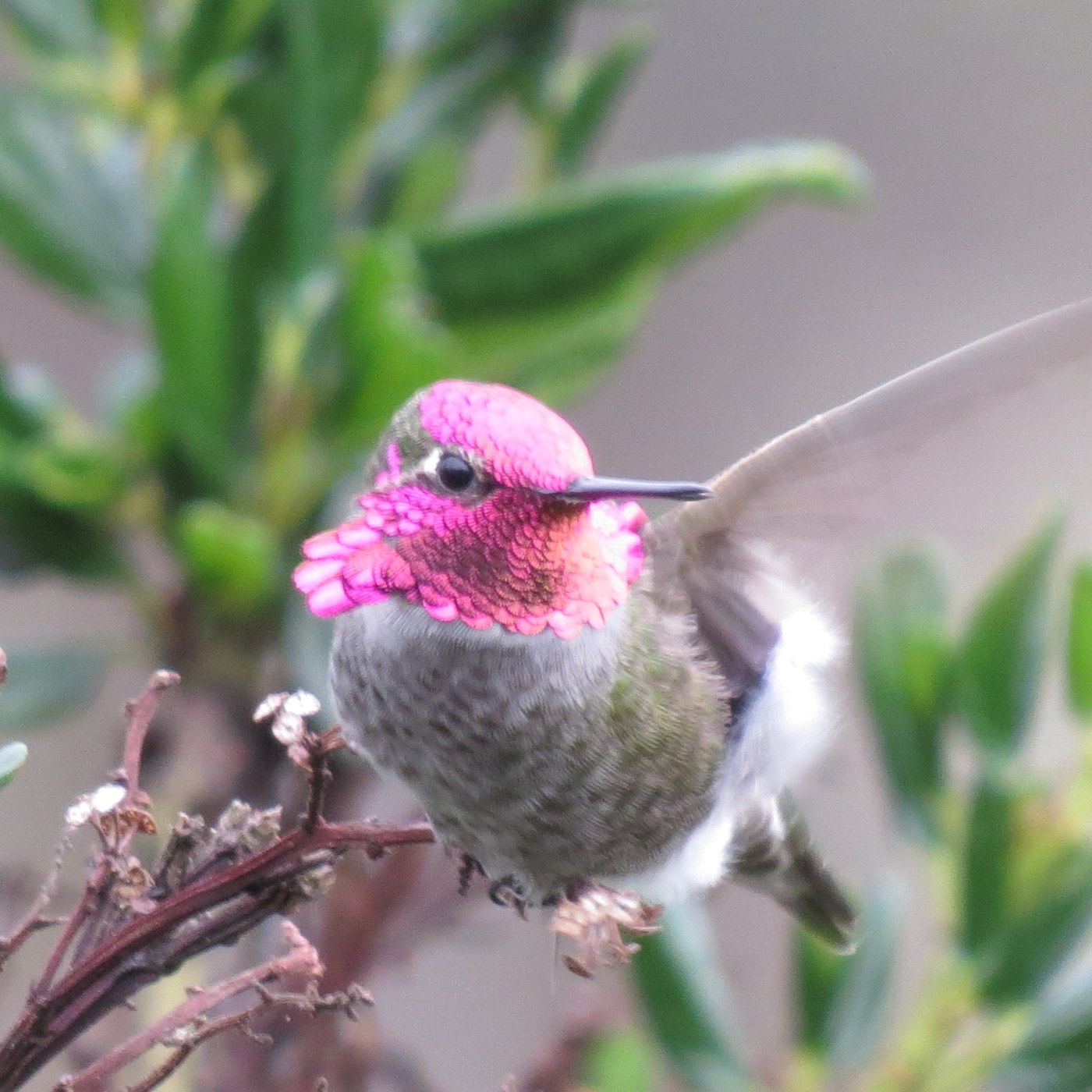
Key Field Marks
- Medium-large hummingbird, about 4 inches (10 cm) long, with a relatively short, straight black bill and a fairly stocky, broad-tailed build.
- Adult male: iridescent rose-pink to magenta gorget that wraps up over the crown as well as the throat — the only widespread North American hummingbird with a colored crown to match the throat. Body is dull grayish-green above and pale gray below.
- Adult female: metallic green back, gray underparts, and a whitish throat usually marked with a small central patch of pink-red spotting (variable, sometimes nearly absent).
- Immatures resemble females; young males slowly acquire scattered pink throat/crown feathers.
- Tail is fairly broad and rounded compared to the notched tails of some other western hummingbirds.
Behavior & Display
- Males give a spectacular, near-vertical J-shaped display dive from 30+ feet up, ending in a loud explosive "pop" or "chirp" produced by tail feathers at the bottom of the dive.
- Unlike most hummingbirds, males regularly sing a scratchy, buzzy, jumbled song from an exposed perch — listen for this year-round, since Anna's do not migrate far.
- Aggressively defends flowers and feeders; often the dominant hummingbird at West Coast feeding stations.
Separating from Similar Species
- Costa's Hummingbird: male has a violet-purple (not pink) gorget with elongated points sweeping down the sides like a mustache, and no colored crown; found in drier desert habitat.
- Ruby-throated Hummingbird: red throat only (no colored crown), mostly an eastern species with little range overlap.
- Broad-tailed / Rufous Hummingbird: males show orange-red gorgets and more rufous in the body/tail; females and immatures can be trickier but lack the crown color potential of Anna's.
- Female/immature Anna's are best told from similar female hummingbirds by overall larger, stockier size, grayer underparts, and any hint of pink throat spotting.
Habitat & Range
- Resident (non-migratory) along the Pacific Coast from Baja California north through California, Oregon, Washington, and into British Columbia; increasingly found inland and even wintering as far as the desert Southwest thanks to backyard feeders and ornamental plantings.
- Found in gardens, parks, chaparral, oak woodland, eucalyptus groves, and urban/suburban yards with flowers or feeders — one of the most feeder-friendly hummingbirds.
- Present and breeding earlier than most hummingbirds; nesting can start in midwinter in mild coastal areas.
Voice
- Song: a prolonged, scratchy, buzzy series of chips and squeaky notes delivered from a perch, unusual among hummingbirds.
- Call: a sharp, dry "chip" or "tick," often repeated.
Frequently asked questions
How do I tell a male Anna's Hummingbird from a Costa's Hummingbird?
Anna's has a rose-pink gorget that extends up over the crown; Costa's has a violet-purple gorget with long pointed sides and no colored crown.
Do Anna's Hummingbirds migrate?
No, they are largely non-migratory residents along the Pacific Coast and can be seen year-round, including through winter thanks to feeders and mild coastal climates.
Why is the male's throat sometimes dark, not pink?
Iridescent gorget feathers only flash color when light hits them at the right angle; from other angles the throat can look black or dull.
What does an Anna's Hummingbird sound like?
Males give a scratchy, buzzy, jumbled song from a perch, plus a sharp dry chip call — and a loud popping sound at the bottom of their display dives.