
Andean Flamingo Identification Guide
The tallest and rarest of South America's three flamingo species, distinguished from its relatives by bright yellow legs and extensive black in the folded wing.
Read the full Andean Flamingo encyclopedia entry →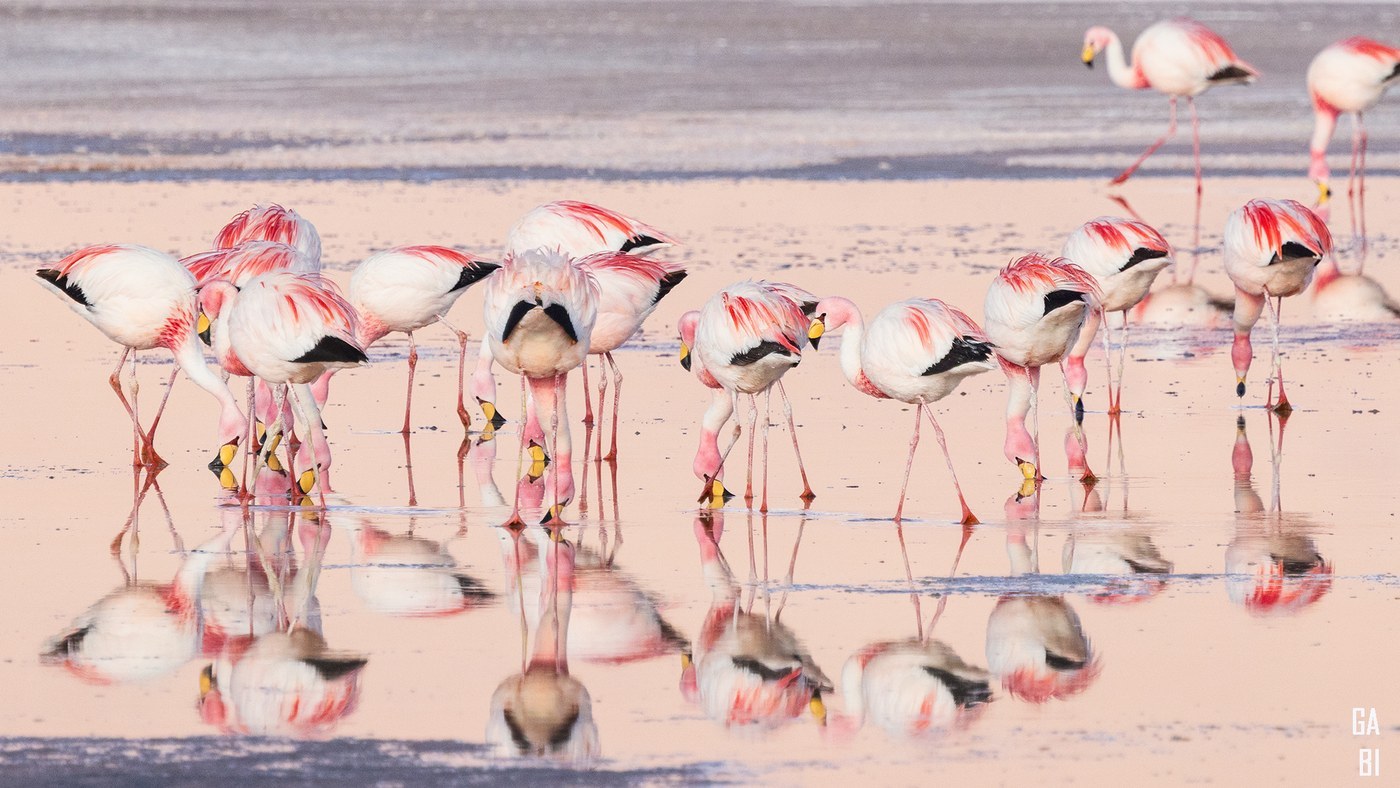
Key Field Marks
- Tall, pale pink flamingo, the largest of the three high-Andean flamingo species
- Bright yellow legs and feet — the only flamingo species in the world with yellow (rather than pink or reddish) legs
- Tricolored bill: pale yellow at the base shading to black at the tip, with black covering a larger portion of the bill than in related species
- Extensive black in the folded wing (tertial feathers), often visible even when the bird is standing and not in flight
- Lacks a hind toe (hallux), a trait shared only with the smaller James's (Puna) Flamingo among flamingos
How to Tell It Apart from Similar Species
- Chilean Flamingo has grayish-pink legs with distinctive reddish "knee" joints, rather than the Andean Flamingo's solid bright yellow legs, and shows less black in the folded wing.
- James's (Puna) Flamingo is smaller and deeper pink/carmine overall, with orange-red (not yellow) legs, a shorter, mostly dark red bill with a smaller area of black at the tip, and bright carmine streaking on the neck and back that the paler Andean Flamingo lacks.
- Leg color is the single fastest field mark: yellow legs indicate Andean Flamingo, while pink-to-red legs point to Chilean or James's Flamingo.
Habitat & Range
Andean Flamingos are restricted to high-altitude salt lakes and alkaline lagoons of the Andean altiplano and puna, across Peru, Bolivia, Chile, and Argentina, typically at elevations of roughly 3,000-4,500 m. These harsh, cold, saline environments support the specialized algae and diatoms that make up the species' diet.
Behavior
Like other flamingos, Andean Flamingos filter-feed by swinging the head from side to side with the bill held upside down in the water or mud, using fine comb-like lamellae to strain out diatoms and algae. They form large flocks and breed colonially, building mud-mound nests in shallow salt lakes, and take part in synchronized group courtship displays involving coordinated marching, head-flagging, and wing salutes. The species is classified as Vulnerable, with its small, declining population threatened by habitat disturbance, including impacts from lithium and mineral mining around key breeding lakes.
Voice
Andean Flamingos give goose-like nasal honking and cackling calls, both from flocks on the ground and from birds in flight.
Frequently asked questions
How do you identify an Andean Flamingo?
Look for a tall, pale pink flamingo with bright yellow legs and feet, a yellow bill with an extensively black tip, and substantial black visible in the folded wing.
What is the difference between an Andean Flamingo and a Chilean Flamingo?
The Andean Flamingo has solid bright yellow legs, while the Chilean Flamingo has grayish-pink legs with reddish knee joints; the Andean also shows more black in the folded wing.
What is the difference between an Andean Flamingo and a James's (Puna) Flamingo?
The Andean Flamingo is larger and paler pink with yellow legs and a bill that is mostly black at the tip, while the James's Flamingo is smaller, deeper carmine-pink, with orange-red legs and a shorter bill with less black.
Where do Andean Flamingos live?
On high-altitude salt lakes and alkaline lagoons of the Andean altiplano and puna region across Peru, Bolivia, Chile, and Argentina, typically above 3,000 m elevation.
Are Andean Flamingos endangered?
They are classified as Vulnerable, with a small and declining population threatened by disturbance to their high-altitude salt lake habitat, including impacts from mining activity.