
Andean Cock-of-the-rock Identification Guide
The national bird of Peru, a vivid orange-red cotinga whose male has a huge disc-shaped crest and performs a bizarre lek display in Andean cloud forest.
Read the full Andean Cock-of-the-rock encyclopedia entry →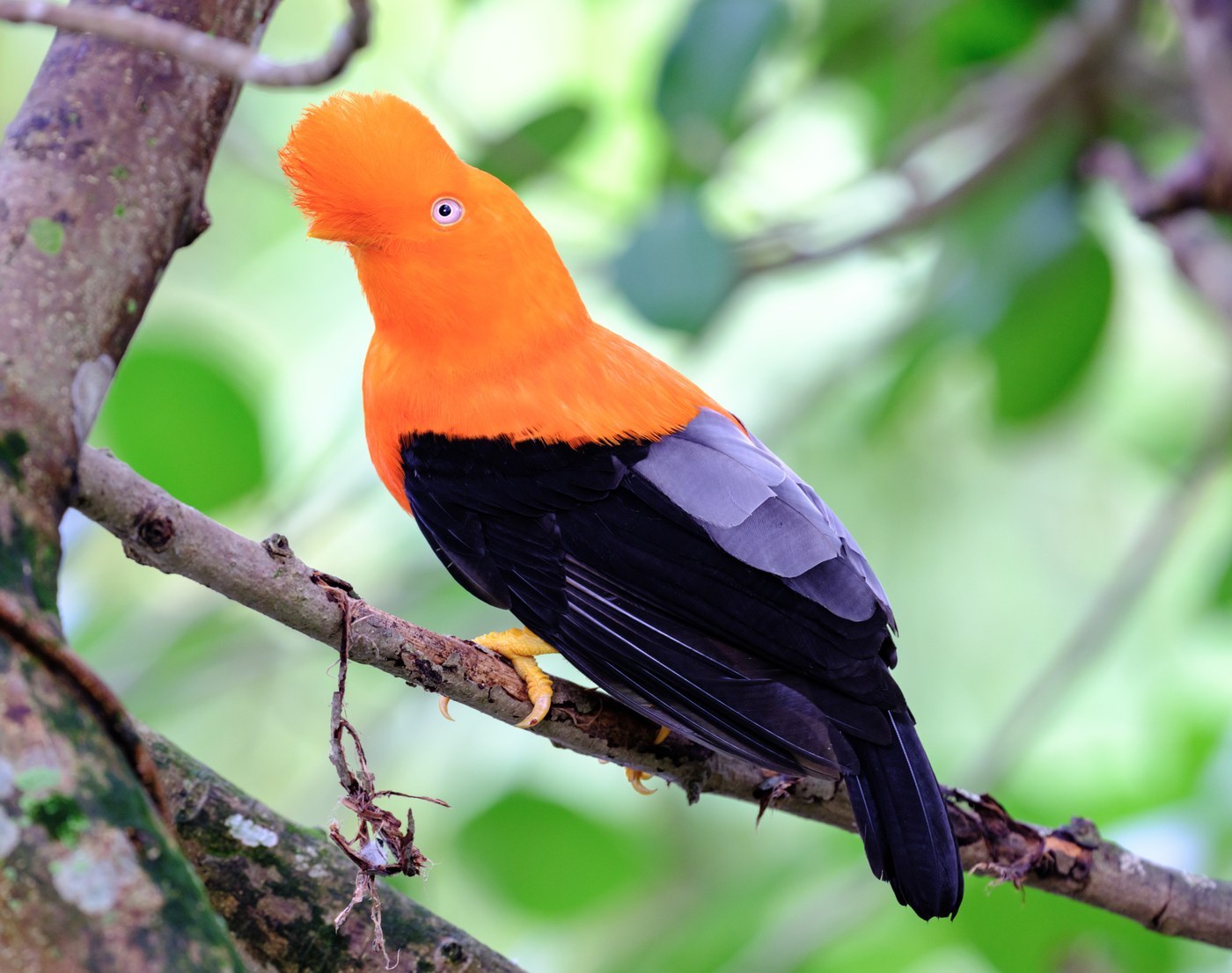
Key Field Marks
- Male: brilliant orange-red to scarlet-orange plumage overall, with a large, semicircular, disc-shaped crest running from the forehead over the crown that nearly conceals the bill
- Black-and-gray wings with a pale, silvery scapular patch and a black tail
- Female: dull brownish-red to rufous-brown overall, camouflaged, with a much smaller and less conspicuous crest
- Chunky, pigeon-like body shape with a short tail
How to Tell It Apart from Similar Species
- Guianan Cock-of-the-rock, the only other cock-of-the-rock species, occurs on the Guiana Shield (Venezuela, the Guianas, and northern Brazil) rather than in the Andes, has a taller, more vertical fan-shaped crest, and tends toward a brighter orange-yellow rather than the often deeper orange-red of the Andean species; the two do not overlap in range.
- No other bird sharing Andean cloud forest habitat combines the male's saturated orange-red color with such an oversized, bill-concealing crest, making adult males essentially unmistakable.
- Females are far less distinctive and are best identified by range, habitat, and association with known lek sites or displaying males.
Habitat & Range
Andean Cock-of-the-rocks inhabit humid montane cloud forest along the Andes from Venezuela and Colombia south through Ecuador, Peru, and into Bolivia, typically at elevations of roughly 500-2,400 m. They favor forest near rocky ravines, boulders, and cliff faces, which provide nesting sites, and are generally shy and difficult to observe outside of display areas.
Behavior
The species is best known for its lek mating system: males gather at traditional display grounds in the forest understory, where they perform elaborate, competitive displays — bowing, hopping, wing-snapping, bill-clacking, and loud vocalizing — to attract visiting females, who then leave to nest and raise young alone. Outside of lek activity, birds are quiet, frugivorous, and often solitary, feeding on fruit in the forest canopy and understory. Females build mud nests plastered onto rock faces or cave walls near streams.
Voice
At leks, males give loud, harsh, guttural grunts, squawks, and croaking calls, often audible well before the birds themselves are seen.
Frequently asked questions
How do you identify an Andean Cock-of-the-rock?
Look for a chunky, orange-red bird with a huge, disc-shaped crest that nearly hides the bill; males are far brighter than the camouflaged brownish-red females.
What is the difference between an Andean and a Guianan Cock-of-the-rock?
The Andean species lives in Andean cloud forest and has a rounder, more forward-drooping crest, while the Guianan species lives on the Guiana Shield and has a taller, more vertical, fan-like crest; their ranges do not overlap.
What is a cock-of-the-rock lek?
A traditional forest display ground where multiple males gather to perform competitive courtship displays — bowing, jumping, and calling — that females visit to choose a mate.
Where can you see an Andean Cock-of-the-rock?
In humid montane cloud forest along the Andes from Venezuela and Colombia south to Bolivia, often near rocky ravines and streams, and reliably at known lek sites.
What do Andean Cock-of-the-rocks eat?
Mainly fruit gathered in the forest canopy and understory, occasionally supplemented with small animals.