
American Woodcock Identification Guide
A plump, camouflaged, forest-floor shorebird relative with a very long bill and huge eyes, famous for the male's spiraling twilight 'sky dance' display.
Read the full American Woodcock encyclopedia entry →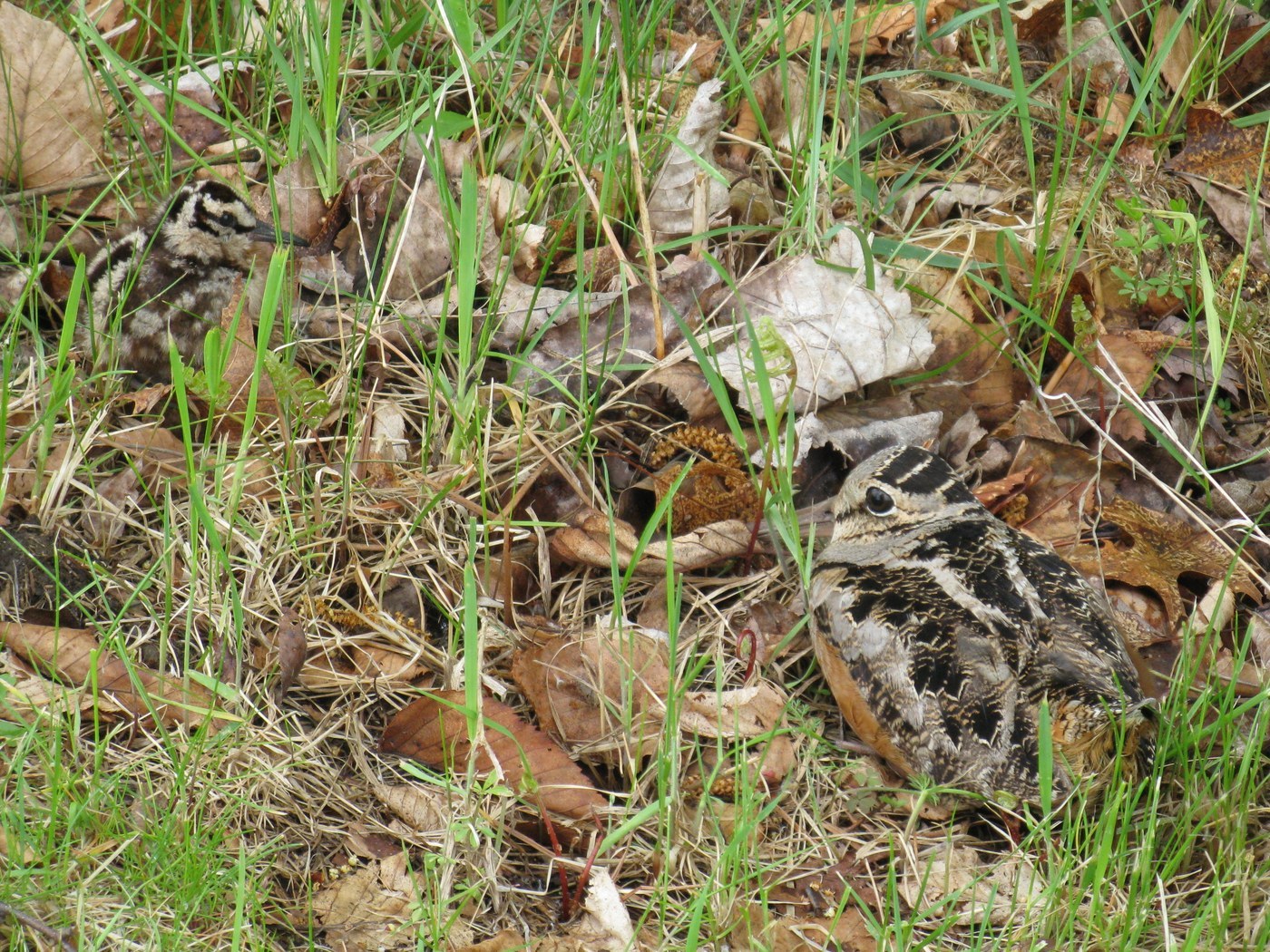
Key Field Marks
- Chunky, round-bodied bird with short legs and a very long, straight bill (roughly 6-8 cm) used for probing soft soil
- Intricately mottled brown, black, buff, and gray plumage that resembles dead leaves on the forest floor
- Large, dark eyes set unusually high and far back on the head, giving the bird near 360-degree vision to watch for predators while probing head-down in the soil
- Short, rounded wings and a short tail; overall a stocky, almost neckless silhouette
How to Tell It Apart from Similar Species
- Wilson's Snipe shares a long bill and cryptic brown plumage but shows bold, contrasting dark stripes on the head and back, a slimmer build, and favors open marshy and wet habitats rather than woodland — woodcocks are birds of dry-to-moist forest floor and shrubby edges, not open wetlands.
- The woodcock's uniformly mottled (rather than boldly striped) pattern, chunkier proportions, and very high, rear-set eye placement are the quickest distinguishing features from any other similarly billed bird.
Habitat & Range
American Woodcock are found across eastern North America, favoring young second-growth forest, moist woodlands with soft soil, alder thickets, and overgrown fields adjacent to woods — habitat that provides both dense cover and earthworm-rich soil. They are migratory, with northern breeders wintering in the southeastern United States.
Behavior
Woodcock are crepuscular and largely nocturnal, most active at dawn and dusk. They forage by probing deeply into soft soil and leaf litter with their long, flexible-tipped bill to extract earthworms, their primary food. While walking, they have a distinctive habit of rocking and bobbing the body up and down. Males are famous for an elaborate courtship performance known as the "sky dance," beginning at dusk with nasal, buzzy "peent" calls given from the ground in an open field, followed by a spiraling flight high into the air accompanied by twittering wing sounds, then a zigzagging silent descent and a soft chirping return to the ground to resume peenting.
Voice
The nasal, buzzy "peent" given from the ground and the twittering whistle produced by the wings during the male's display flight are the most distinctive sounds, both typically heard around dawn and dusk during the breeding season.
Frequently asked questions
How do you identify an American Woodcock?
Look for a plump, short-legged, cryptically mottled brown bird with a very long straight bill and large eyes set unusually high and far back on the head.
What is the difference between an American Woodcock and Wilson's Snipe?
The woodcock has more uniformly mottled plumage, a chunkier build, and favors moist woodland and brushy edges, while the snipe has bold head and back stripes, a slimmer shape, and prefers open marshes and wet fields.
What is the American Woodcock's 'sky dance'?
It is the male's dusk courtship display: buzzy peent calls from the ground, followed by a high, twittering spiral flight and a zigzagging silent descent back to the display site.
When is the best time to see an American Woodcock?
At dawn or dusk during the breeding season, when displaying males perform their sky dance in open fields near woodland edges; they are otherwise secretive and mostly nocturnal foragers on the forest floor.
What does an American Woodcock eat?
Primarily earthworms, extracted by probing the long bill deep into soft, moist soil, along with other soil invertebrates.