
American White Pelican Identification Guide
One of North America's largest birds, an enormous white waterbird with black flight feathers and a massive orange bill that fishes cooperatively while swimming rather than diving.
Read the full American White Pelican encyclopedia entry →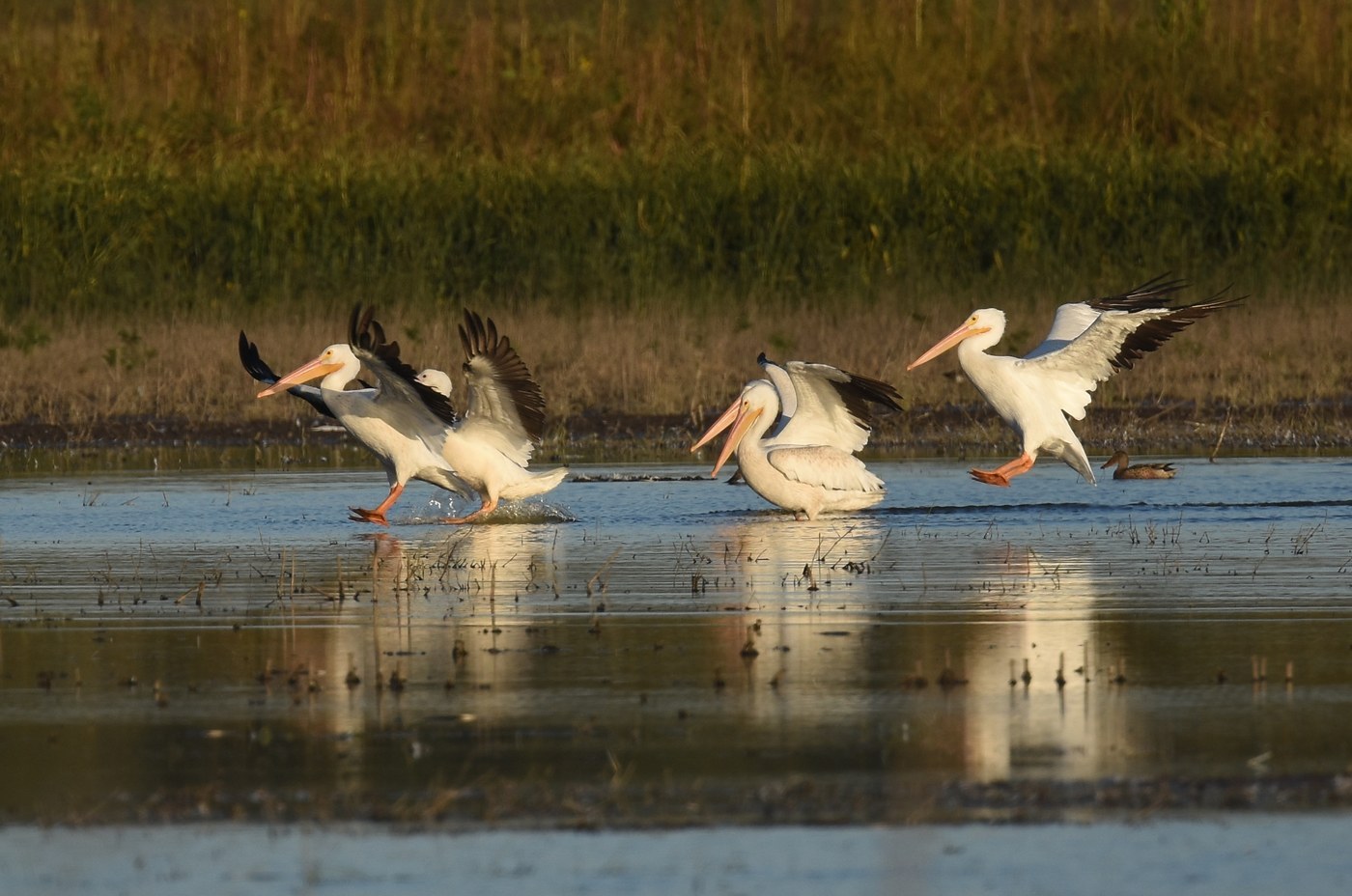
Key Field Marks
- Very large, all-white body with sharply contrasting black flight feathers (primaries and secondaries), visible mainly in flight
- Massive, long, orange-yellow bill with an expandable throat pouch
- Orange-yellow legs and feet
- Breeding adults grow a flattened, horny plate or knob on the upper bill and a shaggy crest on the back of the head, both lost after the breeding season
- Immense wingspan, among the largest of any North American bird
How to Tell It Apart from Similar Species
- Brown Pelican is much smaller, brown-gray overall (not white), restricted mainly to coastal waters, and feeds by spectacular plunge-diving — a habit the American White Pelican does not share.
- Wood Stork, another large white bird with black flight feathers, has a dark, bald, unfeathered head and neck and a heavier, downcurved gray bill, quite different from the pelican's straight orange bill and pouch.
- Trumpeter and Tundra Swans are all white without any black in the wing and lack the pelican's huge bill and pouch.
- Snow Goose shows a similar black-and-white flight pattern at a distance but is far smaller with a short pink bill.
Habitat & Range
American White Pelicans breed colonially on isolated islands in freshwater lakes and marshes across the interior of western North America, from the northern Great Plains and prairie Canada into the Great Basin. Outside the breeding season they winter along the Gulf Coast, Florida, the Pacific coast, and into Mexico and Central America, using coastal lagoons, estuaries, and large lakes.
Behavior
Unlike the coastal Brown Pelican, American White Pelicans never plunge-dive for fish. Instead, they forage while swimming on the surface, dipping their bills to scoop up fish, often cooperating in loose groups or lines to herd schools of fish into shallow water where they can be caught more easily. Flocks are frequently seen soaring high on thermals in long lines or V-formations, alternating bouts of flapping with extended gliding.
Voice
Adults are largely silent away from the breeding colony, where they may give low grunting and croaking calls; young birds beg with harsh grunts.
Frequently asked questions
How do you identify an American White Pelican?
Look for an enormous all-white waterbird with black flight feathers visible in flight, a massive orange-yellow bill and pouch, and orange legs.
What is the difference between an American White Pelican and a Brown Pelican?
The American White Pelican is much larger and entirely white with black wingtips, forages by swimming and scooping rather than diving, and is found mainly on inland lakes and coastal bays, while the Brown Pelican is smaller, brownish-gray, coastal, and plunge-dives for fish.
Do American White Pelicans dive for fish?
No — they feed while swimming on the surface, dipping their bills to catch fish, often cooperating in groups to herd fish into the shallows, unlike the plunge-diving Brown Pelican.
Where do American White Pelicans breed?
On isolated islands in freshwater lakes and marshes across the interior of western North America, wintering along the Gulf Coast, Florida, Pacific coast, and into Mexico.
Why do some American White Pelicans have a bump on their bill?
Breeding adults grow a flattened horny plate on the upper bill along with a shaggy head crest; both are shed after the breeding season.