
American Tree Sparrow Identification Guide
A rusty-capped winter sparrow of northern latitudes, easily told from similar sparrows by its bicolored bill and single dark spot on an otherwise plain gray breast.
Read the full American Tree Sparrow encyclopedia entry →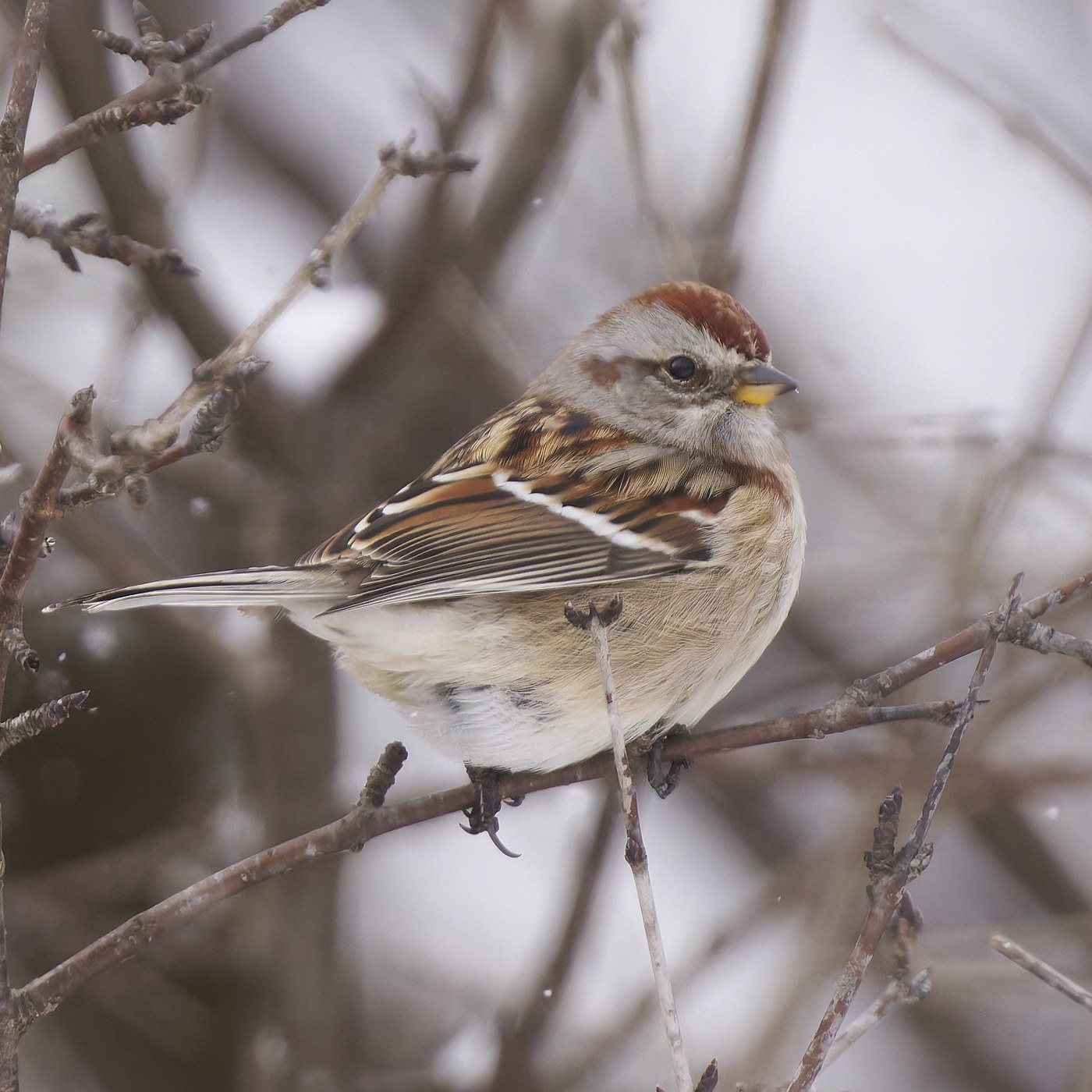
Key Field Marks
- Rusty-red cap and a rusty stripe extending back through the eye, set against an otherwise gray face and nape
- Plain gray, unstreaked breast marked with a single small dark central spot
- Bicolored bill: dark upper mandible, yellow lower mandible
- Rust-streaked brown back with white wingbars
- Long, notched tail
How to Tell It Apart from Similar Species
- Chipping Sparrow looks similar with its rusty cap but shows a black (not rusty) eyeline, a plain gray unmarked breast without a central spot, and an all-dark bill; Chipping Sparrows are also summer breeders across much of the U.S. and largely absent when Tree Sparrows arrive for winter, so the two rarely need to be separated side by side.
- Field Sparrow has an all-pink bill, a plain face lacking the strong gray-and-rust contrast, and a white eye-ring, with no central breast spot.
- American Tree Sparrow is essentially the only common sparrow across most of its winter range showing the combination of rusty cap, gray unstreaked breast, central breast spot, and bicolored bill.
Habitat & Range
American Tree Sparrows breed in the low shrubby tundra and taiga edge of the far north, across Alaska and northern Canada, well beyond the reach of most birders. In winter they move south into a broad swath of southern Canada and the northern two-thirds of the contiguous United States, where they become a familiar sight in weedy fields, brushy hedgerows, marsh edges, and backyard feeders — often in loose flocks. The species is absent from the Lower 48 in summer, making it a true winter specialty across much of its range.
Behavior
Tree Sparrows forage on the ground and in low weeds and shrubs, eating seeds throughout the winter (despite the name, they are birds of open shrubby country rather than forest canopy) and switching to insects during the brief Arctic breeding season. They are often found in loose flocks with other sparrow species at weedy field edges and feeders, and readily visit ground feeders offering millet or mixed seed.
Voice
The song, more often heard on the breeding grounds than in winter, is a sweet, variable, musical warble. The most frequently heard call in winter is a soft, musical "teedle-eet" or "tseet," often given by flocking birds keeping in contact.
Frequently asked questions
How do you identify an American Tree Sparrow?
Look for a rusty cap and rusty eyeline on a gray face, a plain gray breast with a single dark central spot, and a bicolored bill — dark on top, yellow below.
What is the difference between an American Tree Sparrow and a Chipping Sparrow?
The Tree Sparrow has a rusty eyeline, an all-dark-and-yellow bicolored bill, and a central breast spot, while the Chipping Sparrow has a black eyeline, an all-dark bill, and a plain unmarked breast; the two species also rarely overlap seasonally in most areas.
When and where can you see an American Tree Sparrow?
In winter, across southern Canada and the northern two-thirds of the United States in weedy fields, brushy edges, and at feeders; they breed far to the north in Arctic tundra and taiga shrub habitat and are absent from most of the U.S. in summer.
Despite its name, does the American Tree Sparrow live in trees?
Not particularly — it favors open, shrubby, and weedy habitats rather than forest, and the name is considered something of a historical misnomer.
What does an American Tree Sparrow sound like?
A soft, musical 'teedle-eet' contact call in winter flocks, and a sweet, variable warbling song on the northern breeding grounds.