
American Three-toed Woodpecker Identification Guide
A boreal-forest specialist woodpecker with a black-and-white barred back and only three toes, closely tied to burned and beetle-killed conifer stands.
Read the full American Three-toed Woodpecker encyclopedia entry →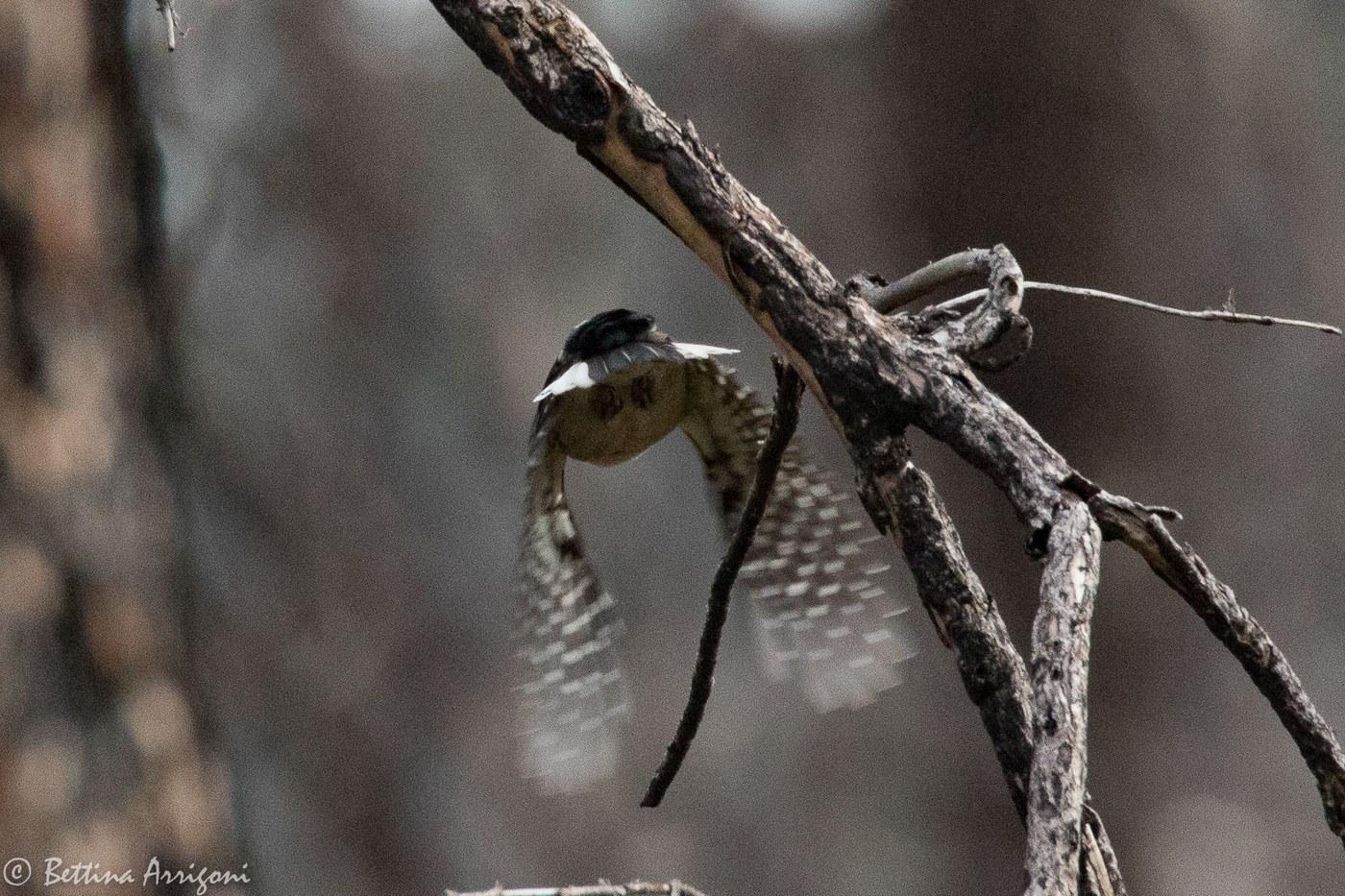
Key Field Marks
- Medium-sized woodpecker with a black back crossed by white barring (a "ladder-backed" pattern rather than a solid white stripe)
- Black wings spotted with white, white underparts, and black flanks marked with white barring
- Black facial pattern with a bold black mustache stripe
- Adult male has a solid yellow crown patch; females lack yellow and show a black crown finely spotted with white
- Only three toes per foot (two forward, one back) — unusual among woodpeckers, which typically have four
How to Tell It Apart from Similar Species
- Black-backed Woodpecker, which shares the same fire- and beetle-killed forest habitat, has a solid, unbarred black back with no white barring — the single best mark separating the two species.
- Hairy and Downy Woodpeckers both show a solid white stripe down the center of the back rather than black-and-white barring, and both have the typical four-toed foot.
- Barred flanks and back combined with a restricted, patchy range in northern conifer forest are the quickest clues to this species.
Habitat & Range
This species is a specialist of boreal and montane coniferous forest across Canada, Alaska, and the northern edge of the contiguous United States, extending south at higher elevations through the Rocky Mountains, Cascades, and Sierra Nevada. It is strongly associated with recently burned forest and stands affected by bark beetle or spruce budworm outbreaks, where standing dead and dying spruce, fir, and pine provide an abundant supply of wood-boring beetle larvae. Populations can be locally nomadic, concentrating in newly disturbed forest stands and declining as dead wood is used up over several years.
Behavior
American Three-toed Woodpeckers forage distinctively by flaking and scaling bark off dead and dying conifers to expose beetle larvae underneath, rather than drilling deep into solid wood as often as some other woodpeckers. They are often remarkably tame and approachable, allowing close observation as they work up tree trunks. Drumming is relatively soft and slow compared to many other woodpeckers.
Voice
Calls include a sharp, single "pik" note and a rattling call; drumming rolls are notably slower-paced than those of Hairy or Black-backed Woodpeckers.
Frequently asked questions
How do you identify an American Three-toed Woodpecker?
Look for a woodpecker with a black-and-white barred (not solid-striped) back, white-spotted black wings, barred black-and-white flanks, and — in males — a solid yellow crown patch.
What is the difference between an American Three-toed Woodpecker and a Black-backed Woodpecker?
The Three-toed Woodpecker has white barring across its black back, while the Black-backed Woodpecker has a solid, unbroken black back; both share burned and beetle-killed conifer habitat.
Why does this woodpecker only have three toes?
It is one of a small group of woodpeckers with three toes instead of the usual four, an adaptation thought to aid in bracing against tree trunks while scaling bark, though the exact advantage is still debated.
Where do American Three-toed Woodpeckers live?
In boreal and high-elevation coniferous forests across Canada, Alaska, and the northern and mountainous parts of the western United States, especially in recently burned or beetle-killed stands.
What does an American Three-toed Woodpecker eat?
Primarily wood-boring beetle larvae, found by scaling bark off dead and dying conifer trees.