
American Purple Gallinule Identification Guide
A tropical marsh bird with deep purple-blue plumage, a pale blue frontal shield, and enormous yellow toes for walking on floating lily pads.
Read the full American Purple Gallinule encyclopedia entry →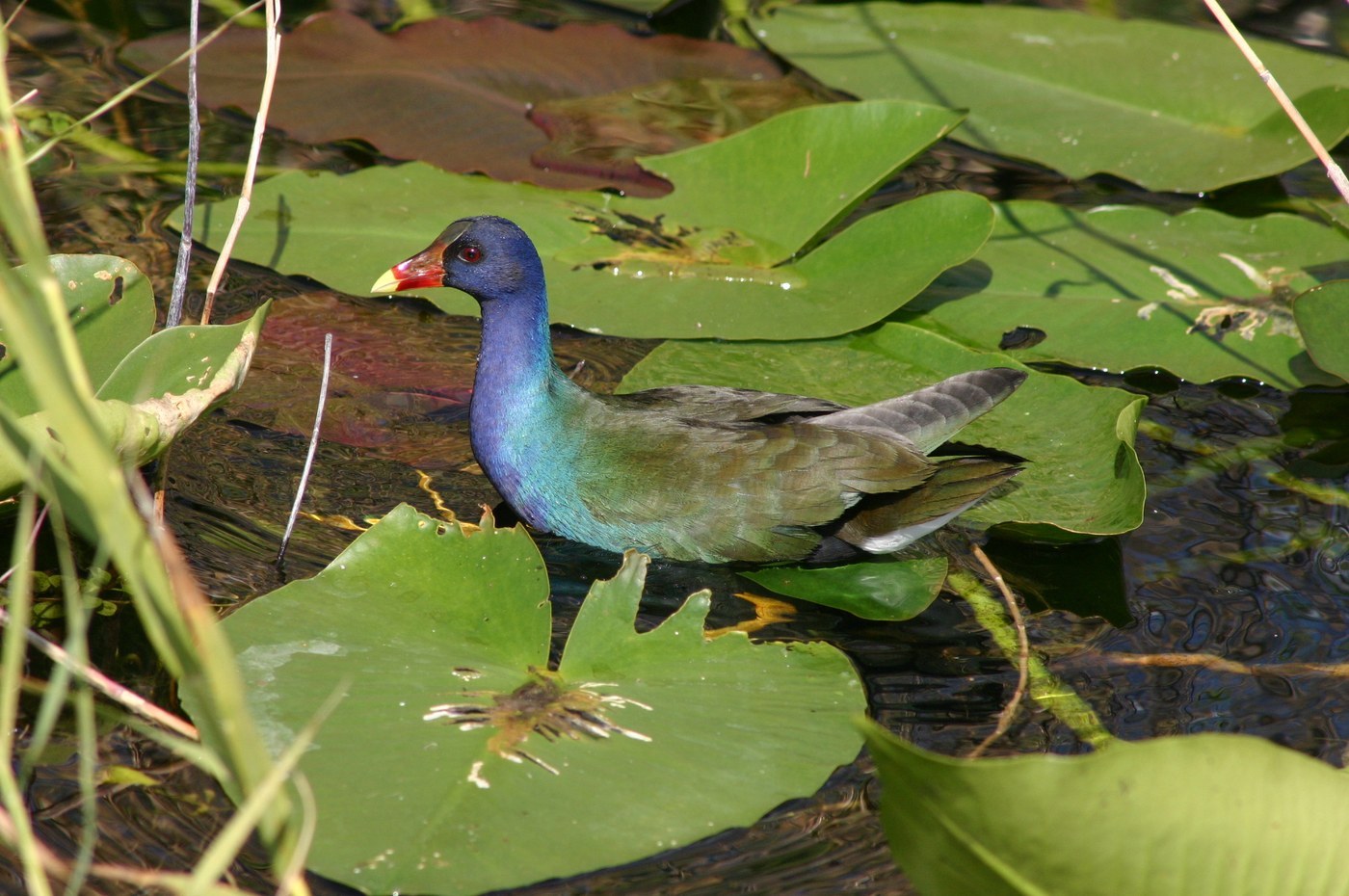
Key Field Marks
- Deep purple-blue head, neck, and underparts with an iridescent green back and wings
- Pale powder-blue frontal shield above a red-and-yellow bill
- Long, bright yellow legs with extremely long, unwebbed toes
- White undertail coverts, frequently flicked while walking
- Juveniles are buffy tan-brown overall, lacking the adult's bright colors, with duller legs and bill
How to Tell It Apart from Similar Species
- Common Gallinule (Moorhen): Slate-gray body overall (not purple/green), red frontal shield, and a white line along the flanks. Common Gallinules also swim more and lack the Purple Gallinule's oversized toes.
- American Coot: Uniform sooty gray-black with a stubby white bill and lobed (not long-toed) feet; coots swim constantly rather than walking atop vegetation.
- Juvenile Purple Gallinules are sometimes mistaken for juvenile Common Gallinules, but the Purple Gallinule's proportionally longer toes and greener wash to the wings are useful clues, along with habitat.
Habitat & Range
American Purple Gallinules inhabit freshwater marshes, swamps, and ponds with dense floating and emergent vegetation such as water lilies, pickerelweed, and cattails. In the United States they are found mainly in the Southeast (Florida, the Gulf Coast, and along the Atlantic coastal plain), with the core range extending through Mexico, Central America, the Caribbean, and much of South America. Northern populations are migratory and withdraw from the U.S. in winter, while tropical populations are largely resident. The species is also a notable long-distance vagrant, occasionally turning up far outside its normal range.
Behavior
Their signature adaptation is a set of remarkably long toes that distribute their weight, allowing them to walk directly across floating lily pads and other aquatic vegetation without sinking — a habit that instantly separates them from most other marsh birds. They climb into low shrubs and reeds as readily as they walk on water plants, and swim less frequently than coots or moorhens. Diet includes aquatic plant seeds and shoots, insects, frogs, snails, and occasionally the eggs or young of other marsh birds.
Voice
Purple Gallinules give a variety of loud, cackling, hen-like calls, including sharp "kek-kek-kek" notes and guttural clucking, most often heard from birds hidden in dense marsh vegetation.
Frequently asked questions
How do you identify an American Purple Gallinule?
Look for a chicken-sized marsh bird with deep purple-blue underparts, an iridescent green back, a pale blue frontal shield above a red-and-yellow bill, and long yellow legs with very long toes for walking on floating vegetation.
What is the difference between a Purple Gallinule and a Common Gallinule?
The Purple Gallinule is purple and green with a pale blue shield, while the Common Gallinule (Moorhen) is slate-gray with a red shield and a white flank stripe; Purple Gallinules also have much longer toes.
Why does the Purple Gallinule have such long toes?
Its unusually long, unwebbed toes spread its weight across lily pads and other floating vegetation, letting it walk on top of the water rather than swim.
Where can you see an American Purple Gallinule?
In freshwater marshes and swamps with floating vegetation, mainly in the southeastern United States, Mexico, the Caribbean, Central America, and South America.
What does an American Purple Gallinule sound like?
It gives loud, cackling, hen-like clucks and sharp kek-kek-kek notes, usually from within dense marsh cover.