
American Kestrel Identification Guide
North America's smallest falcon, a dove-sized raptor with a rufous back and tail, blue-gray wings on males, and a bold black-and-white facial pattern, often seen hovering over open fields.
Read the full American Kestrel encyclopedia entry →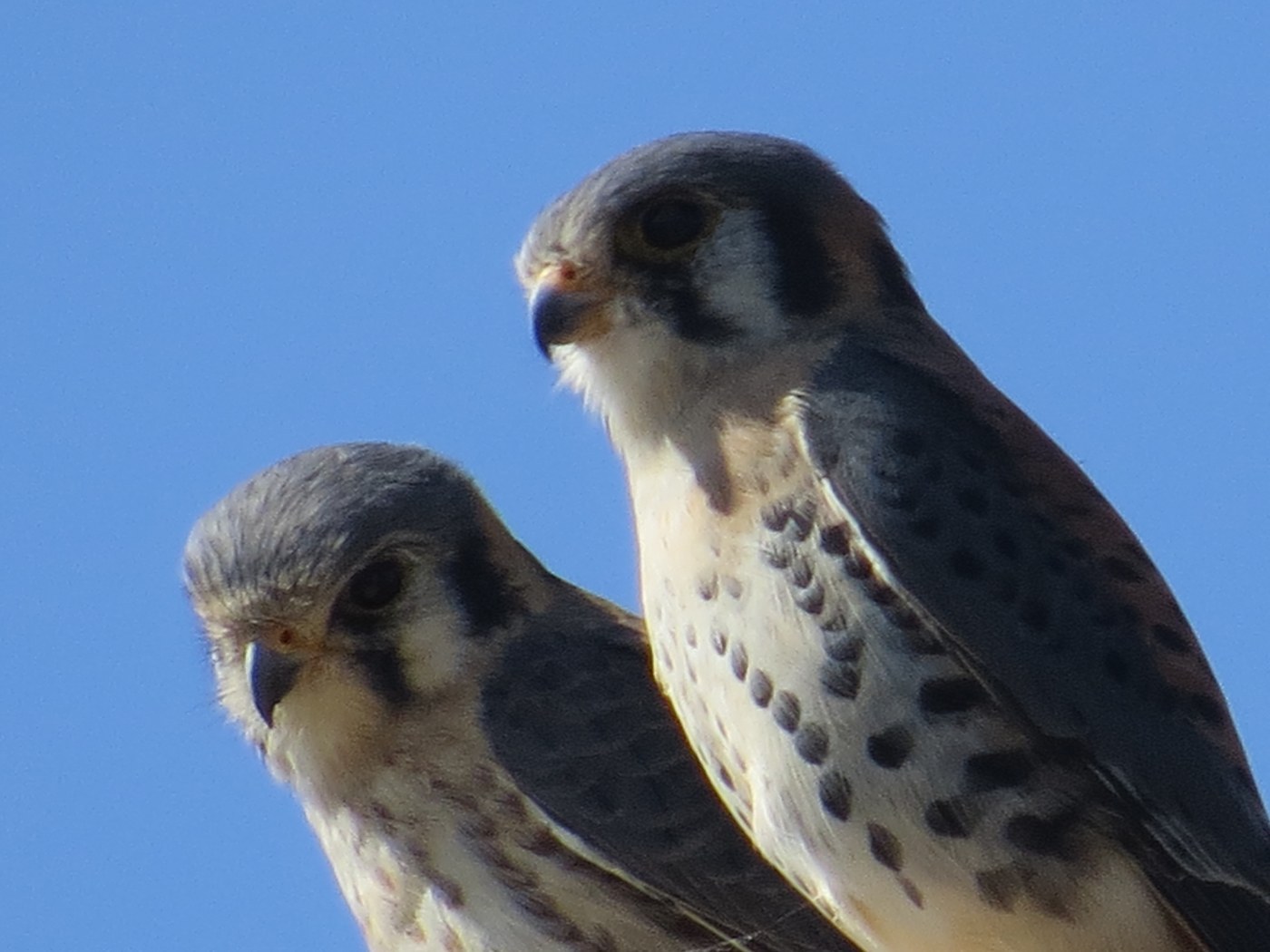
Key Field Marks
- Size: Small falcon, about 19–23 cm (7.5–9 in), roughly the size of a mourning dove — the smallest falcon in North America.
- Face pattern: White face with two bold black vertical stripes (a "mustache" mark below the eye and a "sideburn" in front of it), plus a pair of black false eyespots on the back of the head/nape.
- Male: Blue-gray wings, rufous back and tail with black barring/subterminal band on the tail tip.
- Female: Rufous wings, back, and tail all barred with black bands — lacks the male's blue-gray wings.
- Behavior mark: Frequently hovers in place with rapid wingbeats while scanning the ground for prey, and habitually bobs and pumps its tail while perched.
Separating Similar Species
- Merlin: Stockier and slightly larger, with a plainer, less contrasty facial pattern (a faint mustache mark at most, no eyespots), darker overall coloration, and a fast, powerful, direct flight; Merlins rarely hover the way kestrels do.
- Sharp-shinned Hawk: An accipiter with short, rounded wings and a long tail, flying with quick flaps and glides rather than hovering; lacks the kestrel's falcon-shaped pointed wings and bold face pattern.
- Peregrine Falcon: Much larger and bulkier, with a solid dark hood/helmet pattern rather than the kestrel's double-stripe face, and powerful, fast flight rather than hovering.
Habitat, Range & Season
Found in open country across the Americas — farmland, grasslands, deserts, roadsides, and urban/suburban areas with scattered perches — from Alaska and Canada south through the U.S., Mexico, and much of South America. Northern populations migrate south for winter, while kestrels in milder climates are year-round residents. Commonly seen perched on roadside wires and fence posts.
Behavior & Voice
Hunts mainly from an exposed perch or while hovering over open ground, dropping down to catch large insects, small mammals, small birds, amphibians, and reptiles. Nests in cavities, including old woodpecker holes and nest boxes, which has helped support populations in some areas even as overall numbers have declined in parts of its range.
- Call: A shrill, rapid "killy-killy-killy," typically given in alarm or during territorial encounters.
Frequently asked questions
How can I tell a male from a female American Kestrel?
Males have blue-gray wings contrasting with a rufous back and tail, while females have entirely rufous wings, back, and tail, all barred with black.
What is the easiest way to tell American Kestrel from Merlin?
American Kestrel has a bold, double-striped black-and-white facial pattern and habitually hovers while hunting; Merlin has a much plainer face, is stockier, and flies fast and direct rather than hovering.
Why does the American Kestrel hover in place?
Hovering lets the kestrel scan open ground for prey — insects, small mammals, and other small animals — from a stationary vantage point in the air when no suitable perch is available nearby.
What are the black spots on the back of an American Kestrel's head?
These are 'false eyespots,' a pair of black nape markings thought to help deter predators from approaching from behind by giving the impression the bird is watching in that direction.