
American Coot Identification Guide
A slate-gray, duck-like waterbird with a white bill and a red frontal shield, distinguished from true ducks by its lobed toes and chicken-like head-bobbing swim.
Read the full American Coot encyclopedia entry →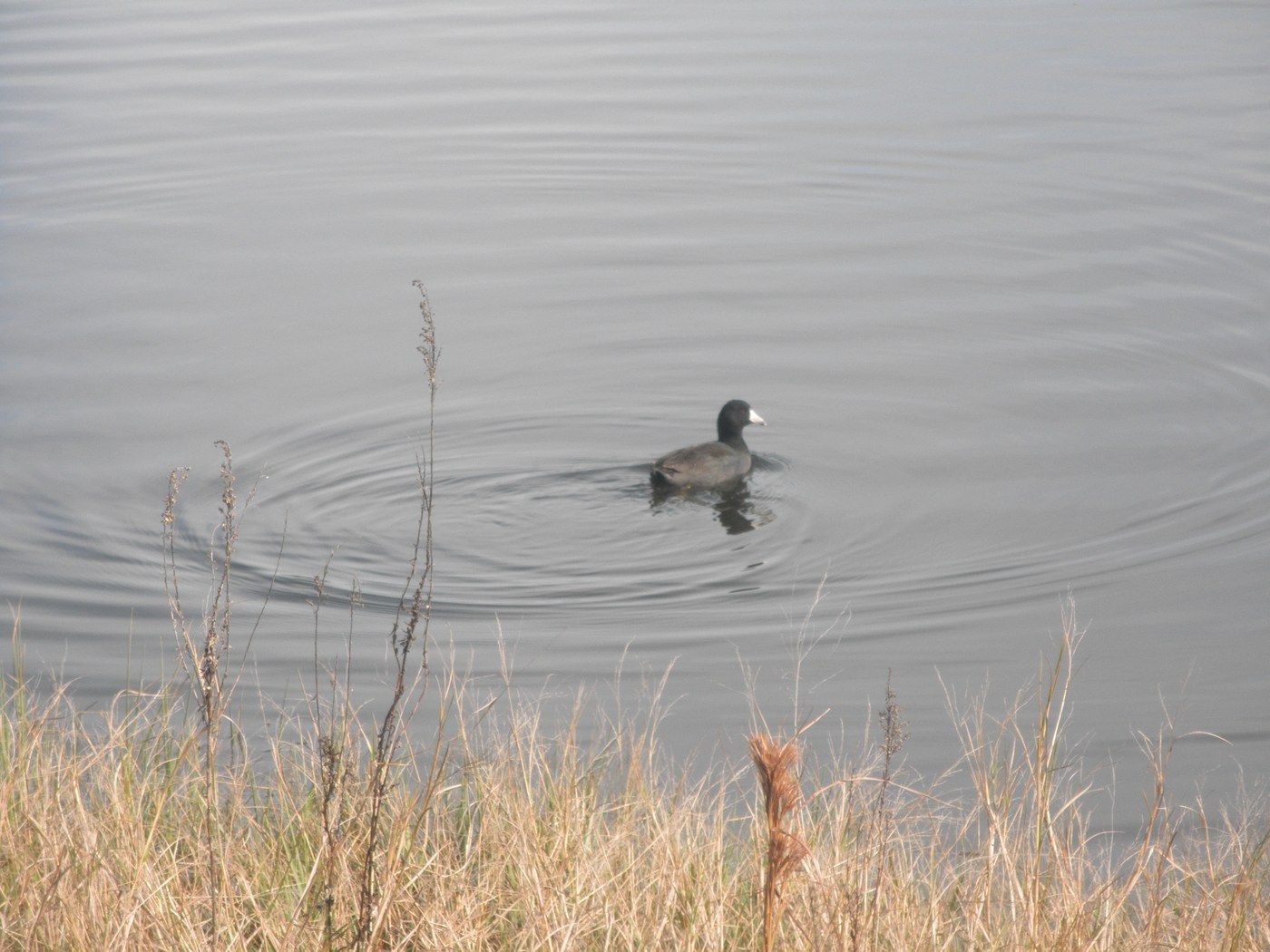
Key Field Marks
- Size: Medium waterbird, about 34–43 cm (13–17 in), duck-sized but a member of the rail family, not a duck.
- Body: Uniform dark slate-gray to blackish body, with a slightly darker, almost black head and neck.
- Bill: Short, thick, ivory-white to pale bill with a small dark subterminal band near the tip, and a reddish-brown frontal shield extending up onto the forehead.
- Eyes: Reddish-orange.
- Legs & feet: Greenish-yellow legs with distinctive lobed (not webbed) toes — obvious when a bird walks on land or a mudflat.
- Undertail: White patches on either side of the undertail, often flashed during social displays.
Separating Similar Species
- Common Gallinule (formerly Common Moorhen): Overall body looks more brownish-olive on the back (versus coot's uniform slate-gray), has a red frontal shield with a yellow-tipped red bill (not white), and shows a white stripe along the flank — coots lack this flank stripe.
- Diving ducks (e.g., scaup, ring-necked duck): Ducks have broad, flattened bills adapted for filtering or grasping, webbed feet, and typically more patterned plumage; coots have a narrow, chicken-like bill and lobed toes rather than webbed feet.
Habitat, Range & Season
Widespread and common on freshwater lakes, ponds, marshes, and slow rivers across most of North America, including many urban and suburban park ponds. Breeds across much of the U.S., Canada, and Mexico; northern populations move south in winter, when coots often gather in large rafts on lakes and reservoirs, including wintering grounds well into Mexico and Central America.
Behavior & Voice
Swims with a distinctive forward-and-back pumping motion of the head, unlike the smooth glide of ducks. Dives underwater for aquatic plants and also grazes on land near water's edge; highly gregarious, often forming large flocks, especially in winter. Can be aggressive, with much chasing and splashing during territorial or courtship disputes.
- Calls: A variety of grunts, croaks, and cackling notes, including a sharp "puhlk" and harsher grating calls.
Frequently asked questions
Is the American Coot a duck?
No — despite its duck-like appearance and swimming behavior, the American Coot is a member of the rail family (Rallidae), not a true duck (Anatidae).
How can I tell an American Coot from a Common Gallinule?
Coots are uniformly slate-gray with a white bill, while Common Gallinules are more brownish-olive above with a red-and-yellow bill and a white stripe along the flank that coots lack.
Why do American Coots have lobed toes instead of webbed feet?
The lobed toes (flattened flaps along each toe rather than connecting webbing) still provide swimming propulsion but also allow coots to walk more easily on land and marsh vegetation than fully webbed-footed waterfowl.
Where can I see American Coots in winter?
Look for large rafts of coots on lakes, reservoirs, and slow-moving rivers across the southern United States, Mexico, and Central America, where northern breeders concentrate for the winter.